[ad_1]
SAN ANTONIO — On May 2, 2010, Kyle Smith officially earned a long-awaited chance to run his own men’s college basketball program. He was a military kid who played Division III hoops. He spent almost two decades on the sidelines at three different schools as an assistant. And, somehow, becoming the head coach at Columbia was the easiest part about becoming the head coach at Columbia.
Smith moved to New York with a pregnant wife during the hottest summer in the city’s history. He went three days without sleep in the run-up to the season. Most frustratingly, none of his new assistants were familiar with his obsessively data-driven plan for program building. It was “Moneyball” for basketball, is how Smith puts it to this day, and no one grasped it quick enough. He had to simplify. Maybe even scrap it.
In this gully of doubt, one staffer intervened.
We’re on to something, Koby Altman insisted.
“That takes a lot of energy, when you’re trying to teach your staff this philosophy,” Altman says now, fresh off a European scouting trip in his role as the president of basketball operations for the Cleveland Cavaliers. “I loved the way these stats teach you how to value players. And once we got it, we got it.”
Smith, taking a break from recruiting calls as Stanford’s head coach on a Thursday in late March, says it could be part of the movie. Without that small infusion of resolve, maybe a coaching tree doesn’t shoot into the sky from the ground at 120th and Broadway. And maybe one of its most notable branches isn’t easily mistakable for the trunk itself. The analytics-heavy model that brings No. 1 seed Florida to the Final Four is effectively the same approach honed by Smith all those years ago at Columbia, executed by many of the same people, only with the added muscle of power-conference resources.
The result? A hulking national title contender with an Ivy League soul.
“If you look at our team at Florida, a lot of these guys were under-recruited, undervalued,” says Kevin Hovde, an assistant on Smith’s teams at Columbia, a current Gators aide and — when this run is over — the new head coach for the Ivy League operation on the Upper West Side. “People look at us: ‘How do these guys do that?’ Well, maybe starting off at Columbia had something to do with that, and kind of learning the ropes that way.”
During a nine-year stint as an assistant coach at Saint Mary’s, Smith’s conviction in analytics and his self-coined “Hustle Stats” — essentially a way to put values on things no one regularly put value on, like possession quality — helped turn around the Gaels. Smith knew he’d follow the same outline in his first head coaching job, for better or worse. He couldn’t guess how the tendrils of it all would snake through the sport.
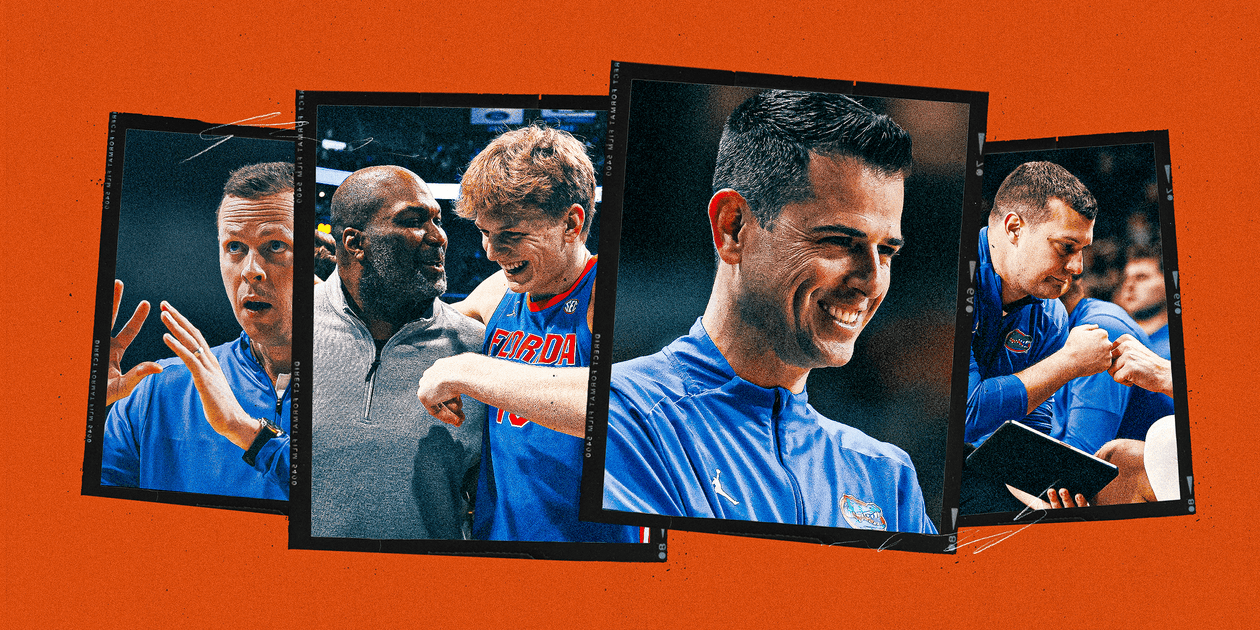
Smith’s first Columbia staff included a current top executive for a 60-win NBA franchise (Altman), the new head coach at Fordham (Mike Magpayo) and, in the most significant bit of present-day foreshadowing, an associate head coach (Carlin Hartman) who is now in the same role with West Region champion Florida. By Smith’s fourth year, three more 2024-25 staffers for the No. 1 seed Gators — head coach Todd Golden, Hovde and assistant coach John Andrzejek — had joined his program.
The acolytes took it from there, to heights no one anticipated: That same devotion to the “Hustle Stats” conceived by Smith is in the concrete of Golden’s three-year build in Gainesville.
“It’s everything,” Smith says on an overcast Thursday in Palo Alto, Calif., days after finishing Year 1 there. “It gets a little emotional, to see what you’ve preached come to fruition. To see it flourish, and guys get their opportunities, it’s been neat. We’re getting there. We got it coast to coast. We got it covered.”
This was not always the feeling.
There was that three-day stretch leading into that 2010-11 season in which Smith did not sleep. He was in the fetal position in his apartment, fairly sure he was physically incapable of making it into the office, when his wife, Katie, more or less kicked her husband in the tail and sent him on his way.
That first Columbia staff shared cubicles until the football program moved into new offices, and even then men’s and women’s hoops staffs occupied the same square footage. Meetings regularly took place on a squash court. Before the first season, Columbia’s equipment manager informed Hartman there were no new practice jerseys. Hartmann asked him whose fault that was. “Kind of yours,” he was told. Columbia’s coaches, as it turns out, were responsible for putting in the order. “So that first year we had some ragtag, makeshift practice uniforms that were just awful,” Hartman recalls with a laugh. “The next spring, I’m like, OK, let’s get on it.”
But these were not roadblocks to basketball idea incubation. Columbia might have been a quintessential job in a quintessential environment for that.
The players, for the most part, would be intelligent overachievers who would respond to a system that measured everything they did on the floor. At the start, it was a total of 34 “Hustle Stats,” counted by hand and charted by Smith’s assistants after every workout and game. “It’s like kindergarten, when you get a star by your name when you do something right,” Smith says. “People are simple.” Each member of the men’s basketball staff, meanwhile, typically lived in close proximity to the school itself, which allowed brainstorming that started in the office to bleed into runs through Riverside Park or hours spent decompressing at Tap A Keg on 105th and Broadway. “No driving, no commute,” Smith says. “You could go to a place after work and hang out and exchange ideas and just have fun.”
And at an Ivy League outpost with relatively modest coaches’ salaries, in a city that stretches every dollar to almost impossible lengths, the likeliest candidates for any staff position were young, hyper-ambitious strivers eager to learn. One summer, when players held voluntary workouts at 6 a.m. three times a week, Golden and Hovde began to compete to see who could get to the office earliest — even though NCAA rules prevented any coaches from being in the gym. Soon, two 20-something go-getters on the Upper West Side were setting 4 a.m. alarms to walk to work and just sit around. “That was before we did anything, right?” Hovde says. “You’re just, like, trying to make Columbia good.”
“We’re young, we’re single,” Altman says. “At that time, you feel like, man, this is all upside.”
All of it made for fertile ground to experiment with — and grow — Smith’s system.
“There’s stuff that we were doing that I think a lot of programs are doing now, that we were just on the forefront of,” Hovde says. “We were tracking a bunch of different things within a possession. Did you get a paint touch? What kind of shot did you get? We would rate the possessions on a zero through five scale. That’s one thing that we did for years. We don’t do it as much now, but I just think there was no one doing it back then.”
As the man at the helm of a Final Four team, Golden is the most public-facing descendant and practitioner. The “backbone” of his coaching career, the Gators coach said during the West Region in San Francisco last weekend, was playing for Randy Bennett and Smith at Saint Mary’s and then working for Smith at both Columbia and San Francisco. It was an introduction to a system, followed by an immersion. Though the latter part didn’t occur as fast as Smith might’ve preferred.
That first summer of 2010, Smith tried to hire Golden. He told his former point guard he’d fly him out to New York and pay him to work a camp, just to get a feel for the place. Golden declined. He said he might like it too much and stay. “I said, you’re a 24-year-old Jewish kid on the Upper West Side,” Smith recalls now. “You’re in heaven. This is going to be unbelievable. And I couldn’t get him to do it.”
Two years on, Golden at last hopped aboard for a two-year stint. (As it happens, he took the spot vacated by Altman, who left to begin his NBA front-office climb.) When Golden compiled his first staff at Florida in 2022, the vines connecting to the past were no coincidence; Hartman, Hovde and director of analytics Jonathan Safir all worked with Smith and Golden at Columbia or had Columbia basketball ties. (Andrzejek arrived a year later.) A massive chart chronicling data gleaned from workouts hung in the practice gym, for all Florida players to reference daily.
On this particular stampede to an SEC tournament championship and now the Final Four, Florida has deployed a first-team All-America guard (Walter Clayton Jr.) and a frontcourt rotation with players who stand 6-9, 6-11, 6-11 and 7-1. At no point will anyone inside the Alamodome this weekend confuse this No. 1 seed for an Ivy League squad. Nor does Florida have to out-data the opposition, always, given its depth of talent and size.
But then there was Golden and his staff, doing the math while facing a late deficit against Texas Tech in the Elite Eight, deciding to foul earlier than usual to halt the clock and steal more possessions. It was a calculated risk. And it worked. “One of the biggest things that we always talk about with the Smith tree is ‘Smart Wins,’” Hartman says. “Getting really good, smart players that can do the things which we want to do on the floor, be able to carry out a scouting report, being able to remember things on the fly, and being able to adjust on the fly.”
And so the roots spread.
Altman’s Cavaliers have instituted their own version of Smith’s “Hustle Stats” system and sport the second-best record in the NBA. In the midst of the NCAA Tournament, Columbia announced Hovde would be its next men’s head coach and Campbell tapped the hard-driving Andrzejek for its top job. (“He’s a combination of Thibodeaux, Belichick and Harbaugh — you do the math,” Smith says with a laugh.) Magpayo notched 89 wins in five years at UC-Riverside and then scored the Fordham gig.
“My ‘why’ has always been, I want to empower people to empower themselves,” Smith says. “I like handing off the knowledge. I don’t mind sharing what we do. It’s not hard. It’s hard to commit yourself to doing it.”
For the news releases to commemorate the Andrzejek and Magpayo hires, Altman was asked to provide a quote on both coaches. He ran the words by B.J. Evans, the Cavaliers’ vice president of communications, to clean them up a bit. Evans had to take a beat to digest how it was that a small Ivy League program in one of the biggest cities in the world seeded so much success.
But, as Altman notes, “nerding out on formulas and algorithms” at a place like Columbia also makes sense. And winning numbers are winning numbers anywhere.
“It gives you a really good foundation of what you’re looking for, and the undervalued stats that can help you,” Altman says. “And then if you mix that in with great character guys that have unbelievable work ethic and really want to be in your program? Now you’re really cooking with some grease, man.”
(Illustration: Will Tullos / The Athletic; photos of, from left, Hovde, Hartman, Golden and Andrzejek: Andy Lyons, Isaiah Vazquez, James Gilbert / Getty Images)
[ad_2]
Source link