The Moment of Zen:
This week, I turn to one of the inspiration texts for this column, Eugen Herrigel’s Zen in the Art of Archery, for help continuing down the path of the “Great Doctrine.”
As you might imagine, Herrigel’s book is about archery. But more accurately, the book is about him – or you, or me. In order to become a master archer, Herrigel first had to master himself and learn the act of “feeling [him]self being carried through it as in a dream” (Herrigel 47). The “it” in the sentence refers to the practice of archery, but I actually think the “it” is just as much “him.”
As any student facing the unique teaching style of a master archer (in the Zen lineage), Herrigel balked at some of his teacher’s initial suggestions. He couldn’t understand, for instance, that the goal of taking the shot wasn’t hitting the target – though piercing the bullseye would in fact be a consequence of achieving the actual goal. He recounts wondering about the “relaxed drawing of the bow, relaxed holding at the point of highest tension, relaxed loosing of the shot, relaxed cushioning of the recoil – did not all this serve the grand purpose of hitting the target, and was not this the reason why we were learning archery with so much trouble and patience?” (29).
The Master worked to correct Herrigel’s misunderstanding, telling him, “Don’t think of what you have to do, don’t consider how to carry it out! […] The shot will only go smoothly when it takes the archer himself by surprise. It must be as if the bowstring suddenly cut through the thumb that held it. You mustn’t open the right hand on purpose” (29).
Herrigel responded to the Master’s advice with weeks of failing, again. And again. And again. Finally, the Master asked him, “Do you know why you cannot wait for the shot and why you get out of breath before it has come? The right shot at the right moment does not come because you do not let go of yourself. You do not wait for fulfillment, but brace yourself for failure. So long as that is so, you have no choice but to call forth something yourself that ought to happen independently of you, and so long as you call it forth your hand will not open in the right way – like the hand of a child. Your hand does not burst open like the skin of a ripe fruit” (30).
Confused yet? Herrigel understandably felt so. And I do too. The Master’s succinct summary of archery doesn’t necessarily clear things up for me: “The art […] is purposeless, aimless! The more obstinately you try to learn how to shoot the arrow for the sake of hitting the goal, the less you will succeed in the one and the further you will recede. What stands in your way is that you have a much too willful will. You think that what you do not do yourself does not happen” (31).
Huh? Willful will? Open like the skin of a ripe fruit? Wait for fulfillment? If you feel confused, I’m right there with you. Bear with me while I try to make some sense of this. As I understand the Master, when we are truly practicing the art (whatever art we are practicing at any given moment), we are so connected to the techniques of the art that we no longer have to think about them. In fact, only when we are so connected to the art that we no longer think about the techniques – and instead focus on being deeply, authentically in the moment of breathing and letting go of expectations, hopes, fears – can we achieve our goals. The goal is mastery over the self – the mastery of the art will necessarily follow if the self is mastered.
Easy enough, right?
How in the world does this apply to fantasy baseball?
If the art of archery isn’t actually about the components of the task, then I’ll assume for the sake of argument that the “art” of fantasy baseball is also not about the components. That, of course, doesn’t mean that player analysis isn’t important, or draft strategy, or understanding underlying data, or trying to spot ADP values. All of those things are, at least in my eyes, essential for success in this game. But I also am aware that I overthink my analysis, strategy, the underlying data, and especially what I perceive as ADP values.
Pop quiz. What do these three players have in common: Cody Bellinger (2023), Dylan Cease (2024), Drew Rasmussen (2025)?
I suppose it’s possible, even likely, that these three players have lots of things in common. But for the sake of today’s article, what interests me most is that Bellinger in 2023, Cease in 2024, and Rasmussen in 2025 were all at ADPs that I simply could not understand. Bellinger was coming off a couple of injury-plagued years and was falling to the 190s. Cease had just come off a down year in 2023 in which he had a 4.58 ERA and a 1.42 WHIP, so he was falling to around pick 100. Rasmussen, like Bellinger in 2023, was coming off back-to-back seasons in which he had missed significant time, so he was being picked in the mid- to late-200s.
I understood that each guy had just been disappointing, but those draft prices made no sense to me. No way these guys could be this cheap, right? So at the beginning of draft season, I started picking them at their discounted prices, thinking I was basically stealing. But soon thereafter, I started overthinking – a lot: What am I missing? Why aren’t these guys being drafted higher? Am I stupid? Surely, I’m missing something, right? Clearly, I need to rethink my position on these guys and figure out what I’m overlooking.
So I went back to the data and tried to find the thing I was missing, but I still couldn’t find it. It was maddening. I knew I had to be wrong about these guys, but I couldn’t figure out why. Spoiler alert: I was not wrong about them.
What should I have done? I think I should have gotten over myself and picked the guys over. And over. And over. As I look back at my draft lists from those years, it’s clear that I waxed and waned on my belief in what I was seeing. I’d go 3 or 4 drafts in a row where I’d draft one of them at their discount. And then I’d go 5 drafts where I didn’t. I’m all for having rosters with lots of variations in them so that I don’t just pick the same players every time, then 5 of those guys get injured, and bam, there goes my season.
But I ended up with Bellinger, Cease, and Rasmussen in only about a quarter of my drafts in those years. And then each guy had a big season and out-earned their draft value by leaps and bounds – just like I thought they would. All the while, I had a front row seat in watching my opponents get the spoils of picking them because I had passed on them so many times. All because I was thinking too much.
And this year I’m doing it all over again with Isaac Paredes. I cannot understand why he’s being drafted so low. I get that Houston’s roster situation is complicated. It’s hard to see what spot in the lineup Paredes will have since there’s no opening at 3B, 1B, or DH. Add to the roster questions the fact that his name is mentioned in trade talks pretty much daily, and it looks like Paredes is a risky pick. But I just don’t get why drafters are so spooked. Check out his stats the last few years:
| Year | PA | BA | HR | R | RBI | SB |
| 2025 | 438 | .254 | 20 | 53 | 53 | 0 |
| 2024 | 641 | .238 | 19 | 64 | 80 | 1 |
| 2023 | 571 | .250 | 31 | 71 | 98 | 1 |
| 2022 | 381 | .205 | 20 | 48 | 45 | 0 |
On the surface, his numbers may look inconsistent, with 31 HR possibly looking like an outlier season. A closer look, however, shows a player consistently performing at a high level in some of the areas that matter: HR, R, and RBI.
In 2023, Paredes pulled all of his skills together to get to a .250 BA with 31 HR, 71 R, and 98 RBI. But notice that in 2025 and 2022, he reached only 438 and 381 PA. Extrapolated out to 650 PA, each year looks much more impressive:
| Year | assuming 650 PA | BA | HR | R | RBI | SB |
| 2025 | 650 | .254 | 30 | 79 | 79 | 0 |
| 2024 | 650 | .238 | 19 | 65 | 81 | 1 |
| 2023 | 650 | .250 | 35 | 81 | 112 | 1 |
| 2022 | 650 | .205 | 34 | 82 | 77 | 0 |
The only “down” season was 2024, but if we take a look at his performance with the Rays vs. his performance with the Cubs after he was traded to the north side of Chicago, things once again look quite different:
| Part of 2025 | PA | BA | HR | R | RBI |
| 1st half (Rays) | 429 | .245 | 16 | 41 | 55 |
| Extrapolated to 650 | 24 | 62 | 83 | ||
| 2nd half (Cubs) | 212 | .223 | 3 | 23 | 25 |
| Extrapolated to 650 | 9 | 71 | 77 |
Considering the split stats, the only number that truly looks concerning is the 9 HR pace in Chicago. But it’s no secret that Wrigley did not suit Paredes’s HR swing because the LF foul pole (355’) is so much deeper than the one at Tropicana (315’). The other numbers look quite Paredes-like – and valuable.
The consistency suggested by the extrapolated stats is further supported by the consistency in some of his metrics, which, by the way, are less than impressive:
| Year | EV (mph) | maxEV (mph) | LA° | HH% |
| 2025 | 87.4 | 107.4 | 23 | 33.6 |
| 2024 | 85 | 107.3 | 22.4 | 27.1 |
| 2023 | 86.9 | 107.7 | 22.1 | 28.5 |
| 2022 | 87.4 | 110.4 | 15.8 | 38.7 |
Paredes doesn’t hit the ball hard despite his ability to hit the ball out of the park. But he hits it just as hard as he needs to in order to get to around 30 HR per season. For the last 3 years, his maxEV and LA have both been remarkably consistent – the maxEV isn’t hard, but with a 20+° LA, 107 mph is hard enough. The guy knows what he is trying to do, and he does it well.
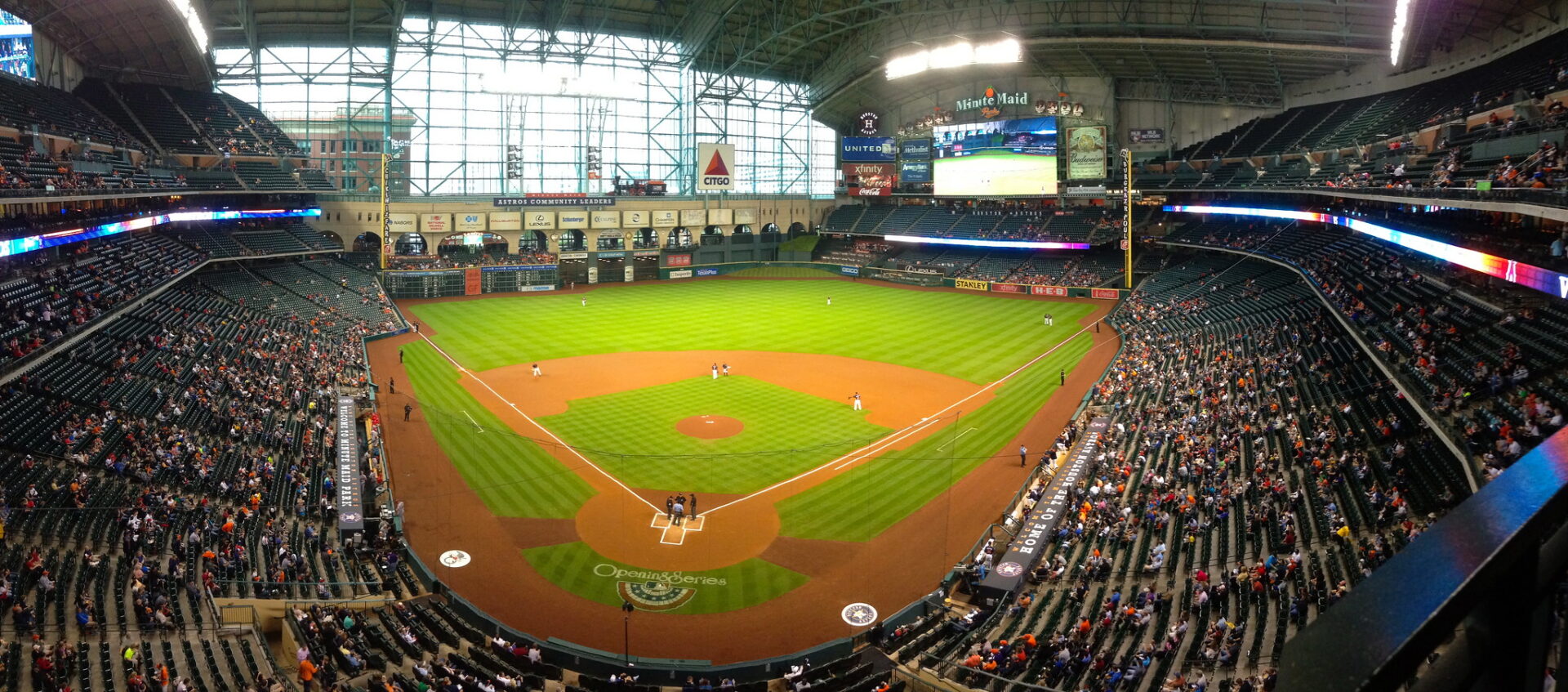
I have a hard time believing that the Astros won’t find a place in their lineup for Paredes – the Crawford Boxes are just too perfect for him. But if Houston doesn’t find a place for him on their own roster, the likelihood is they’ll (1) either trade Paredes or (2) wait for Yordan Alvarez (old man knees), Christian Walker (old man obliques), or Jose Altuve (old man) to get injured. My bet is that if they don’t plan to play him, the Astros will trade him. Surely, after the Cubs experiment went awry, MLB GMs are smart enough to know that, if they have a deep LF, Paredes isn’t their guy.
Now, you might ask why I feel so sure about this. Let’s just say I’ve decided to relax my thinking. I’ve done the analysis, and now I’ll wait for fulfillment, as though Paredes’s upcoming big season will take me by surprise. May it be so.
Until next week. –ADHamley