SAN ANTONIO — The first day Sion James arrived on Duke’s campus last summer — fresh off a 12-plus hour drive from New Orleans in a U-Haul that contained all his worldly possessions — the former Tulane guard was, understandably, exhausted.
Then his phone pinged. A text message from new Duke teammate Tyrese Proctor: “Yo, we’re having dinner at coach Scheyer’s house. Here’s the code to get in.”
Over the next few days, as James unpacked, he realized just how many ordinary things he needed to find around Durham, N.C. A good barber, for instance. Somewhere to get a pedicure. The best places to grab a bite to eat.
Every time one of those questions popped into his head, he texted the same person: Proctor.
It made sense that every new Blue Devil — three critical transfers, plus the team’s six-man freshman class, led by star Cooper Flagg — turned to Proctor, one of just two returning rotation players from last season’s Duke squad. The 6-foot-5 Australian is, after all, the only player to have suited up for each of Jon Scheyer’s first three Duke teams.
“He was just the settling force for all of us,” James said. “The guy we looked to for guidance.”
But there’s a massive difference between suggesting sandwich places and bringing people together. Between cursory advice and becoming connective tissue. And for Duke to reach its full potential, it needed Proctor to tick both boxes — which is admittedly not something he’d had to do his first two seasons in Durham.
As a freshman — especially one who reclassified up a year and joined Duke only a month after Scheyer officially succeeded Mike Krzyzewski as head coach — Proctor was along for the ride, thrust into a starting spot and holding on for dear life. As a sophomore, he was one of multiple returning starters, able to easily blend into the crowd, despite the leadership expectations every team’s point guard must bear.
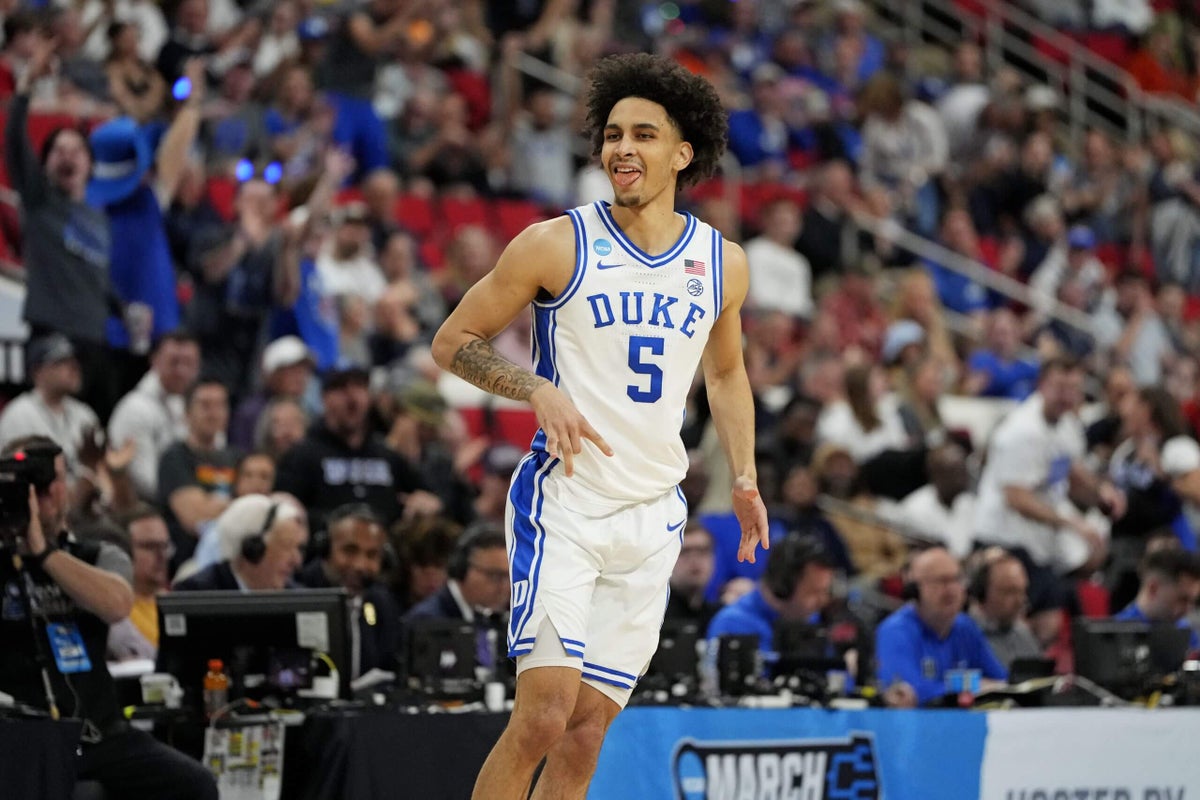
Tyrese Proctor reclassified and arrived at Duke only a month after Jon Scheyer officially succeeded Mike Krzyzewski as head coach. (Bob Donnan / Imagn Images)
This season, though? All eyes and expectations turned his way. For all the talent Scheyer imported to Durham last offseason, the coalescing of those pieces would be the difference between whether Duke made the Final Four … or crashed out of the NCAA Tournament in devastating fashion for the third straight season. And fair or not, which way the pendulum swung hinged largely on Proctor’s growth: as a player, obviously, but also as Duke’s uniter.
Ten months later, with Duke in its first Final Four under Scheyer, it’s clear which side of the coin Proctor landed on. What’s also obvious with the gift of hindsight? While Flagg is Duke’s best player, arguably its most important is the third-year guard who came early and made the rare decision (especially in today’s era) to stay.
“We probably aren’t here,” Scheyer said, “if we didn’t make that decision at that time: For Tyrese to come early, and for him to go for it.”
Proctor’s first time playing for Scheyer, oddly, did not come in the first game of his freshman season.
It came months earlier, in a “secret” scrimmage against the very Houston team Duke plays Saturday night for a berth in the national championship game. What Proctor remembers about that experience, going up against the Coogs’ stonewall defense as a scrawny teenager?
“Physical as hell,” Proctor said this week, grinning. “I got knocked on my ass a couple times.”
Really, the same could be said for his entire freshman season. Proctor was good-not-great, averaging 9.4 points and 3.3 assists per game for a Duke team that eventually won the ACC tournament (back when that meant something).
“It felt like I only had a split second to make a read or reaction,” Proctor said. “I knew it was going to be ups and downs, but I think I had more downs than ups.”
At times, he turned the ball over too much. Others, he missed too many shots. He had moments of brilliance, too, flashes of why Scheyer asked him to come a year early — a double-double in his fourth career game, a 10-assist showcase against Pittsburgh — but little consistency.
Ironically, it wasn’t until Duke’s season-ending loss to Tennessee in the NCAA Tournament — when Proctor scored 14 of his 16 total points in the second half — that he felt like the game “slowed down.”
But that performance was, in many ways, a blessing and a curse. Things may have slowed down for Proctor at that point, but his second-half success led to enormous expectations, too.
“He could have went pro after his freshman year,” associate head coach Chris Carrawell said, “but he wouldn’t have been ready.”
Ultimately, with that last-game surge serving as a tailwind, Proctor passed on the NBA for a second season at Duke, poised to emerge as the next star Blue Devils point guard.
Only, that didn’t materialize. Proctor struggled with his 3-point shot before injuries — first his ankle, then a concussion — robbed him of the chance to rediscover his form. The bottom came against NC State in the Elite Eight, when Proctor infamously went 0-for-9 overall and 0-for-5 from 3.
A no-show and a huge reason why the Blue Devils got sent packing.
In Duke’s locker room in Dallas afterward, the indelible image was Proctor, towel draped over his head, overcome with emotion, barely able to process what had just happened.
Eventually, he got up and disappeared into the coach’s locker room, where he sought out Scheyer.
He’d decided already. He was coming back for a third season.
“The game against NC State in the Elite Eight, he didn’t show up — and he used that to fuel and motivate him,” Carrawell said. “We’ve always believed in him, but more so now as he’s gotten older. Sometimes, just that swag and that aura just kicks in. And for him, it kicked in this year.”
Over the summer, Proctor and his roommate, Caleb Foster — Duke’s only other returner — played a lot of darts.
Proctor learned as a kid, and his uncle bought him a board for his room. (Magnetic, thankfully, for the sake of their drywall.) Foster had never played before. You can imagine how competitive these games were.
“He knew what he was doing,” Foster joked. “I have more learning to do.”
It’s a subtle example, but one small way Proctor attacked this offseason. He knew that Duke’s new pieces needed to gel, quickly, if the Blue Devils were going to have any hope of making the Final Four. So, going to eat? Invite some teammates. Getting up early morning shots? Invite some teammates. Heading to Scheyer’s house for something? You get the point.
“He had to do all of it,” Carrawell said. “They were looking at him like, how are you going to be? You’ve got all these new guys coming in, but it was like, how are you going to play?”
Proctor understood the gravity of the role he’d have to play, both on and off the court. So he made a few notable changes over the summer. For starters, he started working with a personal mental coach, someone his agent suggested could help him harness his raw emotions rather than letting them knock him off-kilter.
“A lot of things on the court are actually in your mind — and you can see, night and day, the difference between players that play confident and don’t play confident,” Proctor said. “The only sort of thing that stops you from your rhythm is yourself. (So) just using that, and just coming back to my breath all the time, is a big thing.”
Proctor also started prioritizing proper sleep to make sure his body had time to recover. He didn’t spend extra time in the gym, but he worked with Duke’s training staff to recalibrate what he did in the gym, to better utilize his time and focus on the explosiveness he needed to drive, create separation and defend. And his diet received a thorough overhaul, too.
So he matured. Simple as that.
“Some of the things that worked when you were 18 or 19 and better than everybody else, you may be able to get away with it if you’re Zion Williamson and built like him — you can eat chocolate chip cookies and s— like that — but for the most part? All us regular guys, we’ve got to eat the right way, we gotta lift weights, we’ve got to get our sleep,” Carrawell said. “He’s become a professional.”
And his game has blossomed accordingly. Proctor is averaging career highs in points (12.5) and rebounds (3.1) while shooting a career-best 41.2 percent from 3, all to go along with a career low in turnovers (1.1 per game). There was no clearer proof of Proctor’s progress than in the ACC tournament title game against Louisville, when Duke was down at the half with Flagg sidelined. So Proctor put on the cape, draining six 3s to push the Blue Devils ahead for good.
He then followed that effort with six and seven more 3s in each of Duke’s first two NCAA Tournament games, respectively, making for an absurd 19-for-30 stretch from 3 in three games.
Through four NCAA Tournament games, Proctor is averaging 17 points and three assists per game while shooting 64 percent from 3 on 6.3 attempts per contest.
“A lot of people sort of put me out of the way early, and now they’re all trying to jump back on the boat,” Proctor said. “Just being able to trust myself and trust the people who believed in me from the start is a big thing.”
Scheyer was one of those. And now, the coach’s faith in Proctor — and Proctor’s willingness to stick it out, in an era where leaving has never been easier — has Duke on the brink of winning its sixth national championship.
“You go after the guys you believe in,” Scheyer said. “You know you’re going to go through some tougher times, maybe, but you just believe at the end of the day, you’re going to be somewhere special.”
(Top photo: Bob Donnan / Imagn Images)