It’s only two games into the Jon Scheyer era, but it sure looks like the differences in philosophies and playing style are minimal. In his final years at Duke, Mike Krzyzewski kept things pretty simple. He spread the floor and let his best players rock without a lot of window dressing in his sets.
Defensively, his team became less aggressive in an effort to keep free-throw rate low, but there was still some of the patented Duke ball pressure and hard denials. His ball-screen coverage was usually conservative. Last year, for instance, he kept Mark Williams in drop coverage to allow him to protect the rim, while asking his guards to fight over screens. Scheyer’s defense has mostly mirrored his predecessor’s thus far. He did adjust his coverage in game two against USC Upstate, a sign that he’s willing to get more aggressive when necessary (I’ll hit on this later), but his coverages are mostly simple. It’s not surprising given he’s coaching a young team, which was usually the case for Coach K once he went all-in on chasing one-and-done talents.
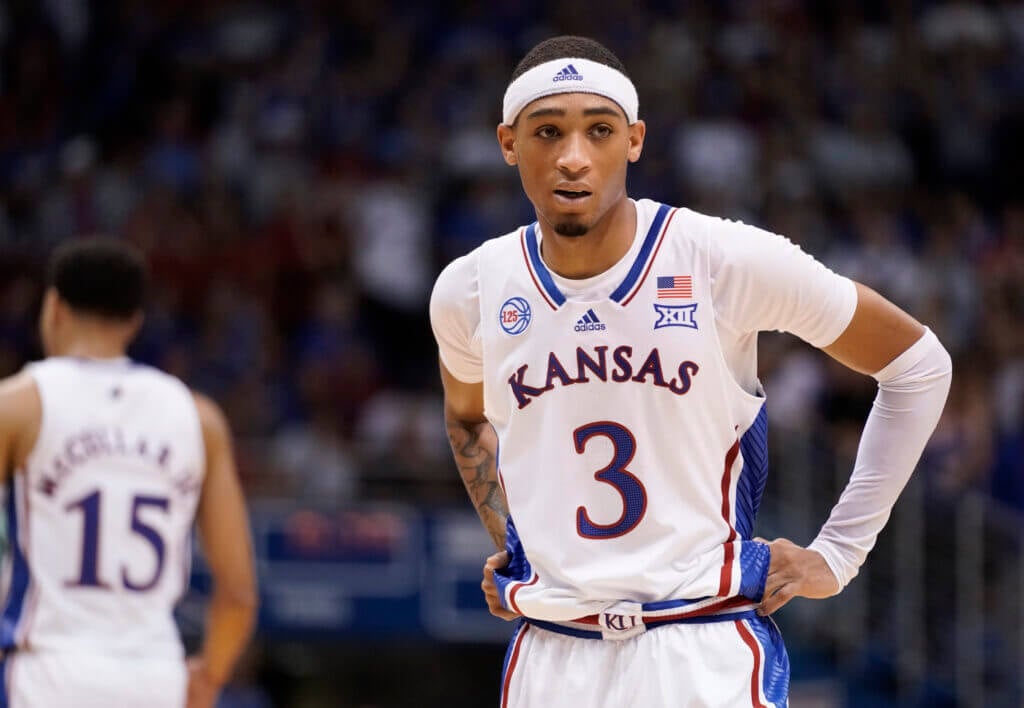
On the other side of Tuesday’s Champions Classic matchup is Kansas, coached for the first four games this season by assistant Norm Roberts. Do not be fooled, as Bill Self is still coaching practice every day and still putting together the game plans. Kansas, however, has made more of a stylistic change this season. With the loss of David McCormack and no true back-to-the-basket big man on the roster, Self is more reliant on his perimeter players and incorporating a lot of pick-and-roll. The offense and sets are nothing new. Last year’s national champs ran a lot of the same actions; only the post pins that are common for a Self-coached team aren’t happening at near the same rate.
I watched both teams’ first two games to try to get a read on how they will play in Tuesday’s marquee game and what the keys will be. It’s the first time for Scheyer coaching on such a big stage. He could throw some curves at the Jayhawks, but again, because he has such a young team, simplicity is probably his plan of action.
Ball-screen coverage: Will Kansas exploit Duke’s youth?
Duke had some sloppy breakdowns in ball-screen coverage in its first two games. The Blue Devils didn’t really suffer much because of the weakness of their opponents, but expect Self to try to create lots of scenarios to exploit the mistakes.
What makes KU’s offense so hard to guard is that there is a lot of ball and body movement designed to get the defense moving and distract the opponent from its assignments. Self teaches his guards to read what he calls the most important guy (the MIG), who is the defender tasked with tagging the roller in the pick-and-roll.
If the MIG is in the paint to tag the roller, then Kansas point guard Dajuan Harris has an easy read, skipping the ball to the shooter on the right side of the floor for a spot-up jumper. If there isn’t a MIG or the MIG is indecisive, then it’s simple: hit the roller.


This is where Duke has been sloppy.

Last year, Duke would ice ball screens on the side of the floor, pushing the ball toward the sideline. Duke’s current strategy seems to be trying to get over the screen and recover, while the screener’s man is in drop coverage and tries to contain the ball.
If the ballhandler occupies the drop man long enough, that roller is going to be open and that’s where the MIG needs to provide help. In this side ball-screen action below, freshman Kyle Filipowski is in position to cover the roller, but look at his eyes. He doesn’t see him coming, and the roller gets an easy dunk.

Do not be surprised to see Self try these side ball screens often. Kansas likes to get its guards inside the 3-point line on these plays, trying to get the on-the-ball defender to fight over and giving the defense less time to recover on the roll. On the other side of the floor, the Jayhawks will set a flare screen to distract the help.


Self loves a big man who is a vertical lob threat, but he hadn’t had one since Udoka Azubuike. He has one now in freshman Ernest Udeh Jr., and KU’s guards are looking for him frequently.
This will also be a big game for the Kansas guards. A good guard can take advantage of a dropping big man. Caleb Love’s ability to attack Duke’s bigs, for instance, was a big reason the Tar Heels won the Final Four game.
Harris isn’t much of a threat from 3, but he does have a strong floater game and will look to attack the basket if he’s got a big on his heels. Backup point guard Bobby Pettiford has also been good thus far working against a big on an island. Pettiford is more of a natural scorer, and this could be his opportunity to introduce himself to the college basketball world after an injury-riddled freshman season. KU will also set ball screens for its big wings — Jalen Wilson and Kevin McCullar — and those two are more comfortable getting to their mid-range pull-up against a sagging big.
One other challenging component of ball-screen defense that young players struggle with is what to do on the two-side (side of the floor with two players) when the MIG helps in the lane. Duke got burned for a 3 on this against USC Upstate when Filipowski was the MIG, leaving Jeremy Roach to defend two players:

Roach should be zoning up on the left side and either taking the ball when it’s skipped to the corner or stunting at the shooter until Filipowski can recover. If he takes the ball, Filipowski takes his man. Instead, Roach stuck like glue to his own man, forcing Filipowski into a long closeout and allowing a wide open 3.
Midway through the first half in that USC Upstate game, Scheyer made an adjustment. He had his big men start playing more to the level of the screen, showing and then recovering to his man.

This approach puts less pressure on the help side if the big is able to recover quickly. Drop coverage gives on-the-ball defenders more time to recover, but the big must communicate well. That’s another worry for Duke: miscommunication on the screens. One example here from Duke freshman Dereck Lively II: He’s out of position and allows an easy right-handed drive.

Lively should be two steps to his left, as this is a simple high-ball screen. Lively missed Duke’s opener with a calf injury and played limited minutes against USC Upstate. He’ll likely see his minutes increase against Kansas, and he’ll need to be sharper to stay on the floor. KU is going to put Duke’s bigs in more complicated actions, and if the Jayhawks are feasting, Scheyer might go to an old staple when his teams couldn’t guard someone man-to-man: zone.
The Blue Devils have yet to show zone in their first two games, but with so much size — Duke has four players over 6-foot-8 in its rotation — Scheyer might consider it, especially with lineups that include two or three big men. Kansas is going to play small, and trying to guard Wilson with someone like Filipowski is a tough ask for the freshman. Wilson has been in attack mode thus far, taking 32.9 percent of KU’s shots when he’s on the floor. When Duke goes with its lineup that has either Ryan Young or Lively at center and then Filipowski and Mark Mitchell at the forward spots, look for whomever Filipowski is guarding (likely either Wilson, Gradey Dick or McCullar) to drive him.
One other part of KU’s offensive game plan could be attacking Duke shooting guards Tyrese Proctor and Jaylen Blakes when the Jayhawks have their big perimeter lineup out there with McCullar at the two. Last year, Self started running some of his patented post-up plays for his guards instead of the bigs, and so far this year, Kansas has finished only two post-ups. One of those was to McCullar on a play that looks like a ball-screen set, designed to distract the on-the-ball defender and make it easier for the passer to feed the post:

After studying Duke, Self is likely to preach patience in the half court, telling his guys to wait for a breakdown. KU also will run some sets to exploit mismatches, but with plenty of window dressing in an attempt to get the defense moving before going to the intended mismatch. The one disadvantage for the Jayhawks is Self will not be on the sidelines moving the chess pieces, but Roberts has been with Self for 21 seasons — following him from Oral Roberts to Tulsa to Illinois to Kansas — and he knows his system well.
Who wins the iso wars?
Even though Scheyer is playing some massive lineups, Duke is still mostly playing four-out or five-out offense. The goal, just like under Coach K, is to space the floor and allow the best players to go make plays. There’s not a lot to it. Duke has landed elite talent, and there wasn’t a need for a lot of deception. Simply get your stars the ball and get out of the way.
Last season nearly everything was built around Paolo Banchero. He was arguably the hardest player in the country to guard. The Blue Devils would run simple action to get him an isolation, and then Banchero would try to score or draw help and then play behind that.
Playing the Banchero role so far this year has been Mark Mitchell. Mitchell is not at Banchero’s level, but he’s similar in that he’s built like a traditional power forward, has guard skills and is at his best going off the bounce. Notice in the play above that the goal was to get Banchero a driving lane going to see his right. Theo John, starting in the right short corner, switches over to the left to open the right side of the floor for Banchero.
Duke is now doing the same thing for Mitchell, except flipping the play because Mitchell is a lefty, so the goal is to get him going left.


Mitchell has the highest shot rate (taking 28 percent of the shots when he’s on the floor) in Duke’s rotation. A good bet is that Roach will eventually catch him. Roach is the lone returner from last year’s Final Four rotation, and allowing Roach to play out of ball screens looks to be one of Duke’s other primary options, especially late in the shot clock.
Under Coach K, again, most everything was simple when the Blue Devils went to ball-screen action. One thing Scheyer has tried so far is create more action away from the play, giving his guys multiple options out of a high ball-screen look. This is one play Scheyer went to repeatedly in the opener:


It starts with screen for the screener, who begins under the bucket. Filipowski can set the ball screen on either side, then he pops. If the two defenders stick with Roach, then Filipowski has the green light to take the 3. The original screener (here it’s Proctor) then receives a screen to flare to the corner. Depending on the side Filipowski picks, it puts the corner man’s defender in a spot where he has to decide whether to leave Filipowski open or run at him if he wants to take away his shot, leaving the corner man wide open. Both the right and left corners’ shooters got open 3s out of this set.
These are easy reads to make, and that’s the point. Put your young guys in spots where they can easily read and react to what’s in front of them.
Similar to Coach K, Scheyer is also running a lot of sets out of horns (two bigs at the elbows). Sometimes this is to set up a ball screen, but he’s also using it to go high-low with his big men.


Since Kansas plays small, he may try to isolate Filipowski or Young. Against North Dakota State, Kansas used its guards to dig against post-ups, and Duke could get some open 3s out of these sets.
Young is an efficient 10 of 14 from the field thus far, and he could be a surprising X-factor in this game. KU is young at center, and so far has started 6-7 forward KJ Adams at the five. Mitchell likely will be guarded by Wilson, an experienced defender used to guarding guys on the perimeter. And Roach will be guarded by Harris, one of the best on-the-ball defenders in the country. McCullar is also known for his defense. Lively, the top-ranked recruit in the 2022 class, could be a threat as a roller working with Roach in pick-and-roll, but his stretch is not posting up. So Filipowski (likely guarded by Dick, a freshman) or Young could have the most advantageous matchups. That duo also has a combined 15 offensive rebounds, making Duke the best offensive rebounding team in the country thus far. Kansas has gang rebounded well, but that’s another area Duke should try to capitalize on its size advantage.
Can Duke handle the ball pressure?
It’s still really early, but if there’s a trend to pick up on the KU side, it’s that Self is encouraging his guards to apply more pressure and try to create turnovers. Self has said he wants to play faster because of his personnel. His guards, led by Harris, have quick feet and hands. McCullar, who came from Texas Tech, was well-schooled in help defense playing in that system. McCullar is terrific off the ball, baiting opponents into passes that he can intercept.
Outside of Roach, Duke has young guards who haven’t faced pressure like they’re about to see against Kansas. Mitchell could be a pressure release, but Scheyer doesn’t have a lot of handlers on the perimeter. Jacob Grandison, his one other veteran guard, is more of a spot-up shooter. Proctor can handle the ball, but he’s off to a slow start, and his confidence appears shaky. If Harris is giving Roach problems, Proctor will need to share more ballhandling responsibilities. He could be another important X-factor for the Blue Devils.
The Jayhawks have more experience, but they did lose six of their top eight from the championship rotation. The Champions Classic never defines these teams — several teams that have lost games in this series have drastically improved by season’s end — but it’s a great early look to see where they are. Though both teams have had a pair of blowout wins, Kansas appears further along from an execution standpoint. Scheyer is also playing without Dariq Whitehead, the freshman expected to be one of the team’s go-to guys. But the Jayhawks are without Self.
Those are two of the bigger storylines going in, but the winner likely will be determined by the smaller details. And this will be a good early look at the type of adjustments Scheyer makes on a big stage. Will he continue to be like Coach K, or will we start to see his own spin on the program?
(Top photo of Dajuan Harris: Ed Zurga / Getty Images)