When we think about NCAA Tournament upsets, we tend to focus on the plucky underdogs who rise from obscurity to prominence through one magical moment. Truth is, unexpected results are as much about the other end of those matchups. Our Slingshot model has identified several statistical traits that make top-seeded teams more or less vulnerable to early exits, just as it rates underdogs’ likelihood of pulling off upsets.
After looking at potential killers last week, we turn to vulnerable giants. We examined teams projected to be top-six seeds according to the Bracket Matrix crowd-sourced projections for the field of 68, then asked Slingshot to assign red flags to any that appeared particularly susceptible to an upset.
Here are the teams (and fan bases) that should think about grabbing some antacids for next week.
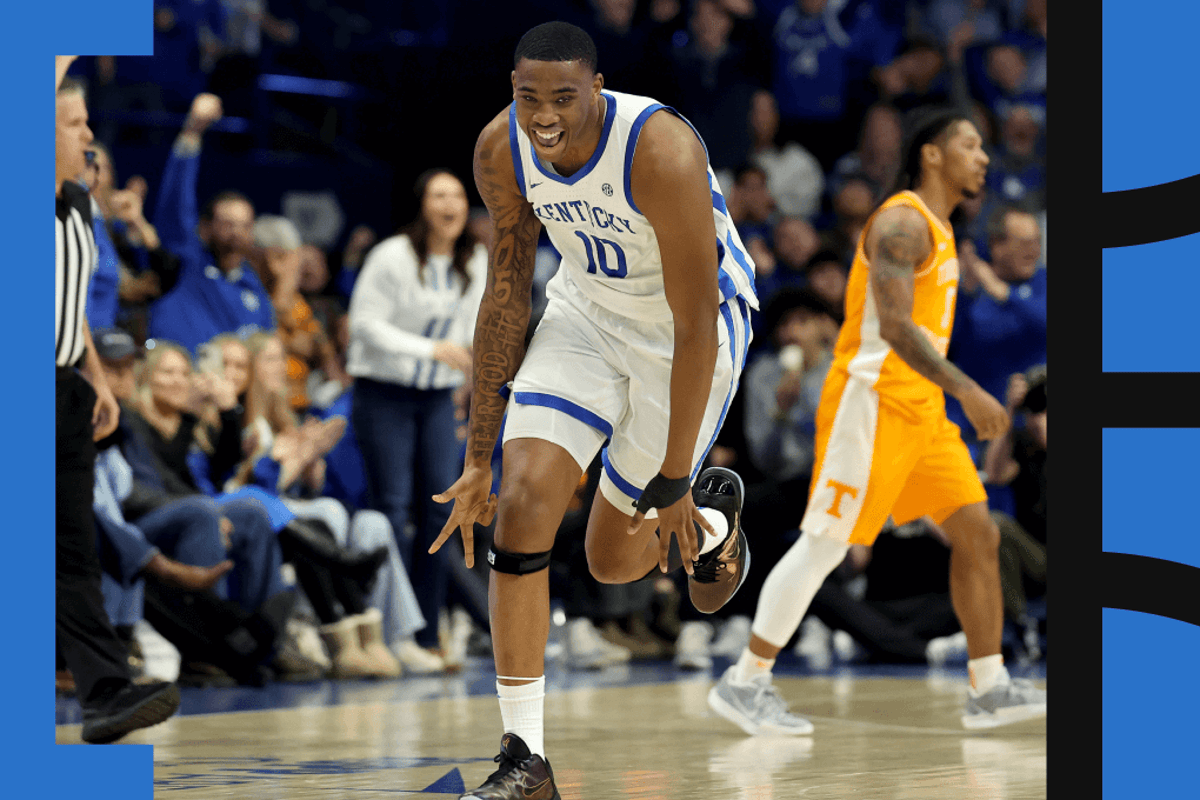
Kentucky Wildcats
Projected Seed: 3
Kentucky has persevered despite a deluge of injuries. Their win at Missouri last Saturday showed that, even without Jaxson Robinson and Kerr Kriisa, they remain dangerous, particularly on offense. But they’re also vulnerable in the first round, yet again.
Why? They don’t maximize possessions. Start on defense, where the Wildcats force a turnover about as often as their fans applaud a ref’s call. In fact, they rank dead last in the nation in steal rate (4.8 percent). While they do a good job of limiting opponents’ success from three-point range (30.4 percent shooting allowed), they let teams take a lot of treys (43.7 percent of attempts). That’s a dangerous gambit: Analytics show that the best form of perimeter defense is to limit 3-point attempts, as 3-point percentage is harder to control and more subject to fluctuations. Kentucky fans have seen that firsthand all season. In a loss to Auburn, the Wildcats allowed the Tigers to hit 12-of-26 3s. Ole Miss hit 13-of-30 in a 14-point win in February. Alabama hit a combined 24 3s in a pair of wins. Looking ahead to the tourney, letting a mid-major shoot a lot of 3s is … not great, Bob.
Nor is UK’s offensive rebounding. That’s the only weak link in the country’s sixth-ranked offense, but it’s a big one from Slingshot’s perspective. Like Wisconsin, Kentucky lacks a buffer against a poor shooting night, which is a serious concern in March. Mark Pope’s first year back in Lexington has certainly been a success, but there’s a real chance it could end with another first-round disappointment.
Wisconsin Badgers
Projected Seed: 3
It’s been hard to miss the changes wrought by the phenomenon local media is calling “Greg Gard 2.0.” This season, Wisconsin’s coach has overhauled his staff and embraced analytics, installing a pro-style offense that stretches the floor, creates open looks and leads to fusillades of 3s. The Badgers, who played solid and stolid for eons, are playing an average of 1.4 seconds per possession faster than last year. And they are launching 47.4 percent of their shots from behind the arc, ranking 27th in the country, up from 229th in 2024. The overall results have been terrific: Wisconsin has the 11th-most efficient offense in the nation and ranks 17th in our basic power ratings.
But here’s the thing: Favorites need to stay safe while exerting their dominance to avoid trip-ups. All those bombs inject risk into Wisconsin’s game. You don’t need a model to envision a scenario where a team goes cold from deep on one unfortunate evening and quickly boards a plane back home. It happens every season — like Virginia’s 2-for-12 3-point shooting performance in a one-point loss to Furman in 2023.
The best way to protect against that outcome is through offensive rebounding — if you miss a lot of shots, you can always go get the ball back. But the Badgers don’t have that safety valve. Wisconsin ranks 231st in offensive rebounding (28.2 percent). The Badgers have always emphasized getting back on defense to prevent transition opportunities, but that comes at a cost when they’re off from deep. Slingshot estimates that the Badgers’ statistical profile will cost them 4.1 points per 100 possessions against a long shot in a tournament scenario, the worst underperformance by any team likely to land a 1-6 seed.
Michigan Wolverines
Projected Seed: 5
Michigan’s overall ratings, both in our power ranking and according to Slingshot, are in line with the numbers generated by other high seeds. But the Wolverines have been sliding — they have lost three in a row and are just 9-6 after starting 5-0 in the Big Ten. We suspect that’s because their outstanding early-season play was based on unsustainably good shooting that obscured some terrible ballhandling.
For most of this season, Michigan somehow posted a top-20 offense despite ranking below 300th in turnover rate. You can understand why the Wolverines’ stats might look sloppy. Point guard Tre Donaldson — a key cog in Dusty May’s successful effort to rebuild quickly — is a good player, but he had a turnover rate of more than 20 percent in each of his two seasons at Auburn before transferring and is up there again this year. And while 7-footers Danny Wolf and Vladislav Goldin are highly effective big men, playing them together comes with tradeoffs, particularly when it comes to dribbling and passing.
Sure enough, the Wolverines’ shooting has come back to earth — they now rank 58th in offensive efficiency — while their turnover rate has remained stubbornly extremely high (20.2 percent, 335th). It cost them in early losses against Wake Forest and Arkansas. And it cost them last week against Maryland — when they still had a chance to nab the No. 2 seed in the Big Ten conference tournament — and committed 16 turnovers. One of every five times Michigan touches the ball, the Wolverines throw it away. There is no precedent for such a team to make a deep tournament run — and plenty of evidence Michigan will be vulnerable to a ball-hawking Cinderella.
Oregon Ducks
Projected Seed: 5
The Ducks may not be all they’re … quacked up to be. Their resume may earn them a top-5 seed, but advanced metrics don’t paint as impressive a portrait. Slingshot’s basic power rankings say they’re just the 34th-best team in the country; KenPom ranks them 31st. If you trust the stats, they won’t have as big an advantage over a 12-seed as you might expect.
They’re also an enigma. If you take away the two weeks between Jan. 25 and Feb. 8, Oregon would be 23-3 with wins over Alabama, Texas A&M, Wisconsin and Maryland. Unfortunately, the other five games count, too, and they were all losses, including an eight-point defeat at Minnesota and a 26-point drubbing by UCLA.
The Ducks don’t have any of the glaring vulnerabilities of Wisconsin, Kentucky and Michigan, but they also lack their clear strengths. They’re just … pretty good at a lot of stuff. Oregon is 35th in adjusted offensive efficiency and 36th on defense. They rank above the national average in forcing turnovers and rebounding at both ends but no better than 139th in any of those categories. At their best, the Ducks beat teams with balanced scoring (four players average between 14.1 and 10.2 points). But they may not have enough weapons to stave off a live ‘dog.
Ole Miss Rebels
Projected Seed: 6
Did you hear the one about the priest and the rabbi in Oxford who were having a doctrinal dispute? To settle the question of who was smarter, they decided to show up to the local medical school’s entrance exams and see who could get the better score.
And that was the only time this year two guys crashed the boards at Mississippi!
Look, we realize we sometimes rely heavily on particular statistical categories in our analysis. We also cheerfully acknowledge that there are many ways to build winning programs. But Ole Miss ranks 317th in the NCAA with an offensive rebounding percentage of just 25.6. That’s right between 15-17 St. Francis (PA, thanks for asking) and 10-21 Charlotte.
Kudos to the Rebels for doing enough other things right that they’re in line for a 6-seed anyway. They protect the ball exceptionally well, and they’ve faced a very strong schedule. But they are undersized and just don’t do enough on the glass at either end to get the kind of possession-building boost that has historically kept Goliaths safe.
(Photo of Kentucky’s Brandon Garrison: Andy Lyons/Getty Images; Illustration: Will Tullos, The Athletic)