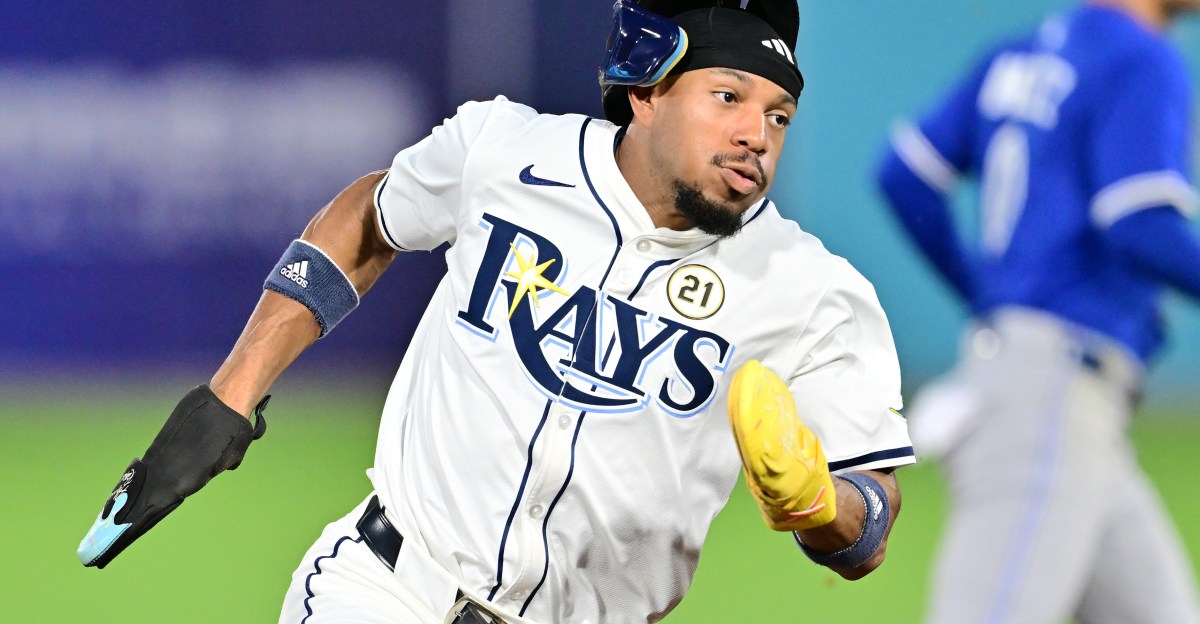
The Rays front office has quietly done a nice job restructuring the outfield group – so quietly that the improvements may have even flown under the radar of many fans.
The outfield production was less than ideal last season. Together, Rays outfielders produced an 85 wRC+ – which was the 5th lowest among all outfields in the league. However, they were the best base running group in the league by far in terms of Fangraphs BsR at 21.8 (the next closest was Arizona at 14.5) so they added some offensive value in that regard. Defensively, they were 19th in DRS and 20th in OAA, leaving room for improvement.
The front office was tasked with both improving the offensive production and solidifying the defensive capabilities of the outfield. Josh Lowe, Jake Mangum, Christopher Morel, Jose Caballero, Kam Misner, Everson Pereira, Travis Jankowski, and Tristan Peters saw over 76% of the PAs from Rays outfielders last season but are no longer with the team. It may seem daunting to replace some of those guys, but I think it’s possible to match their production and then some.
Below are some key performance indicators for the players who contributed in the major league outfield last season. In-zone minus out-of-zone swing rate helps measure plate discipline, contact rate can show bat-to-ball ability, 90th percentile exit velocity is one of the best ways to measure raw power, and looking at line drive plus fly ball rates lets us see how much a player’s contact ability and power can lead to real production in-game.
| Player | PA | Z-O Swing% | Contact% | BBE | EV90 | LD+FB% |
| Chandler Simpson | 441 | 31.7% | 89.8% | 378 | 96.7mph | 40.6% |
| Josh Lowe | 435 | 33.3% | 74.9% | 290 | 103.9mph | 53.8% |
| Jake Mangum | 428 | 32.0% | 83.2% | 343 | 102.0mph | 38.9% |
| Christopher Morel | 305 | 48.9% | 63.6% | 169 | 108.3mph | 62.5% |
| Jose Caballero | 275 | 33.0% | 74.8% | 159 | 101.9mph | 69.4% |
| Kameron Misner | 217 | 32.3% | 67.0% | 131 | 104.3mph | 56.7% |
| Everson Pereira | 73 | 46.5% | 58.3% | 38 | 107.9mph | 57.9% |
| Johnny DeLuca | 59 | 23.2% | 78.6% | 44 | 101.9mph | 54.6% |
| Richie Palacios | 48 | 40.4% | 78.3% | 34 | 101.9mph | 58.8% |
| Travis Jankowski | 34 | 35.1% | 79.7% | 23 | 101.2mph | 31.8% |
| Tristan Peters | 12 | 12.7% | 54.2% | 5 | 101.3mph | 80.0% |
| Total | 2,327 | 34.9% | 76.1% | 1,614 | 102.7mph | 50.2% |
| 2025 League Average | 37.1% | 76.9% | 105.1mph | 58.2% |
Right away we can see the unit showed below average swing decisions and an average bat-to-ball ability. Losing Lowe, Mangum, Caballero, and Misner actually helps improve the team’s swing decisions and – aside from losing Mangum’s contact skills – the bat-to-ball ability improves. This “addition by subtraction” comes at a cost, however; Lowe, Morel, and Misner all showed some power, and the ability to tap into that power, although they were still not particularly great according to this metric. The group as a whole had below average raw power and they did not tap into it much compared to league average.
Now we’ll look at the same key performance indicators for the current outfielders on the 40-man roster with their MLB data from 2024-2025 (I’ve chosen to exclude Gavin Lux as Neander has already spoken of him as a second baseman).
| Player | PA | Z-O Swing% | Contact% | BBE | EV90 | LD+FB% |
| Cedric Mullins | 997 | 43.0% | 80.7% | 679 | 102.5mph | 68.0% |
| Jake Fraley | 599 | 46.2% | 78.8% | 425 | 102.4mph | 59.0% |
| Chandler Simpson | 441 | 31.7% | 89.8% | 378 | 96.7mph | 40.6% |
| Johnny DeLuca | 421 | 33.0% | 78.4% | 301 | 101.7mph | 61.6% |
| Richie Palacios | 364 | 47.0% | 77.8% | 233 | 101.7mph | 61.7% |
| Justyn-Henry Malloy | 357 | 42.6% | 68.6% | 193 | 102.3mph | 65.3% |
| Total | 3,179 | 41.4% | 79.6% | 2,206 | 101.6mph | 59.9% |
| 2025 League Average | 37.1% | 76.9% | 105.1mph | 58.2% | ||
| Ryan Vilade AAA Data | 903 | 43.6% | 76.4% | 603 | 106.3mph | 55.1% |
| Jacob Melton AAA Data | 342 | 40.5% | 76.5% | 224 | 107.4mph | 46.4% |
Before we even factor in the guys who haven’t yet established themselves in the majors such as Vilade and Melton, we already see the swing decisions have significantly improved over the 2025 group. Guys like Mullins and Fraley bring a veteran presence that comes with consistently more competitive at bats, and that helps the outfield unit as a whole get to plus swing decisions. The contact skills also move into plus territory with the new additions. Raw power does remain below average, but the power they do have becomes more usable in game as the line drive and fly ball rate is up over 9% from last year. Below is what the data looks like when we include what Vilade and Melton bring.
| Player | PA | Z-O Swing% | Contact% | BBE | EV90 | LD+FB% |
| Cedric Mullins | 997 | 43.0% | 80.7% | 679 | 102.5mph | 68.0% |
| Jake Fraley | 599 | 46.2% | 78.8% | 425 | 102.4mph | 59.0% |
| Chandler Simpson | 441 | 31.7% | 89.8% | 378 | 96.7mph | 40.6% |
| Johnny DeLuca | 421 | 33.0% | 78.4% | 301 | 101.7mph | 61.6% |
| Richie Palacios | 364 | 47.0% | 77.8% | 233 | 101.7mph | 61.7% |
| Justyn-Henry Malloy | 357 | 42.6% | 68.6% | 193 | 102.3mph | 65.3% |
| Ryan Vilade AAA Data | 903 | 43.6% | 76.4% | 603 | 106.3mph | 55.1% |
| Jacob Melton AAA Data | 342 | 40.5% | 76.5% | 224 | 107.4mph | 46.4% |
| Total | 4,675 | 41.7% | 78.6% | 3,033 | 102.9mph | 57.9% |
| 2025 League Average | 37.1% | 76.9% | 105.1mph | 58.2% |
The swing decisions remain plus, and the contact ability is still above average and better than last season. The raw power is now comparable to last year’s below-average performance, but it’s significantly more playable in game with their line drive and fly ball rate up over 7% from last season. I debated leaving out Simpson’s EV90 and LD+FB% (measuring exit velocity as well as line drive/fly ball rate) because his style of play benefits from weaker contact on the ground, but I left him in to help keep things simple. However, if we were to exclude Simpson’s profile, the Z-O swing% moves to 42.7%, contact% to 77.5%, EV90 to 103.6mph, and LD+FB% to 60.3% – suggesting there’s more power in this group than it might seem.

Losing Mangum, Lowe, and Caballero does hurt the base running ability of the group, but I’m not too concerned about that. They were already the top base running group last season by quite a bit so they can afford to trade some of that speed for plate skills and usable power. Mullins and Fraley are strong base runners, and (when healthy) DeLuca and Palacios are plus athletes who can also impact the game with their base running. Simpson could steal 100 bases if he gets a full season of every day playing time.
Of course, all eight of the outfielders on the 40-man roster will not be on the active roster at the same time. Injuries will happen and guys will be pushed into different roles, an NRI like Edward Olivares might play his way into the group, or someone could be traded or DFAd. However, the offensive floor of this group is higher than last year with the improvements in plate skills and the in-game power potential is significantly greater depending on who ends up getting the bulk of the playing time.
For reference, I calculated the numbers for the Rays outfield groups during their run of five consecutive postseason appearances from 2018-2023 to see how it would compare with what we saw last season and what we could expect from the unit in 2026 (including Simpson’s data).
| Player | Z-O Swing% | Contact% | EV90 | LD+FB% |
| 2019-2023 | 38.6% | 73.3% | 105.4mph | 55.5% |
| 2025 | 34.9% | 76.1% | 102.7mph | 50.2% |
| 2026 | 41.7% | 78.6% | 102.9mph | 57.9% |
The 2026 group still doesn’t get to the same power of the outfields we saw during the team’s impressive run of postseason appearances, but the at bats should be just as competitive with better contact rates and a chance to unlock more in-game power given the more optimal launch angle distributions.
Projecting defensive production is much more difficult than projecting offense because there’s a lot we don’t know about who will play where and how much they could’ve improved or regressed compared to last season. What we do know is there are plenty of great athletes in the current group, and that last year the defense graded out below average in a couple measurements.
Losing plus defenders in Mangum and Misner will be tough. However, Mullins is still above average out there and a healthy DeLuca is probably the best defensive outfielder they’ve got. I think Fraley and Lowe are comparable corner outfield defenders, and Simpson has been working hard this offseason to improve on his below average defense last season. I love Morel but not having him in leftfield is a boost to the outfield defense. Caballero was fine when he was out there, but not someone you’d want every day. Malloy is more of a DH than an outfielder so I’m not expecting much from him if he were to win a roster spot, but Vilade looks fringe average in a corner and can even fill in at second base. Melton is easily a plus defender at all three spots if he were to crack the roster.
Overall, the outfield defense looks at least a little better and should be more league average in 2026 after looking below average last year. A best-case scenario defense could look like Mullins in LF, a fully healthy DeLuca in CF, and Melton winning a job in RF. That would easily be a plus defensive unit and one of the better trios in the league.
What I’ll Be Watching in Spring Training
The front office has set the outfield up for success in 2026. The floor is higher thanks to some of the veterans they’ve brought in, and there’s a realistic shot that the outfield is a position of strength for this team. It’s now up to the guys on the roster to compete for playing time.
There will be plenty of competition for roster spots for the first time in a few years. I’ll be closely monitoring a couple players:
- Melton has the most upside of all the outfielders, but he needs a chance to establish himself. No other outfielder can match his combination of plus speed, power, and defense. His main competitors for reps seem to be Fraley and Simpson.
- Simpson, whose defense has been below average both in defensive metrics and the eye test, has been training offseason with Michael Harris of the Braves and former big leaguers Marquis Grissom and Lou Collier. His growth defensively will be interesting to follow. Even last season he improved as the season went on but he still didn’t look comfortable in left or center. Regardless of his defensive home, finding a way to get his bat and legs in the lineup makes the offense significantly more dynamic.
- DeLuca experienced a bad-luck broken hand in 2024 after being hit by a pitch in Spring Training, and his shoulder issue early on in 2025 came out of nowhere. While I don’t expect injuries to be an issue for him going forward, I do want to see him healthy because he is an impact defender and base runner who has more to show with the bat than we’ve seen from him so far.
- If you know me, you know I’ll be watching Vilade more than anyone else. His right-handed bat adds some much-needed balance to complement all of the lefties, and his ability to impact the ball helps add some power. Vilade’s defensive versatility and the fact that he’s out of options also help his case to win a roster spot.