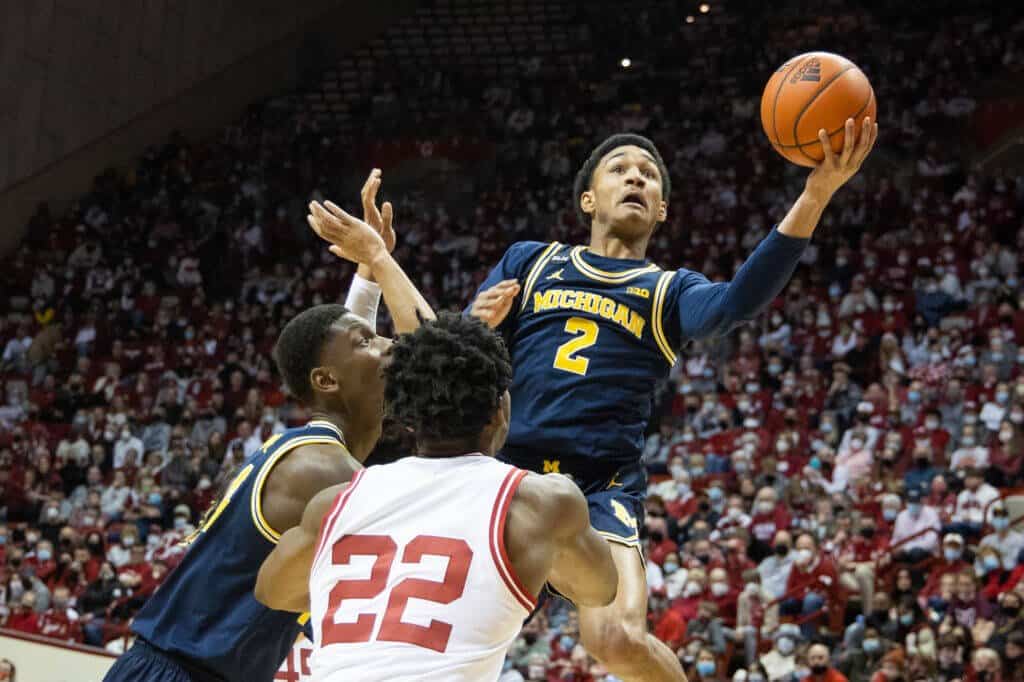
Perception could be, in hindsight, far different for Michigan basketball entering this season.
Last year’s Wolverines began the year as a top-10 team, started 7-7, see-sawed through conference play, and saw their coach suspended for sticking an opposing coach. Then a blown lead against Indiana in the Big Ten tournament and a No. 11 seed in the NCAA Tournament. A trying season looked ready to mercilessly end when first-round opponent Colorado State jumped to a 15-point lead. A fitting conclusion, it appeared.
Instead? Michigan stormed back against CSU. Two days later, cashing in on Rick Barnes’ persistent resistance to the second weekend of the tournament, the Wolverines upset No. 3-seeded Tennessee to advance to the Sweet 16. There, the Wolverines went toe-to-toe with Villanova before falling respectfully to a team that’d eventually land in the Final Four.
Michigan ended its season with some good vibes. Howard went from entrenched in controversy to becoming the first Michigan coach to reach two Sweet 16s in his first three seasons. In the offseason, highly touted freshmen Caleb Houston and Moussa Diabate both entered the NBA Draft, as expected, and were selected in the early second round. Star center Hunter Dickinson, though, opted to return for his junior year, giving the Wolverines a major boost for 2022-23. Another highly regarded recruiting class is inbound and Michigan is a borderline top-25 team.
Just like that, all is well.
Funny how that works.
This all feels like a fitting starting point for Year 4 under Howard, a season that’s beginning with more questions than any of the prior three. Michigan is currently on a trip abroad, playing three games over 10 days in France and Greece. It’s affording an overhauled roster a head start toward finding its way.
As Michigan enters these nascent days of what will be a long road to March, here’s a medley of thoughts to consider.
1. The roster turnover is … significant
Michigan is losing seven of its top nine scorers from last season.
Eli Brooks, a nearly irreplaceable presence, exhausted his eligibility. So did point guard DeVante Jones, who started 33 games and averaged nearly 30 minutes. Houstan and Diabate are gone after one-and-done visits. Brandon Johns Jr. transferred to VCU for a graduate season. He’ll be joined there by Zeb Jackson, who left Michigan midseason. Frankie Collins, the hero of Michigan’s win over Colorado State, transferred to Arizona State.
That leaves Dickinson, Terrance Williams II, Kobe Bufkin and Jace Howard as Michigan’s lone scholarship returnees. Will Tschetter and Isaiah Barnes are sophomores, but essentially first-year players for the program. They’re joined by five incoming freshmen: Jett Howard, Youssef Khayat, Tarris Reed Jr., Dug McDaniel and Gregg Glenn III. Desperately needing both shooting and point guard play, Michigan dipped into the transfer portal to pull guard Jaelin Llewellyn (Princeton) and wing Joey Baker (Duke).
Llewellyn and Baker combined have six seasons of regular-rotation experience.
The rest of the Michigan roster combines for five.
How does this odd mix stack up nationally? Bart Torvik has an offseason metric that measures how old (in terms of class year) a team projects to be based on how its minutes are projected to be distributed. For Michigan, that comes to an average experience of 1.57 years, 310th nationally and the third-least experienced in the Big Ten.
Joey Baker, a rotational wing for Duke the last three seasons, is now one of Michigan’s most experienced players. (Rob Kinnan / USA Today)
2. Every summer, a variety of NCAA teams go on trips abroad. And every summer, every coach waxes on about how crucial the extra time is. Not only the games, they say, but the NCAA-allotted 10 extra practices permitted prior to the trip.
It’s a bit of a cliche at this point. For every team that finds success after going abroad, there are plenty of examples of those that don’t.
When it comes to this Michigan team, though, it’s pretty darn tempting to lean into the idea of this trip being invaluable, and it’s not just because of youth and inexperience.
This is Michigan’s third straight season with a transfer point guard walking in and taking over.
Two years ago, it was Mike Smith. The Columbia grad transfer arrived in Ann Arbor as a bona fide scorer and needed to adjust to a read-and-react, pass-first role. It took some time, but he evolved nicely and by season’s end was crucial to a team that reached the Elite Eight. Last year it was DeVante Jones. The Coastal Carolina transfer struggled early, but improved over the course of the year. By season’s end he was a primary option and one of Michigan’s few reliable pieces.
Now it’s Llewellyn’s turn. The 6-foot-2 guard averaged 15.7 points and 2.5 assists per game last season at Princeton. Like Smith and Jones, the big question is how his game will translate moving up to consistent high-major competition.
Unlike Smith and Jones, though, some of Llewellyn’s growing pains and adjustments should be mitigated by an early start to the process. From an outsider’s view, the overseas trip seems more valuable to Llewellyn than anyone else, including the freshmen. Anything to flatten the learning curve is critical.
3. As for what Llewellyn brings to the table, he’s a decidedly different point guard than his predecessors. Whereas Smith was a high-level shooter and scorer, he was notably limited by his size. And whereas Jones was adept at attacking the paint, he wasn’t much of a shooting threat.
Llewellyn is different. At 6-2, he brings size and athleticism. He also made 2.3 3s per game last season on 38.6 percent shooting.
The question facing Llewellyn offensively is his ability to create others’ scoring as a point guard. While he’s considered a capable passer, he only produced three or more assists in 11 of 26 games last year.
To consider: Jones came to Michigan with 341 assists in 81 career games. Smith came to Michigan with 393 assists in 92 career games. Llewellyn? He comes with 187 assists in 76 games.
“Like any point guard coming here, the test is yet to come on absorbing all the calls and the responsibility of knowing where the other four guys have to go,” assistant coach Phil Martelli said. “The point guard in this system is responsible for the other four guys, also. That will be a work in progress.”
Beyond that, Llewellyn will have to prove he can step into a leadership role, develop his voice and, perhaps most importantly, defend.
4. Most jarring about the Michigan roster is the sheer volume of capable bodies. At a time in college basketball where most programs are leaving scholarships open, not only are all 13 scholarships at Michigan filled, but they’re all essentially occupied by high-major recruits. Eleven of the 13 spots are former top-150 recruits. The lone exceptions are Jace Howard, who was recruited as a walk-on but ultimately awarded a scholarship, and Khayat, an international recruit with no true recruiting ranking.
Of those 11 former top-150 players, six ranked in the top 50.
Here are Michigan’s 13 scholarship players and their final recruiting ranking .
Michigan’s 2022-23 roster
|
Player
|
Position
|
National ranking
|
Position ranking
|
|---|---|---|---|
|
Joey Baker |
Small forward |
33 |
7 |
|
Tarris Reed |
Center |
35 |
8 |
|
Jett Howard |
Small forward |
42 |
14 |
|
Hunter Dickinson |
Center |
43 |
10 |
|
Kobe Bufkin |
Combo guard |
46 |
4 |
|
Dug McDaniel |
Point guard |
81 |
14 |
|
Jaelin Llewellyn |
Combo guard |
99 |
18 |
|
Terrance Willians |
Power forward |
101 |
18 |
|
Isaiah Barnes |
Small forward |
119 |
25 |
|
Gregg Glenn III |
Power forward |
120 |
21 |
|
Will Tschetter |
Power forward |
145 |
26 |
|
Jace Howard |
Small forward |
390 |
75 |
|
Youssef Khayat |
Forward |
NR |
NR |
Hayat, meanwhile, was recruited by multiple high-major programs this summer and is said to equate to a four-star recruit.
So, some brilliant analysis here — this is a lot of bodies looking for a lot of minutes. That can be a great problem to have. It can also just be a problem.
5. This group’s opportunity to travel abroad can be a much-needed reset from last season. There was something about last year’s Michigan team that never fully clicked. No collective personality ever emerged. There have been Michigan teams in the recent past that had a discernible edge to them. Last year’s wasn’t one of ‘em.
It also was the program’s worst defensive team since 2015-16.
It’s a safe guess that these two facts might be related.
How will this year’s group evolve together? Should be interesting. The roster is made up of six players who spent last year together, two new veterans with high profiles, and five highly-touted freshmen.
6. That aforementioned defense was the root of Michigan’s issues last year. The unit allowed 1.1 points per possession or worse in 12 games (all losses), and ranked 11th in the Big Ten in defensive efficiency (1.08 ppp) and 12th in effective field-goal percentage (52.7 eFG%). Woof.
Can this year be markedly better? Can it even be … better, at all? The only thing holding last year’s group together was Brooks. Now he’s gone and the defense is led by … Dickinson? Williams? Llewellyn?
Quick, name this team’s best defensive player.
See, it’s not easy.
Now this doesn’t mean this year’s Michigan defense necessarily has to be worse than last’s. But it does mean that if there’s any hope of improvement, it has to be as a collective.
7. Khayat seems like the wildcard in all this. Howard describes the freshman as “a very dynamic, bigger wing.” A native of Lebanon, he and his mother traveled to France when he was 15 to pursue basketball. He’s now 6-foot-9 and carries a long resume of Euro pro and national team experience.
An unknown in the spring, Khayat could very well be a starter for this team. Time will tell how Big Ten-ready he is, but the combination of size, skill and attributes is enticing. Khayat is a good shooter, a great cutter and brings good size. He could also be one of the better defenders on the roster. Not too bad, considering Howard started recruiting Khayat only after Houstan and Diabate declared for the NBA Draft.
Howard’s scouting report: “Can shoot from the outside” … “you can play him at multiple positions” .. “athletic” … “versatility” … “high-IQ player.”
8. If there’s a name generating buzz, it’s Bufkin. The sophomore’s talent simmered on the surface last year, but is apparently now bubbling after Bufkin spent the bulk of the offseason in Ann Arbor. He worked out in team facilities, including time spent with visiting Zavier Simpson and Franz Wagner. He added 20 pounds and is now listed at 6-foot-4, 195 pounds.
“The extra pounds of muscle is not just fat, this is lean muscle,” Howard said. “It won’t prohibit him from being faster, quicker, athletic. This is muscle that is athletic muscle that he’ll be able to move and not be knocked off (his) route and be able to defend. (He’ll be) a two-way player.”
When recently asked if any player on the roster other than Llewellyn can reasonably be expected to produce out of ball screens, Martelli quickly pointed to Bufkin.
“He’s shown tremendous growth in that area and because of that, I don’t think it’s going to be a one-man band when it comes to (ball screens),” Martelli said.
The chance of a major sophomore leap by Bufkin is one of those possibilities that could determine the ceiling of this team.
9. Another glowing comment made recently by Howard.
“The kid has reinvented himself.”
Having averaged 12 minutes per game in 52 career outings, Williams is often the overlooked piece of this puzzle. Maybe that changes in his junior year. Howard says he’s going to take on “a larger role.”

Hunter Dickinson remains Michigan’s most known quantity. (Daniel Dunn / USA Today)
10. If not for Dickinson being rubber-stamped for about 33 minutes per game, there’d be a lot more chatter about Tarris Reed Jr. The freshman center is listed at 6-foot-10 and 260 pounds on the official roster, and he has drawn good reviews in early practices. He’ll have at least year to spend working and learning behind Dickinson.
And before anyone asks — no, the two centers aren’t likely to play alongside one another.
11. There’s a reason we waited this long to get to Dickinson. It’s because all roads lead to him.
Michigan will go as far as Dickinson takes it. He was a first team All-Big Ten selection and consensus All-American last year. Question is, how much better can he be as a junior? Last year he entered the season keying on proving himself as a perimeter shooter, expanding his face-up game and improving his defense. He checked a lot of boxes, notably making 21 3-pointers while also leading U-M in scoring (18.6 ppg) and rebounding (8.6 rpg).
This year? As opposed to specific areas to prove himself, Dickinson will aim to be better overall. More efficient, more athletic, more explosive. Juwan Howard said the 7-footer is “stronger, leaner” and playing with “a higher motor.” Martelli, meanwhile, said the junior is more assertive and vocal than ever in practices, stepping into the large leadership void left behind by Brooks. He’s more well-rounded and focused on his game, instead of what NBA scouts want to see.
“It’s not as forced,” Martelli said. “Last year, it was, ‘Oh, man, I have to do this, this, this. I have to shoot the perimeter shot. I have to show I can guard in the ball screen.’ This year, it seems like it’s all so much more natural for him.”
That should all equate to Dickinson being one of the most reliably dominant players in college basketball. What a luxury. Dickinson is the bedrock for a roster that’s loaded with talent but equally unpredictable. Jett Howard, for instance. The head coach’s son is a potential star — a 6-foot-9 wing who can stretch the floor and score as a playmaker. As Juwan Howard says, “What he has is what we need.” But Jett is a freshman, and anyone who wants to bank on him being an all-league caliber player should go back and re-read what was expected of Houstan last year.
Dickinson, though? Michigan knows exactly what it’s got. No matter what, that gives it a chance for a special season.
(Top photo of Kobe Bufkin: Trevor Ruszkowski / USA Today)