Major League Baseball has released a treasure trove of bat tracking data at Baseball Savant, which offers an incredible new look at hitters. The data is robust and will hopefully help add even more information on what makes a hitter effective, or wimpy at the dish. MLB.com’s Mike Petriello put together an explainer that introduces six new Statcast metrics and breaks each down. The data includes average bat speed as well as swing length.
There is going to be a ton of stuff to look at here, but for now I wanted to take a surface level look at what the new metrics say about the Atlanta Braves. Below are some quick thoughts. You won’t be surprised to learn that like pretty much everything else, the Braves have a clear hitter “type” and strategy, and just like they’ve aimed to dominate the xwOBA leaderboards, they pretty much aim to appear at the top of these new bat speed leaderboards as well.
Bat Speed
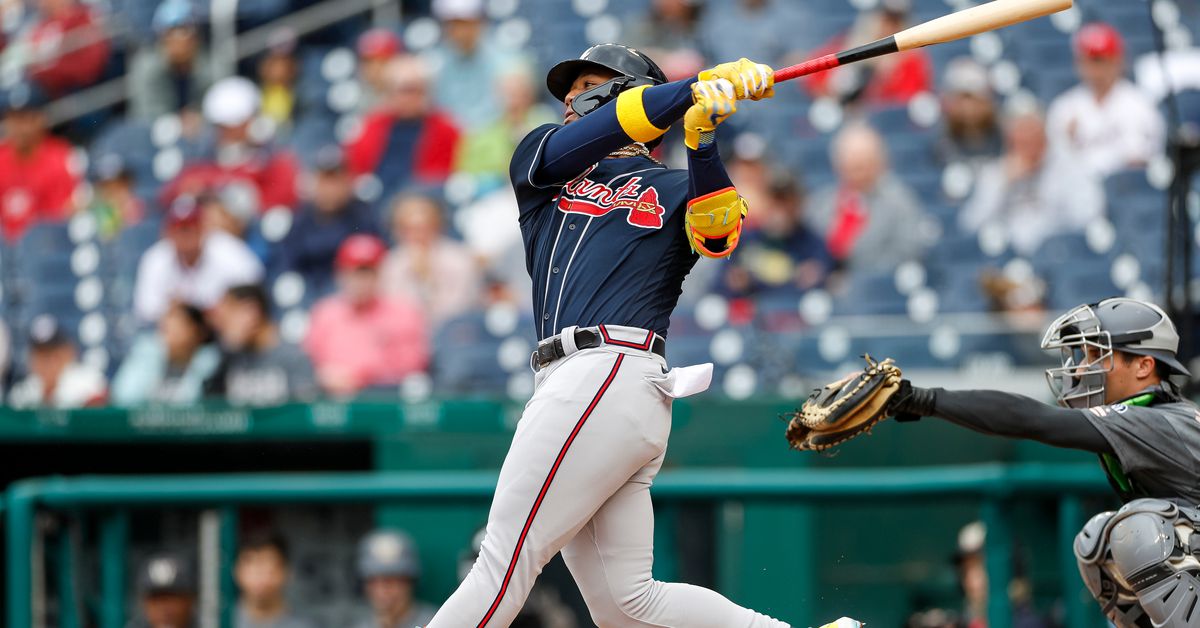
First, and shouldn’t be a surprise to anyone, Ronald Acuña Jr. leads the team in average bat speed and ranks fifth in the majors at 76.7 mph. The major league average is 72 mph, for context. The Yankees’ Giancarlo Stanton leads the majors at 80.6 mph. Austin Riley (75.0), Marcell Ozuna (74.7), Michael Harris (74.4) and Matt Olson (74.0) round out the top five for the Braves.
Of players with at least 50 swings, Ozzie Albies ranks 10th on the team at 69.1 mph ahead of only the now departed Luis Guillorme.
It’s important to keep in mind that bat speed, as defined here, tries to capture how hard a batter can swing rather than how hard he does swing — the metric does this by reporting the average of the top decile of a player’s swings, rather than the average of all their swings, or even the top half of their swings.
The Braves, as a team, have the highest average bat speed in the majors, which shouldn’t be surprising to you.
Fast Swing Rate
A fast swing rate is defined as a swing at more than 75 mph. Looking at the Braves, this is where Acuña outshines everyone else. Acuña’s fast swing rate is 71.5%. Austin Riley is second at 50.4%. Acuña’s mark is the fourth-best in the majors. The rate of “fast” swings is really interesting because there are some clear standouts at the top, and then a much more middled “rest of the league” bucket. There are only a handful of guys that are swinging super-hard basically every time, and the rest of the league really isn’t.
Again, the Braves are so far in first here that it’s almost comical. The gap between the Braves, as a team, having fast swings 37 percent of the time, and the second-place Orioles doing so 29 percent of the time, is as big as the gap between the Orioles and teams ranked in the bottom third of MLB. There’s a very clear thing the Braves are trying to achieve, and it involves (or consists of) swinging out of their shoes, a lot.
Squared-up Rate
This is one of the key aspects of the new metrics. First some background as defined by Petriello’s explainer.
Each swing has a max attainable exit velocity based on the speed on the swing and pitch. If a swing attains at least 80% of that exit velocity, it counts as a ‘Squared-up” swing. A swing more than 80% squared-up can only happen on the sweep spot of the bat.
This metric measures more of a quality of contact. You can have a slower swing, but still square a ball up and get maximum effect from it. Orlando Arcia tops the Braves’ list at 29.0% with Ozzie Albies second at 26.8%. It’s really important to keep in mind that while this is a quality of contact measure, it’s not really one that works the same way as xwOBACON or anything else you’ve considered before. The reason for that is that a slow swing where you guide the bat to the ball can end up “squared up,” but has relatively limited potential — this metric doesn’t care about the actual potential you’re achieving, only that your contact is as good as possible once you control for bat speed (and pitch speed).
The Braves are, perhaps intuitively (or perhaps not), fairly terrible at squaring balls up, in a vacuum. Their rates of squared-up contact, either as a percentage of contact or a percentage of swings, are barely outside the bottom five among all teams. Again, this might make intuitive sense: if you swing super-hard all the time rather than in a subset of situations where you think you’re getting a meatball, you’re going to have more mishits and glancing contact that falls short of the potential of your swing.
Blasts
Blasts take things a step further, and into more familiar territory. A squared-up swing doesn’t have a bat speed minimum. A blasted swing is one that is squared up and has a fast swing. Naturally, squaring a ball up is good, but squaring it up with a fast bat speed is even better.
Austin Riley leads the Braves with 16.5% of his swings being blasts, and is followed by Marcell Ozuna (15.6%) and Michael Harris (13.5%). Acuña currently ranks sixth at (12.3%). This data is only available from the first seven weeks of the season. It would be interesting to know where Acuña would have ranked during his MVP season last year. That really holds for all of this — with these data only available from early April-onward, we don’t have any way of seeing which guys are struggling due to bat speed problems they’re experiencing now as compared to before. But, at least we’ll be able to use on a going-forward basis.
The Braves are second, behind the Orioles, by a teeny-tiny decimal point, in the fraction of their contact that’s been a blast, so far. They’re fourth in the percentage of swings that turn into blasts, probably because they swing a ton.
Swing Length
This is another term that has been talked about a lot over the years, but until now was nearly impossible to measure. Somewhat surprisingly, Harris has the longest swing on the Braves at 8.1 feet. Albies has the shortest at 7.2.
Javier Baez has the longest swing in the majors at 8.7. Luis Arraez has the shortest at 5.9. Arraez also has the slowest bat speed in the majors at 62.4 mph but leads the majors in squared-up swings at 43.5%. Baez, on the other hand, has a long 8.7 foot swing and an average bat speed of 75.4 mph. His squared-up percentage is just 23.7% and a his blast percentage is just 10.7%.
While swing length is not necessarily directly related to the other metrics here, again, the Braves seem to have a type, and they collectively have the longest swing in MLB. The Braves seem to be targeting guys with (or coaching them into) swings with the arc to generate a ton of delta-v and therefore a ton of impact when they connect. Again, we pretty much knew this: it’s what taking your z-whiff in exchange for better quality of z-contact is all about. This is also why they are in the top five leaguewide in swords, which essentially result from guessing so wrong on a pitch you don’t even want to commit to the bit — it’s hard to try to hit a homer on every pitch and not look like you’re LARPing here and there.
In conclusion, there is a lot of things to wrap your head around with the new metrics. A short and slow swing doesn’t necessarily mean that a player is a bad hitter, especially if they square a ball up at a high rate. But, the potential of those swings does tend to be limited relative to a guy who can swing harder and not gain a bunch of mishits in the process.