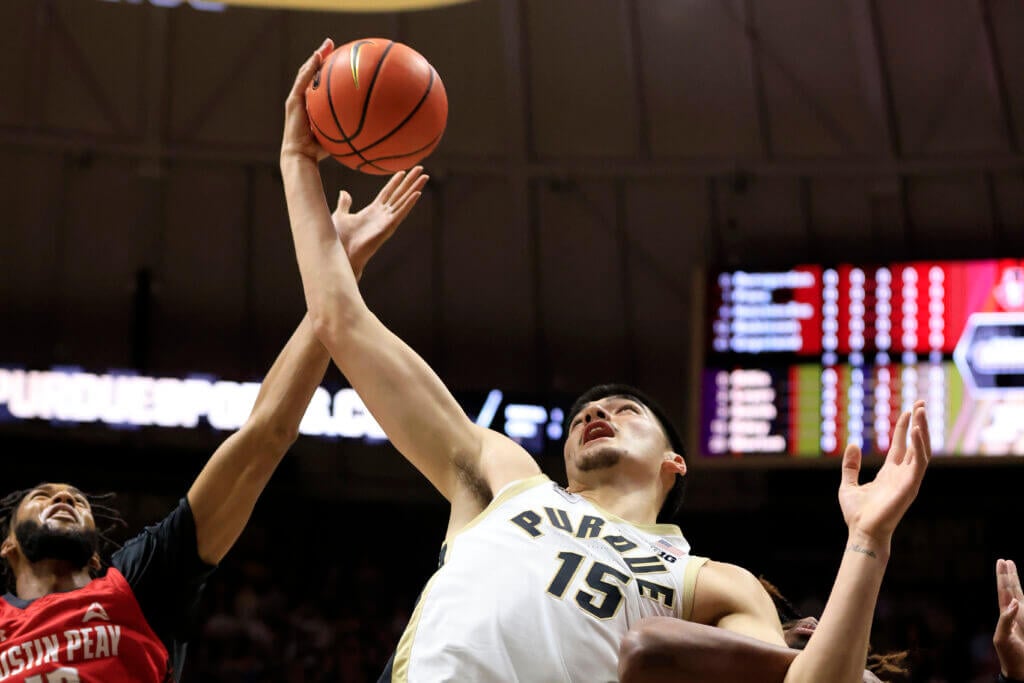
Throughout the season, The Athletic senior writer Sam Vecenie will interview and watch tape with some of the best prospects across college basketball, Europe, Overtime Elite and the G League. Together, they’ll dive deep into what makes them such an interesting prospect and analyze some of the best parts of their game. Today, Sam chats with Purdue big man Zach Edey. The conversation has been edited for clarity and length.
There is arguably no more dominating player than Zach Edey within college basketball. The 7-foot-4 Purdue center has been one of the most productive players on a per-minute basis over the last two years, and opened his season for Purdue with a pair of monster double-doubles that currently see him averaging 21 points, 14 rebounds, and 3.5 blocks per game. With Trevion Williams gone, the middle is now Edey’s to own. He’s Purdue’s centerpiece this year, the guy who will be asked to lead them to their ceiling. And it’s a real come-up for a player that not all that long ago was not even playing competitive basketball.
It’s well-established that Edey came to basketball later. After playing baseball and hockey in his youth — he told The Athletic about pursuing baseball at an academy in Canada until realizing he didn’t quite love it enough to continue with it — Edey originally picked up basketball to cross-train for baseball. But in 10th grade, he started to get serious about it thanks to his friend’s dad.
“I remember learning like basic stuff that seemed so complicated, like a hook shot and when you do the right-left into a layup,” Edey said. “That was so complicated. I had to do a full practice to figure out how to do right-left, then left-right with different hands. Like, super, super basic concepts that I really had to work on in 10th grade. I hadn’t played it. I was brand new. So I started super behind.”
He got noticed by the Northern Kings AAU program in Canada, played well enough to earn a couple of scholarship offers almost due to his size alone, and then decided to go to IMG Academy in Florida after recognizing that he loved the game and really had a chance to succeed within it. There, he played on the second team at IMG — not the national team — and says he would “get his ass busted for a while” against guys who were good high school players, but not the kind of talent he’d go on to face later as he moved up the ladder at IMG. But where he really noticed that he was getting better was when he went back and played AAU again for Northern Kings. It’s hard to tell how good you’re getting when you’re going up against potential first round picks. But then when you leave the IMG atmosphere, it became a bit easier.
That’s when he got his offers from Baylor, Purdue, and others, and immediately got an opportunity to move up to the national team at IMG the next year. Edey says that constantly moving up, from Canadian basketball, to IMG’s second team, to IMG’s national team, then up to college basketball, has made him really embrace the grind of work. He looked at as restarting the process every time he’d move up a level, because he’d get beaten for a while, then would eventually adjust and improve through sheer work ethic. He’s had to go up against players better than him at every level and earn his place every time. He went from facing former Duke center and 2022 first round pick Mark Williams in practice at IMG to then having to face an All-Big Ten center in Trevion Williams. The only way you go from not playing competitive basketball into an All-Big Ten player in five years is work, and as you’ll notice throughout our conversation breaking down tape, that’s what Edey just focuses on: the work.
“That’s how I am when I’m practicing. I don’t believe there is any point in going to practice if you’re not going to actually try hard and go hard in practice,” Edey said. “I know there are some guys where their thing is just kind of coasting in practice, and then when you get to the games, they can really just go. I can’t really do that. So when I go to practice, I go to practice to really work hard.”
Here’s a condensed form of our conversation with Edey. The full, hour-long conversation can be found below.
Elite post player due to size and fundamentals
Vecenie: Let’s transition from there to actually talking about basketball. You have, in some ways, what looks to the viewer as a very simple game. Post up, run the floor, establish position go. But I have a feeling that you’re going to be able to explain to me like how complicated some of this stuff is.
These are two back-to-back possessions against Penn State. On this first one, you’re going to set up John Harrar. Harrar is a really underrated defender.
Edey: Dude’s strong.
Vecenie: Yeah, and you’re gonna get to your hookshot here. And then here’s the second one. You’re going to bounce it right twice, and then you’re going to go drop step over the back shoulder. So how much are you trying to set up your opponent for one thing versus something else? What is kind of going through your mind here as you’re working through these two possessions?
Edey: You can’t really go into your moves thinking “I’m gonna do this. I’m gonna do that.” You have to always take what the defense gives you. If you look in this first clip, he hasn’t really gotten his top foot around enough. I feel like he’s kind of giving me middle a lot. And I’m gonna take my middle. I’m gonna take my right hand, that’s kind of bread and butter every single time. I just kind of go over the top, you can’t really do anything about it.
Then the second one, you can see with his left arm, he kind of jumps out and tries to make a play on the ball a little bit. When someone does that, they can’t try to just make a play like that and then also have bounce to come back to the baseline like that. So that’s just an easy drop step into it. And since I’m tall, people always say, “Oh, you’re just tall.” But you have to use your height to your advantage, you know? Like you can see in that clip that Seth Lundy, he’s just going to take that ball from me. I go over the top of him (with the ball). If I go over, he can’t make a play on the ball, he’s gonna hit my arm. That’d be number one.
Vecenie: And speaking of fouling, the thing that is just immediately evident to me is that you’re 7-foot-4, but you’re getting below Harrar’s waist here, even with him trying to get a wide base to try and stop you. Your bend and your flexibility…I mean, god, we all know that college referees love calling chargers as much as anything, and they’ll catch you if you don’t do this. I really like the way that you use your bend on post ups to be able to move guys backward without fouling.
Edey: Yes, low man wins, everyone always knows that. I’m tall, so I have to really, really try to get low on my moves. Defenders are smart enough in college, if I lead with my shoulder, someone’s gonna go down, and I’m probably gonna lose my balance, it’s gonna be a foul on me. So you have to make sure you’re leading with your entire side of your body. So you can stay on balance if they go down, and then that’d be a foul on them.
There are various things like that I really struggled with my freshman year. You know, making sure I’m not leading with my elbows, make sure I’m keeping my elbows down behind me so that I can’t accidentally hit someone in the head and it’s a foul on me. So just various tweaks. People see my game, and I’m not out there, like, cross(over), cross(over), behind-the-back, step-back, you know what I mean? It’s not like highlight reel stuff. People don’t understand how hard it is to do the basics really well. That’s something I really focus on. There are tons of guys around our league that are just really good at doing the basics. You know, we have some guys like Mason (Gillis), like Sasha (Stefanovic last year), guys who were really solid. They could shoot the 3-point shot, they weren’t going to turn the ball over, they’ll rebound, they’ll do their job every single time. I think that’s something I really try to do.
Vecenie: The other thing I want to point out here is in terms of establishing position early. You set this screen here, across for Mason, and you establish your position early. You actually get Harrar pretty deep here coming off this screen. Your foot is basically touching the block at this point. How do you go about trying to establish your position? How are you trying to get a guy deep on the block pretty early?
Edey: The main key for getting a guy deep is that you have to be the first one to hit. If he hits you before you hit him, he’s gonna push you out maybe two, three, four feet. And if you hit him, you’ll get maybe another foot deeper. There’s a lot of different moves in order to do that. They’re not flashy moves. In the first clip, I just put my butt on him and he couldn’t do anything about that. In the second clip, you can also just hit him with your shoulder and then kind of roll into him. The main key for post-ups is you want to make sure to get your butt on him and make sure to kind of close out as much space as possible. Like here, he can’t really move. Smaller dudes know they can’t really defend me if I get the ball so they’ll try to jump out and make a play when the ball’s in the air. If you get your butt on him, that’s something they can’t really do.
Vecenie: So let’s move to this next little clip here. You guys often start games with the goal to get you a touch. This one, you’re gonna come down here and set a screen for Jaden Ivey, and you’re going to turn and you’re just going to absolutely pin Filip Rebraca. What are you reading here?
Edey: So they were game-planning Jaden, super, super hard. Like, they don’t want to give him any space for us to run any actions to get Jaden the ball. So that’s kind of what Iowa thought here. You see Jaden cutting off my screen. They figure that Eric (Hunter) is gonna dribble and make that pass to Jaden right there. But he reverses it. See my defender? He thinks Jaden is going to get it, so he goes into three-quarters. But I’m just not even like looking for that touch because our play is to go back to the middle. So I kind of step around his back foot. And as soon as I do that, he’s screwed. He knows, I know. Like, as soon as I get around to his back, at this point, there’s really nothing you can do to stop me to getting a catch. So he’s trying to just get in between me and the rim to prevent me dunking.
Vecenie: So this one here is against Cliff Omoruyi. Here, you’re gonna get behind them, and you’re gonna pin him and then move him up the lane. What are you trying to do here?
Edey: Like you see, Mason clears out. So there’s gonna be no one at the rim. My job is just work him up, kind of get underneath them, and just clear as much space as possible. Make this pass as easy as possible. I just keep it high on the catch and go up quickly.
Vecenie: If it’s not the same play as last time, it’s very similar. Right?
Edey: Yeah, it’s just a different look out of it. Yeah, totally. Me getting around completely, it’s an over the top look, right? You just have to push him up as much as possible…really get low on these and then just go up and finish.
Vecenie: You were obviously one of the most effective most players in the country and I think everyone just feels that it’s because of your height but it’s absolutely not just your height as we can see here. There is real technique that you’re bringing to the table. There is real polish, that I think you don’t really get enough credit for with the way that you move guys around, the way that you get lower than your opponent, the way that you actually use your footwork — like the swim move around Rebraca there in the second clip to get your foot around him. That’s not easy stuff. You bring up the idea of it being fundamental and it 100% is but that’s stuff that everyone’s doing. I don’t mean any disrespect to Kofi Cockburn, but like, I feel like Kofi was more of your typical battering ram (on the block). Whereas you’re a little bit more of a technician despite being 7-foot-4 and 290 pounds.
Edey: Yeah, I appreciate that. It’s just a lot of things that Purdue really has taught me. They have had really good bigs for a reason: they they know what to teach, they know what footwork to give, they know what to really harp on. I definitely I didn’t have all this coming into Purdue. It’s something I really had to work on. It’s something I’ve really had to perfect — obviously not that I’m perfect by any means. But yeah, it’s stuff I really had to work on, and really had to work hard at.
Vecenie: Yeah, and just to reference, you finished seventh nationally last year in points off of post ups per game. You averaged 7.7 points off of post ups. You look throughout the top 10, Kofi Cockburn finished second. Drew Timme finished fourth. Trayce Jackson-Davis finished eighth. Hunter Dickinson finished 10th. Loads of Big Ten guys there. That’s the kind of league that it is.
Good screener, upside as a screen-and-roll big
As you move forward throughout your career, obviously, you’re going to continue to be a big post presence. But if and when you get to the NBA, assuming that you’re lucky enough to do so, you’re gonna play more out of ball screens. So this one, you’re gonna come up and set the screen for Jaden (Ivey). Jaden just makes the high pass. And then you’re just dunking. It’s just catch and finish for you. So how, how have you gone about developing within ball screens?
Edey: Yeah, just always staying ready. Like playing different teams that play different ball screen (coverages) like Michigan State. They’re there, they’ll switch some stuff, they’ll randomly high hedge some stuff. It’s constant.
Here, you really have to try to get around Chucky Hepburn (the guard). I have to try to get in front of him. So they go behind him here. There’s no path for Jaden. And then just catching the ball, keeping it high, finishing. In ball screens, you want to make sure, obviously, you’re hitting the dude that you’re screening. Staying ready for the pass, staying ready. Something I’ve learned, you want to make sure your butt on the screens is facing the baseline or facing the corners. You want to make sure that the guard has a good angle to kind of come off.
Vecenie: And you want to present a big target here too, right? You’re gonna turn. The defender clears, and then look at your target. You’re outstretched, you’re ready. It’d be impossible for Jaden not to hit you in the hands.
Edey: Yeah, you want to have a big catch radius. And then, Jaden, teams really gave him a lot of respect out of ball screens. So I just wanted to make sure I was ready when he when he was ready to give me the ball.
Vecenie: And I’m glad that you brought up the screening. That was the next thing I wanted to bring up here. So on this one what I wanted to point out is that you just completely swallow up Max Christie on this screen. Just look at this. He has no chance to get through you. And he’s not terrible getting through screens. I love that you actually do physically make contact on screens because a lot of bigs, they’ll slip the action. They’ll do different things. They don’t realize how big the advantage is, if you actually stop that man who’s on the ball from getting through you, because then you can just turn your foot and dive like you do here. And it’s impossible for this backside tagger here to come especially out of like almost empty action. Yeah,
Edey: I like hitting the little guards I don’t really want to slip out of that action, you know what I mean? They get their licks in during the game. They get their swipes in, they get their bumps when you’re diving to the rim. So when you get a chance just to hit one, that’s the only thing I want to do right there.
Because I hit him, it creates a big advantage for me and Eric because Marcus Bingham has to help out or else Eric’s just gonna go straight to the rim or have a pull up jumper at the free throw line, which we love.
Vecenie: And here, you know Marcus Bingham is super long, super athletic defender, shot blocker. Your scout here is to pump fake and you know he’s gonna bite, and then you’re using the other side of the rim, you’re using the basket for protection, essentially. And you know, he’s gonna foul you almost every time.
Edey: Yeah, some of the guys in our league, they’re pump fake guys. When you get against them in the games, you’re pump faking them every single time to try to get them in the air. They’re athletic, they’re long enough, they can make a play on you. They do that, they disrupt my shot a little bit. So definitely a lot of guys, you just gotta get a pump. And that’s something that I really would lock into on scouting reports.
Awesome offensive rebounder
Vecenie: So here, this is going to be offensive rebounding. This is just an awesome spin move off Marcus Bingham. Offensive rebounding is one of the things that you’re very good at, how did you develop that skill? You read the ball really well off the glass, it feels like.
Edey: The key for offensive rebounding, you always want to get long opposite. That’s where the majority of the balls are gonna go. That’s where you can make a play on the ball most. Like you see, I was close short here. So I spun because I want to get to the opposite side of the ball, especially on long shots. Coach always says long shots are gonna go long. So a 3 is not going to bounce in the restricted area, you know it’s gonna bounce kind of out there. So you want to try to be able to get out there a little bit.
And then also just having a variety of techniques to get around a box-out. Not accepting box-outs is a big thing for offensive rebounding. If someone boxes you out, you can’t just kind of run on their back and try to push them a little bit. You have to have various things like a side-step, swim move. You can do the spin move, like I did here. Just various things. Like, I’m someone who probably could just stand behind someone get more rebounds. But I wouldn’t get as many. That would be the easy solution. That’s what a lot of big people do. But trying to get around a box out, so I have a lot of opportunity to move left and right laterally to also make a play on the ball.
Shooting potential long-term?
Vecenie: This is the last thing that I’ve got for you. It’s just your shooting. You have real touch. You can actually shoot. You are comfortable shooting from the foul line. Have you tried to incorporate any shooting into your game?
Edey: Yeah, that’s something I really work on. I feel like I’m a pretty good shooter. I don’t really shoot during the games, because kind of in my mind, almost, there’s not really any point in me shooting. I can do it. And I feel like maybe once people are able to match me physically, that’s something that can be a part of my game. But right now, for example, if I turned and faced and shoot a jump shot, I feel like that’s a waste of a post up possession for me because I can just physically get the dude deeper. And then the opposing team is gonna have to send a double team, which creates close outs for the rest of my guys who are really, really good jump shooters. I feel like me shooting those shots is settling. And that’s letting our team my teammates down a little bit. Even if I do really well, I shoot 55 percent on my jump shots. Yeah, that’s a pretty good number.
Vecenie: I mean, that’d be best in the NBA number. The best midrange shooters in the NBA shoot like 50 percent.
Edey: Yeah, like if I shoot 50 percent on my jump shots, I feel like I can shoot 60 percent with my hook shots. So just playing the percentages and playing the numbers, there’s really not much benefit for me turning and facing and shooting a jump shot unless it’s in like very niche situations like the end of the shot clock where we’ve got to get shot up. It’s something I work on. It’s something I feel like I can really do. But it’s not something I feel like is a good shot for me just because I can physically dominate my man and get into a better shot.
Vecenie: I can give you the exact numbers on that. You posted up and received the ball and either shot or turned it over or got fouled 284 times last year. You shot 58 percent on those shots. Even accounting for the turnovers, you still ended up at 1.05 points per possession, you’d essentially have to shoot 53 percent on your mid range shots for that to be more effective than your post ups. And look, there’s probably a time and place for everything, right? But at the end of the day, it’s probably the right attitude for you. But I did just want to point out, I think this is a real upside potential for you as you move up levels. I went through all of your numbers, you have over 100 games in Synergy’s database across all competitions at this point, and you literally have not taken a jump shot in a single game so far.
Edey: Yeah I’ve never actually taken a 3 in a game.
Vecenie: Yeah, you’ve never taken them in a game. And I don’t think it’s because you can’t, I guess is my point. When you look at that free throw stroke, it looks good.
Edey: Yeah, I just feel like it almost would be kind of a selfish shot for me to take. There’s not much benefit for it.
(Top Photo: Justin Casterline/Getty Images)