[ad_1]
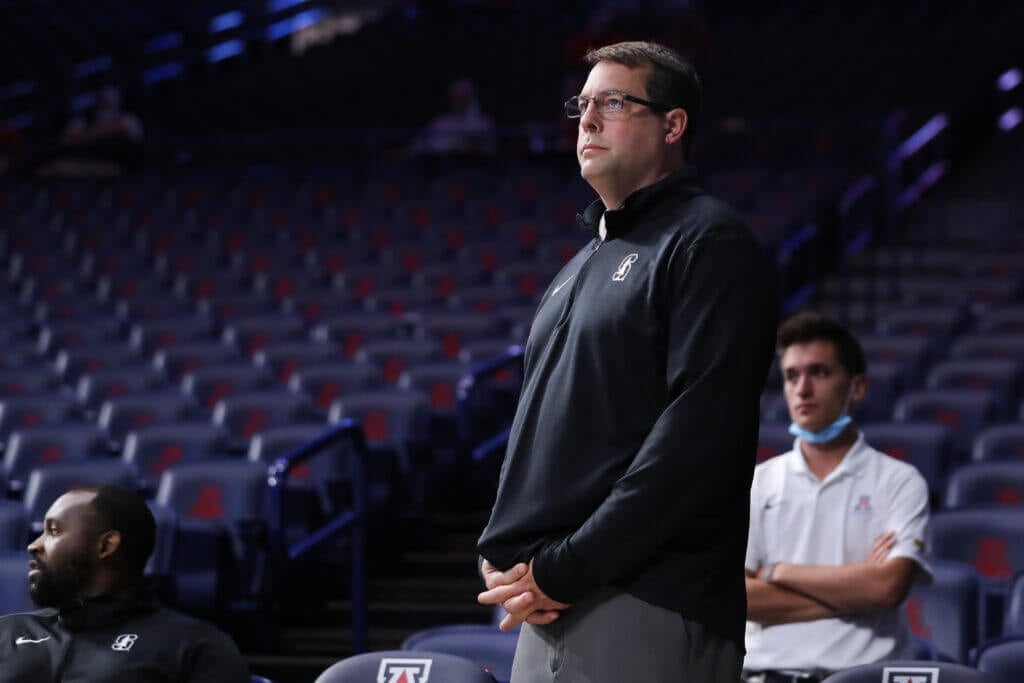
PALO ALTO, Calif. — Jerod Haase has a thing for clever clichés and corny aphorisms, so it’s no surprise he’s a fan of the hit show “Ted Lasso.” Unlike most of the people who watch that show, Haase has a team of his own, and just like Lasso’s fictitious AFC Richmond, Haase’s Stanford basketball program has faced its share of adversity of late. In a desire to keep his players optimistic, Haase has borrowed from the Lasso playbook and affixed signs with the word “Believe!” all over the place — offices, locker rooms, weight rooms, film rooms. He even puts it on their bag tags when they travel and hangs signs in the locker room for road games. For the last two years, each time Stanford breaks its huddle, Haase says “We …” and his players respond by shouting, “Believe!” You have to see it before you can do it, the thinking goes, so Haase wants his guys to see — and say — that word as much as possible.
“Philosophically, I’m probably a little bit odd,” Haase explains. He is sitting in his office, just a few feet from where a “Believe!” sign is taped to the inside of his door. “I want to win as much as anybody, but I’m not willing to sacrifice and take shortcuts to get it done. I believe in the process. I believe in doing the little things. I believe in the ethics and morals. We’re trying to live by those things, and I believe if you do them over and over, the results will get here.”
Would that Stanford basketball fans had the memory of a goldfish. Haase, 48, can wax poetic all he wants about the beauty of the process, but he is acutely aware that at some point, he needs to produce results. That point has arrived. Haase is entering his seventh season in Palo Alto, and he has yet to coach the Cardinal in the NCAA Tournament. Most power conference schools wouldn’t keep coaches around that long with so little to show for it, but Haase is fortunate to work at a place that shares his beliefs about the importance of doing things a certain way, the right way — the Stanford Way. The challenges of coaching at one of the world’s most prestigious private universities are well-known, but Stanford has won big before. Beginning in 1995, the Cardinal went to the NCAA Tournament 13 times in 14 years, and in 1998 coach Mike Montgomery led them to the Final Four. Over the last 14 years, however, Haase and his predecessor, Johnny Dawkins, took the team to just one NCAA Tournament, and none since 2014. That’s the second-longest drought in the Pac-12 behind Washington State. Haase’s teams are 52-60 in Pac-12 play, and they finished higher than sixth just once.
Haase has faced a wide array of challenges that were not of his own making, but his teams have shown a troubling tendency to falter down the stretch. Such was the case again last season, when the Cardinal lost eight of their last 10 games and finished ninth in the Pac-12 with an 8-12 record (16-16 overall). Not surprisingly, all this losing has fostered great apathy. Maples Pavilion used to be one of the most rocking home courts out west, but last season’s average home attendance of 2,360 was by far the lowest in the conference.
Shortly after Stanford’s season ended with a loss to Arizona in the Pac-12 tournament, athletic director Bernard Muir pulled Haase aside and let him know the school would be putting out a statement on his behalf. “Fan bases get anxious and people start speculating, so I just wanted to let everybody know that we support Jerod and we know this is a long-term thing,” Muir says. According to Haase, it was the only time all season he had discussed his job status with Muir. The endorsement helped, but it was hardly ringing. “Coach Haase and I agree that the on-court results of our men’s basketball program are not what we want them to be,” the statement read. “Having said that, I believe that the young nucleus of talent on our team and promising recruiting will propel us to take the next steps we all desire while our program continues to operate with great integrity and achieve the highest levels of academic excellence.”
Neither Muir nor anyone else at Stanford has told Haase he has to make the tournament this year, but that is a reasonable expectation given that the Cardinal returned eight of their top nine players. That includes 6-8 sophomore forward Harrison Ingram, a former McDonald’s All-American from Dallas who was named Pac-12 Freshman of the Year. Ingram put his name in the NBA Draft and was invited to the league’s pre-draft combine, but decided to return. To this mix, Haase has added 6-5 redshirt senior guard Michael Jones, the first graduate transfer in school history. Jones shot 40.3 percent from 3 during his three seasons at Davidson, and he had 31 points in the Cardinal’s 88-78 season-opening win over Pacific on Monday. Haase evinced his own belief in this team by putting together a rigorous nonconference schedule, which includes a game Friday against Wisconsin in Milwaukee.
The win over Pacific was nice, but it wasn’t the program’s biggest victory that day. Ninety minutes after the game ended, Andrej Stojakovic, a 6-6 guard from Carmichael, Calif., announced he had chosen the Cardinal over Oregon, Texas and UCLA. The son of former NBA All-Star Peja, Andrej is ranked No. 21 in the 247Sports Composite, and he joins a freshman class that already included Kanaan Carlyle, a 6-2 guard from Georgia who’s ranked 26th in the 247Sports Composite. Stojakovic has heard all the chatter about Haase’s job security, but the coach convinced him that if he came to Palo Alto, he would have the opportunity to play major minutes and get a world-class education. “If I didn’t believe in his future, I wouldn’t have chosen Stanford,” Stojakovic says.
Just a little taste of what you can expect from the newest Card 🌲#GoStanford x @AndrejSto2 pic.twitter.com/RSewvCvguP
— Stanford Men’s Basketball (@StanfordMBB) November 10, 2022
After putting a team on the floor last season that was ranked No. 315 nationally in experience, per KenPom, Haase now has a roster comprised of one fifth-year senior, two seniors, four juniors, four sophomores and three freshmen. The upperclassmen will get the bulk of the minutes. That is an unconventional template in today’s transfer-mad culture, but it has the chance to be not only successful but sustainable, especially with two five-star recruits on the way. Haase is fortunate to be coaching at a school that has shown remarkable patience, but he knows full well that that is a finite resource. “Everybody talks about doing things the right way,” he says. “Stanford not only talks about that, they really believe in it. But I understand this is big-time college basketball. We do need to win.”
Just like every staff around the country, the Stanford coaches spent countless hours last March scavenging through the NCAA’s transfer portal. This would seem to be a fool’s errand considering Haase had never landed a transfer, but they figured it was worth a shot. As the coaches locked in on Jones, they were taken by his long-range shooting, and were impressed to learn he was a straight-A student at Davidson with degrees in economics and mathematics. Though schools like Alabama, Clemson and Northwestern were also pursuing him, Jones expressed an interest in coming to Stanford to pursue a master’s degree in statistics. “This is a once-in-a-lifetime type of place,” he says. “At some point, I’m going to be living my life after playing basketball. It’s never bad to have a Stanford degree on your resume.”
Unlike undergraduate admissions, Stanford’s graduate programs make their own decisions about whom to admit. Not only are the standards high, but applications are normally submitted in December. Jones did not become available until March, yet somehow, some way, he got admitted. “I’m shocked he’s here,” Haase says. “We were able to get all the stars to align.”
Jones’ arrival in Palo Alto wasn’t just the result of a cosmic convergence. No one is saying Stanford lowered its standards or altered its process in a major (and unethical) way, but when a school accepts an application in March, admits its first-ever men’s basketball grad transfer in May, and then said transfer goes out and scores 31 in his first game, it doesn’t require a Stanford degree to intuit there’s probably some intentionality at work. “Our academic prowess is not going to take a step back, but we understand where the game is going,” Muir says. “We’re working with the university to navigate this as best we can.”
It would be an even bigger help if Stanford found a way to tap into the bountiful undergraduate transfer market. This is no easy task considering the university only admits 40 to 50 each year, and no student can transfer in after their sophomore year. Haase could be forgiven if he gets chagrined seeing some of his coaching brethren add a half-dozen or more transfers in a single cycle, but to paraphrase Hyman Roth in “The Godfather,” this is the school he has chosen. “I’m hopeful and confident that there will be another grad transfer or transfer in the future,” he says. “But it is not our bread and butter, and I don’t want it to be our bread and butter.”
Haase has been able to bring in the occasional international player — Maxime Raynaud, a 7-1 sophomore forward from France, had 22 points and nine rebounds in the opener — but his main source of talent is the old-fashioned high school pipeline. Haase remains convinced that he can recruit players who are good enough to make his formula work, and his commitments from Carlyle and Stojakovic (and Ingram and 2020 five-star recruit Ziaire Williams before that) bear that out. “We can go toe to toe with anybody when it comes to recruiting,” he says. “We do talk about the dream of going to the NBA, but that’s not the only dream when you come here. It works with the right parents, and it works with the right basketball player.”
The flip side to the transfer conundrum is that Haase has only had two undergraduates transfer out. That gives him a chance to build roster stability, so long as most of his key non-seniors return. Unfortunately, the program went through a period of attrition that took a heavy toll. In 2018, Reid Travis, the team’s leading scorer and rebounder, left for Kentucky as a grad transfer. The following year, the team lost two undergrads — 6-5 freshman guard Cormac Ryan, who transferred to Notre Dame, and 6-9 sophomore forward KZ Okpala, who entered the NBA Draft. The 2019-20 squad was paced by 6-1 freshman point guard Tyrell Terry. He was ranked No. 88 in the Recruiting Services Consensus Index, so Haase reasonably expected he would play for multiple seasons. Instead, Terry became Stanford’s first one-and-done player. The second one came a year later, when Williams, a consensus top 10 prospect who was the highest-ranked recruit in school history, likewise entered the draft.
Spencer Jones, left, is Stanford’s leading returning scorer. Harrison Ingram passed up the NBA Draft to return for his sophomore season. They’re two reasons for hope the Cardinal can make the NCAA Tournament. (Kirby Lee / USA Today)
The COVID-19 pandemic was a huge challenge for every college basketball program, but it was especially problematic for Stanford. It’s possible the 2019-20 squad would have made the NCAA Tournament had it not been canceled, although a shocking loss to Cal in the quarterfinal of the Pac-12 tournament seemed to push the Cardinal on the wrong side of the bubble. Stanford started the pandemic-shortened 2020-21 season with a promising win over Alabama at the Maui Invitational in Asheville, N.C. The Cardinal lost their next two games to North Carolina and Indiana, but instead of going back to Palo Alto, they had to remain in North Carolina for several weeks because the campus had shut down. The team then spent two months living in a hotel in nearby Santa Cruz, where the Cardinal played their “home games” at Kaiser Permanente Arena. It wasn’t until February that Stanford could return to an empty Maples Pavilion. The team lost its last five games and finished 14-13.
Two of that team’s best players, 6-9 forward Oscar da Silva and 6-3 guard Daejon Davis, were seniors who could have returned because the NCAA had granted all players an extra year of eligibility due to the pandemic. Alas, neither could get into grad school. (Davis transferred to Washington; da Silva went undrafted by the NBA and is currently playing professionally in Barcelona.) That left the Cardinal with just one senior. “We got young,” Haase says. “At Stanford, that’s exactly the opposite of what you want to do.”
And yet, Haase channels his inner Ted Lasso and calls last season “maybe the most fun I’ve ever had coaching a team. Culturally, we were off the charts.” That was reflected in Ingram’s decision to return to school. Like every other player on the roster, Ingram came to Palo Alto primarily to play basketball, but the university’s sterling academic reputation was a big reason why he chose Stanford over North Carolina and Purdue. “I like to pave my own path,” he says. “If you’re supposed to be in the NBA, I feel you’ll get there eventually. Meanwhile, I’m getting the best education in the world.
Winning is fun, too, and Haase hopes there will be more of that now that he has a mature team. During Pac-12 media day, he cracked that the first day of practice was “one of the greatest days I’ve had since I’ve been the coach at Stanford” because half his team needed to shave. The Cardinal are returning a higher percentage of points, rebounds, assists and minutes than any other team in the Pac-12. That’s the good news. The bad news is, he’s out of excuses. It’s time to win.
To prepare for what’s ahead, the team spent its off-season indulging in some bonding. All the players stayed on campus over the summer, participating in rigorous conditioning workouts on the football field, practices with the coaches, afternoon games of pickup basketball, and then hanging out at night over dinners, video games, and Catan marathons. In September, Haase took everyone to Santa Cruz for a three-day retreat. He ran them through practices, invited former NFL quarterback Alex Smith to give an inspirational talk, and brought everyone onto the beach at night to cook s’mores. The hope is that all of this will lead to better chemistry on the court. “Last year we were really cliqued up,” Ingram says. “Now I might be with three people one day, and later at night I’m with three different people. I think that helps us during a game, because now when someone yells at me, I know it’s coming from a good place.”
Ever on the hunt for corny metaphors, Haase derived inspiration from a text message he recently received from David Berkun, an assistant AD. It relayed the lesson of the bamboo plant, which takes several years to develop its roots, and then sprouts some 50 feet in a few weeks. “That’s how results happen,” the text read. “Slowly and then all at once.” Haase is confident he has done the slow, hard, steady work. The question now is whether — and when — the results will happen. “We’ve built a strong foundation. We’ve got our roots,” he says. “There’s a belief in the program that we’re about to take off.”
(Top photo of Jerod Haase: Rebecca Noble / Getty Images)
[ad_2]
Source link