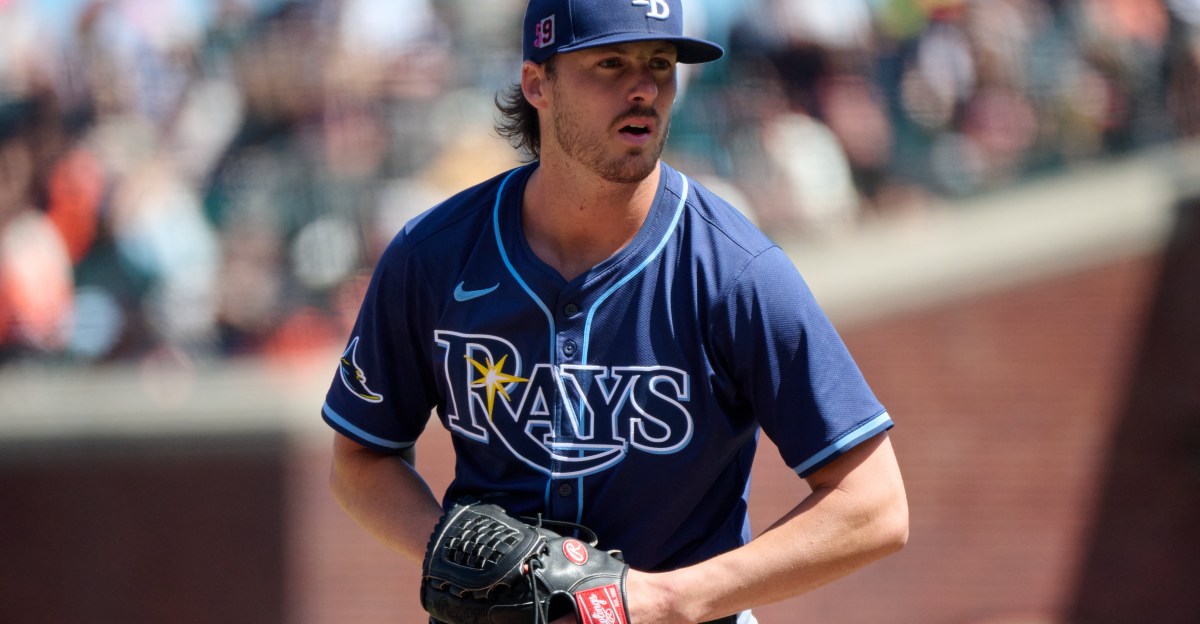
Last offseason, the Rays acquired Mason Englert from the Tigers for Drew Sommers, adding a flexible, multi-inning arm with option years. Englert fit that role well, posting solid results while working more than one inning in nearly half his appearances.
But the interesting question is whether the Rays should ask for more. Marc Topkin reported that Englert was in consideration for a rotation spot prior to bringing in Nick Martinez. Signing Martinez should not come at the expense of Englert getting stretched out.
Englert’s combination of plus strike-throwing, shape diversity, and outlier command – particularly of his change-up – gives him traits that translate beyond middle relief. With incremental adjustments already underway in, there’s a plausible path toward a back-end starter role.
A fourth-round pick in 2018, Englert lost nearly three seasons to Tommy John surgery and the pandemic but quickly established himself as a strike-throwing starter in A-ball. By 2022, his 66% strike rate and deep repertoire made him a Rule 5 target.
The Tigers followed the usual script for Rule 5 pickups who have to remain on the major league roster. They deployed him in low-leverage relief. It wasn’t a surprise that Englert didn’t immediately replicate his previous MiLB success – especially when considering he skipped AAA.
In 2024 Rule 5 no longer applied, meaning Englert could be optioned, and he appropriately spent most of the season in AAA. His production in the majors, when promoted, still wasn’t great, but it was an improvement from what he had shown in 2023.
Englert’s defining trait is strike-throwing – a skill the Rays value quite a bit.
The team helped alter Englert’s cutter shape in 2025, reducing vertical break while adding some horizontal movement. The result is a pitch with clearer separation from his four-seamer and more gyro characteristics – effectively blending his previous cutter and slider into a single, more versatile shape. The 2025 grip shows him working more around the ball (top image; index finger more on the side of the ball), compared to the more behind-the-ball grip in 2024 (bottom image; index finger more behind the ball).

Englert now throws three distinct fastball shapes – similar to the Drew Rasmussen and Shawn Armstrong molds we’ve seen in the past. Fastballs are generally the easiest shapes to command, but tend to not generate as many whiffs, so it makes sense that Englert has become more of a contact manager with this adjustment. The rest of his arsenal remains largely unchanged. Any subtle differences in shapes could be attributed to his arm slot shifting from 33 degrees in 2024 to 40 degrees in 2025.
The other change to Englert’s arsenal when he joined the Rays was that he added a larger breaking ball shape. Though used sparingly (8%), the addition hints at preparation for a starter or bulk role in 2026. This upper 70s breaking ball gives him a third distinct velocity band in his arsenal; his four-seamer and two-seamer sit low 90s while his offspeed pitch and cutter sit in the upper 80s. Multiple shapes and velocity bands give him different looks the second and third time through a lineup.
While it may lack significant velocity or VAA separation from his fastball that you’d typically want, Englert’s best pitch is his change-up. He might have 70 grade command of it. Many pitchers have a single, general intended location for each of their pitches, but Englert is actually able to locate his change-up to two distinct locations depending on the batter’s handedness. Below is his heatmap of the pitch against RHB last season:


While this pitch doesn’t have any physical outlier traits in movement or how it interacts with his fastball, his command of it is an outlier. It’s clear why he feels so comfortable throwing the pitch to righties just as much as lefties.
The obvious objection to Englert moving to the rotation is that he doesn’t miss enough bats to profile as a traditional starter. His velocity sits in the low 90s, and his whiff rates have been modest. But the Rays have repeatedly shown they value shape diversity and command over pure velocity. Starting isn’t only about overpowering hitters; it’s about sequencing, disrupting timing, and navigating a lineup. Englert’s arsenal gives him tools to do exactly that.
Given his command, shape diversity, and developmental runway, the Rays have little to lose by stretching him out. He has distinct attack plans for both LHB and RHB, with enough shapes to vary sequencing multiple times through a lineup. He may not immediately crack the major league rotation, and he’s in his final option year so there’s some flexibility with how he could be used between AAA and the majors. The Rays don’t need Mason Englert to become a frontline starter. They just need to find out if there’s more here than middle relief, and the evidence suggests it’s worth asking the question.