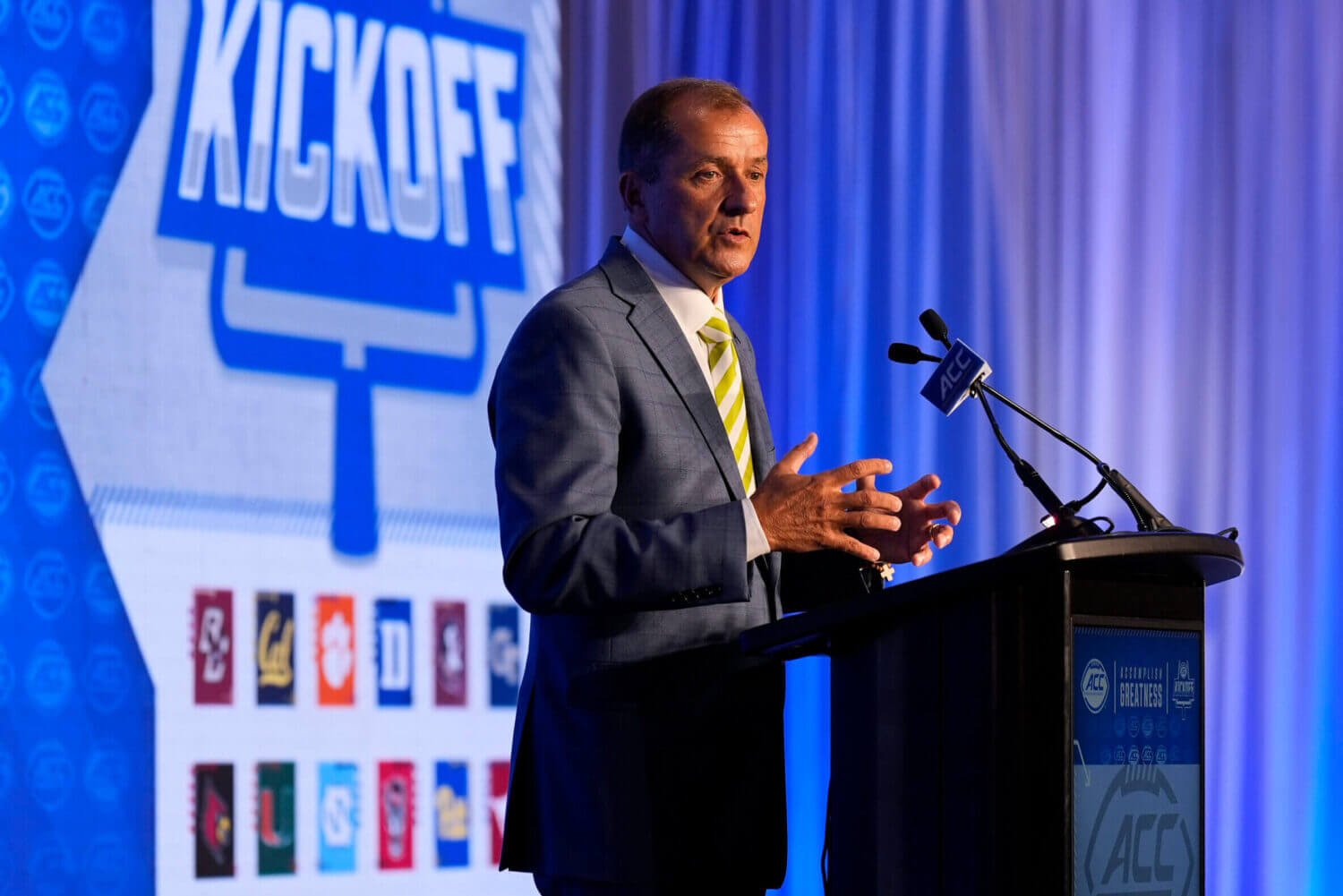
CHARLOTTE, N.C. — With the ACC mired in four different lawsuits in three separate states — all of them concerning the league’s preeminent football powerhouses, Florida State and Clemson, and their desire to get out of the conference’s current grant of rights — commissioner Jim Phillips doubled down on the league’s position on the first day of ACC media days.
“Every member of this conference willingly signed the grant of rights and quite frankly, eagerly agreed to this television contract,” Phillips said Monday during his opening remarks.
“Either you believe in what’s been signed, or you don’t,” he added during a subsequent question-and-answer session. “This conference is bigger than any one school, or schools.”
Florida State and Clemson’s desire to exit the ACC is, like nearly everything in modern college athletics, financially motivated. According to recent tax filings, the league distributed a record average of $44.8 million per school in 2022-23, most of which stems from the ACC’s current television deal with ESPN — but that figure still lagged behind annual distributions for both the Big Ten ($60.2 million) and SEC ($51.2 million).
With recent conference realignment moves finally taking effect this athletic year — namely, Oklahoma and Texas joining the SEC, and USC, UCLA, Oregon and Washington joining the Big Ten — that revenue disparity only figures to grow as new, lucrative television contracts for the Big Ten and SEC take full effect. The ACC’s grant of rights, meanwhile, locks the league into its present deal through 2036. Even the ACC’s third-place finish among average conference distributions isn’t safe, with the Big 12 — which distributed an average of $44.2 million per school in 2022-23 — adding Arizona, Arizona State, Colorado, and Utah for the coming athletic year.
That growing revenue gap is at the crux of what the ACC’s last two national championship-winning football programs are arguing in court: that the financial disadvantage of remaining in the ACC will, in the immediate future, become prohibitive to competing at the highest level of the sport.
Phillips confronted that idea head-on Monday, saying that “we will fight to protect the ACC and our members for as long as it takes.”
“These disputes continue to be extremely damaging, disruptive and incredibly harmful to the league,” he said. “The ACC deserves better.”
Phillips also defended oft-criticized former commissioner John Swofford — under whose leadership the ACC locked in its current TV deal — and warned against personal attacks on all fronts. “This thing doesn’t have to be evil,” he said.
In addition to discussing the ongoing lawsuits directly — two of which are taking place in North Carolina, plus one in Florida and one in South Carolina — Phillips was asked about options the league is exploring to close that revenue gap, especially two potential routes that other conferences are reportedly investigating: selling the league’s naming rights and allowing private equity firms to provide a financial buoy. The commissioner declined to provide specifics of conversations he’s had with fellow ACC officials but also didn’t deny that everything is on the table.
“I wouldn’t be doing my job if we aren’t exploring every area that’s available,” Phillips said. “I would just say we are (looking), and we have continued to look, at all options as it relates to revenue.”
Those discussions are taking place on top of the league introducing a “success initiative” in the coming athletic year, the first time in power-conference history that a league has implemented unequal revenue distributions. Phillips confirmed that schools can earn up to $20-25 million based on exceptional performance, including College Football Playoff appearances, participation in bowl games, Top 25 finishes and making (and advancing in) the men’s NCAA Tournament.
“That was something that we wanted to do, I felt like we needed to do,” Phillips said. “As we walk through it, it will reward the teams that have the most success. It’s not an absolute correlation, but those that invest more have a higher chance to have success.”
(Photo: Jim Dedmon / n-USA Today)