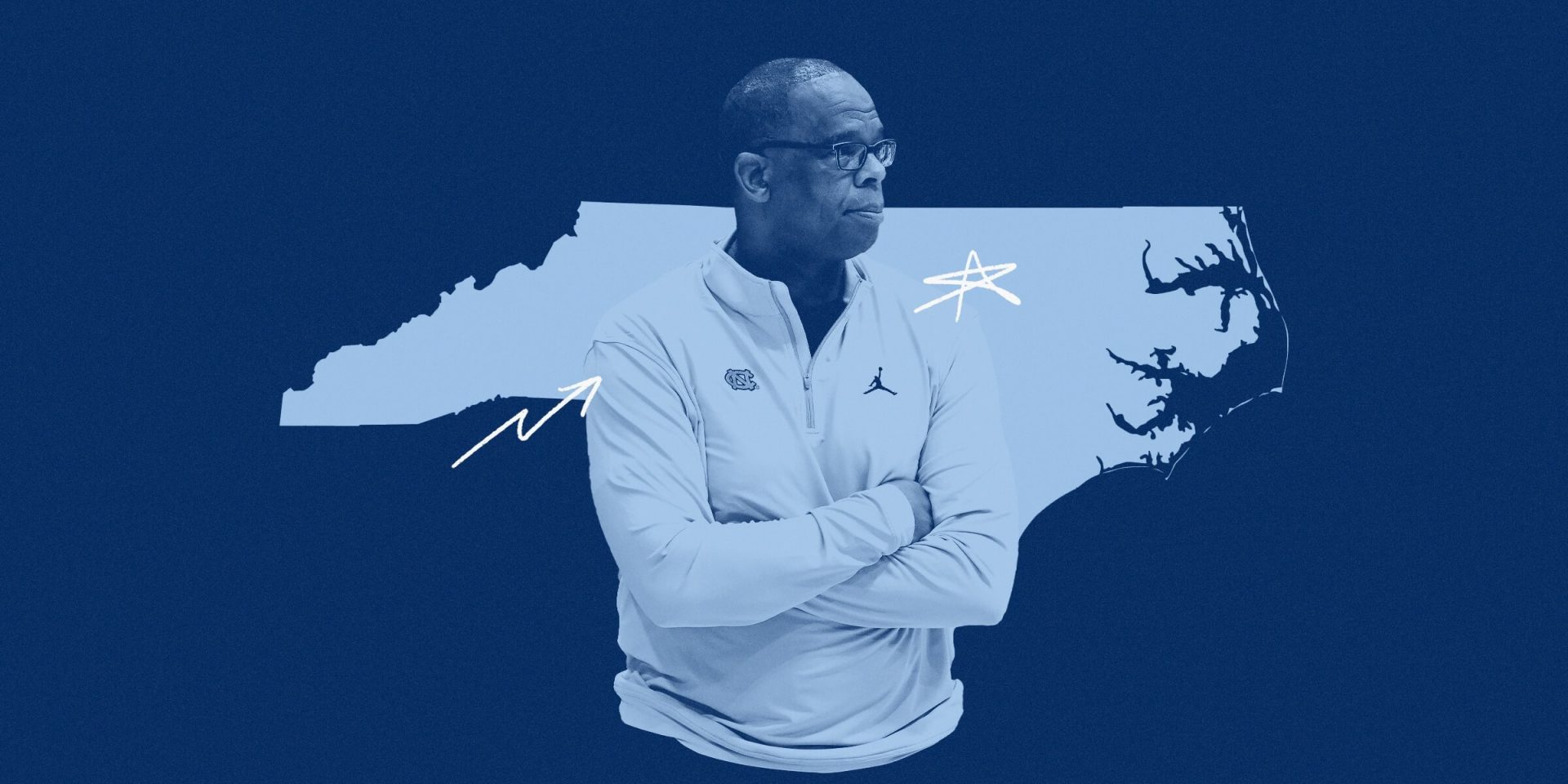
CHAPEL HILL, N.C. — Nine words. That’s all Tracy Wolfson got out:
Coach, how would you assess what you’ve seen from …
And then, boom, verbal dynamite, stopping her dead in her tracks. Hubert Davis is hoarse, but man is he hollering. “Pretty fun game, isn’t it?” the North Carolina head coach calls out. (An apt observation, midway through the national championship game against Kansas.) Then, a second later, the line that’s lingered since April: “It’s live action, Tracy! It’s live action out there!”
Wolfson’s reaction? The same as anyone else watching, be it in a Chapel Hill sports bar or courtside in the Caesars Superdome: shock. “Did not expect to see that out of him,” Wolfson says now, chuckling as she recalls the viral moment. “I never saw that energy from him in one of our (pregame) meetings.” Nor had North Carolina fans during the first six months of Davis’ tenure.
Because, on a day-to-day basis, Davis isn’t that worked up. What Wolfson saw in her week-of conversations with Davis, what she heard in phone calls with his friends, was a common characterization of the man: how gentle he is. There’s a golly-gee-whiz gusto about him. “Always calm, cool and collected,” Wolfson adds. “The kindest guy that you could be around.” Assistant coach Jeff Lebo, who played alongside Davis for a season at UNC, says he used to call Davis just to chat — and frequently hit him while Davis was cutting his lawn, riding around on his motorized mower. “Just a regular guy,” Lebo jokes. Davis says this summer, in his pockets of down time, you could find him lounging by the pool with his wife, Leslie, or taking his kids fishing or tubing on nearby Lake Jordan. The man never curses, same as his old college coach, and giggles hysterically at just about any joke. Roy Williams, Davis’ predecessor who has known him since high school, doubles down on Wolfson’s sentiment, but with a much broader frame of reference: “Absolutely the nicest person I’ve ever known.”
That is the Hubert Davis we all know. Mostly from seven public-facing years as an ESPN analyst, but also from nine seasons as Williams’ assistant. But here’s the thing: Just because we didn’t see the demanding, “Live Action” side of Davis’ personality … doesn’t mean it wasn’t there. Because it always has been, if you ask folks closest to the 52-year-old. UNC director of recruiting Pat Sullivan saw that side firsthand when they were Tar Heel teammates. “He was the talking junk guy, you know, but on the rated-G variety,” Sullivan says. “It would almost make you more mad.” Assistant Sean May, the 2005 Final Four MOP, remembers the first time he saw Davis’ “button get pushed” in practice last summer, a month or two after he’d gotten the job. Guys weren’t listening, or weren’t playing hard enough — Davis’ top trigger, his staff agrees — and his resulting rip into the team so changed the intensity of practice that even May stood up a little more, “kinda on my toes.”
Usually, the aftershock of these outbursts is Davis pacing by himself, symbolic smoke still steaming out of his ears. That’s the competitive streak Davis usually keeps contained, only letting it out inside the lines.
“When I tell the guys there’s a level of intensity and energy and effort and passion that you have to bring every day, then if I don’t bring it, then what am I talking about?” Davis tells The Athletic. “So if I’m gonna say something, I like to back it up with action.”
“Live action” was our window into that side of Davis’ persona. And, in hindsight, it provided an explanation for how Davis took a team teetering on the edge in late January, and turned it into one with teeth, with toughness. You don’t get ferocious fireworks out of nowhere in March and April; that’s only after extended exposure to a steady flame. “He wants us to adapt to his mindset, and that’s to always be the aggressor, always throw the first punch,” says junior guard R.J. Davis. “What more could you ask for? You see a coach that passionate on the sideline — getting down in a defensive stance, throwing fist bumps in the air — that gets you going.”
But it took time for Davis’ players to figure out his duality — and even with the nation’s No. 1 team right now, it remains a work in progress. That said, a calendar year and change since Davis took over as the face of the program, one thing is certain:
His way — tweaking Tar Heel tradition with his temperament — works.
“That’s all I know how to be,” Davis says.
It feels forever ago now, but before this spring’s postseason run covered the program in a rose-colored haze, there were serious doubts about Davis. Sure, he’d succeeded every step of his career — leading scorer on a Final Four team, first-round pick by the New York Knicks, 12 seasons in the NBA, big-time basketball analyst for ESPN — but folks focused more on what he didn’t have: a long coaching CV. Nine years on Williams’ bench, including several seasons running UNC’s junior varsity program, were not, in the eyes of public opinion, on par with a job of North Carolina’s pedigree. Davis had to prove himself before he earned serious staying power.
Which is why, five games into his tenure, you felt tremors of trepidation rippling through the fan base. The Hall of Fame Tip-Off at Mohegan Sun was not kind to Davis’ Tar Heels: two losses, and too little fight on the court. The second game of the event, against Tennessee, was especially egregious. Allowing 21 layups to the Volunteers, who shot 65 percent in the second half? Not many players shoot that superbly in an open gym, Davis said that day, less against an actual opponent.
For fans less concerned about keeping it in the family, who wanted someone more seasoned to succeed Williams — a Mark Few, a Scott Drew — or who were worried Davis’ too-nice demeanor would be detrimental, what played out in that Connecticut casino was fuel to the fire.
“I was a little stunned myself,” says assistant coach Brad Frederick. “I knew that there would be people that were critical of him being named the head coach; I guess I just didn’t expect how quickly everyone turned, you know? Like, one loss, and all of a sudden he’s the wrong guy.”
Even Williams, sitting courtside with three buddies, heard those criticisms, worries about the season slipping away. Williams tried reassuring them: “We had the parts,” he remembers saying, “and Hubert was gonna be tough enough — and stubborn enough — to get them to conform.” Their response?
“My buddies thought I was daggum crazy,” Williams says, laughing. “An absolute idiot.”
What they — and every baby-blue-clad critic — failed to see, or understand, is that these things take time. Williams’ inaugural season at KU in 1988-89, with plenty of parts back from the prior season’s national title team, went 19-12 and finished with a losing conference record. Dean Smith, another Carolina assistant who slid over a seat to the head coach’s chair, had only one losing season in almost four decades — his first. “When you go from an assistant that everybody loves to the head coach, who’s making decisions on playing time and all that,” Williams says, “sometimes that transition is hard, just for that reason right there.” Not only that, but Davis brought in two new assistants, Lebo and Sullivan, upon earning the job. He tweaked how the Tar Heels have traditionally played — shifting away from the secondary break to a more modern, four-out, spacing-based offense — despite every Carolina coach since Smith running the old system. “Takes a lot of courage,” Sullivan says, “to do something like that.” The whole situation was like breaking in a new pair of sneakers: somewhat stiff at first, before you settle in.
“There was a lot of newness,” Davis says. “In any new situation, it takes time to grow. It takes time to learn. It takes time to develop a chemistry, and I just think it was just the natural progression of us continuing to grow.”
Hubert Davis built bonds with players like Armando Bacot with a personal touch. (Bob Donnan / USA Today)
The inflection point was invisible. It was a subtle shift, slower, honed through hundreds of hours spent together. Some of that quality time can be attributed to a quota Davis set: Players had to visit his office, and his staff’s, at least three times weekly. “Mainly he’d just ask me what I’m doing with school, and then we’ll just talk about family,” says star big man Armando Bacot, “or I’ll joke on him about something he’s wearing. Things like that.” Nothing groundbreaking, but granular. Personal things. The kinds that form fuller, deeper relationships.
Because Davis, who writes “help and encourage” on each day’s practice plan, also understood this: Relationships, even at the highest level of college basketball, are two-way streets. Sure, his players had to adjust to his temperament, his offense, his non-negotiables — but he had to change, too, to learn what made them tick.
Against Baylor in the NCAA Tournament, when Brady Manek was ejected and it took the Tar Heels until overtime to knock off the reigning champs, Davis entered a postgame locker room less positive than he was expecting. “I thought the guys were gonna be going crazy,” Davis says. “They were excited, but it wasn’t nearly to the extent that I thought they would be.” So, he asked. What’s up? As it turned out, the team misunderstood NCAA rules, thinking Manek would now miss their Sweet 16 matchup. Even as the team fought off Baylor, in the back of their collective minds, that was bumming them out. “They felt horrible and sad for him,” Davis recalls. “I told them, ‘Guys, no no no no no, he can play next week’ — and then they started going crazy.” Davis, as much as at any point last season, was struck by the significance of that: “I just thought, wow, man. We’re a team.” He even pauses re-telling that story, soaking in the moment all over again.
But as far as favorite memories go, there’s an easy one Davis points to: the first collective testimony of his head coaching career, the win over Duke at Cameron Indoor. The win, which solidified North Carolina’s NCAA Tournament bid, was momentous in itself. But Davis’ mind goes to after the game, when he paced in the hallway outside the locker room, ruminating on his thoughts — and out of nowhere came Bacot, and then Manek, and then Leaky Black, a train of teary-eyed Tar Heels trapping their head coach in a big ol’ bear hug. “I felt like, for the first moment,” Davis says, “the guys got it.” Then came the best part: the bus ride down U.S. 15-501, straight to Franklin Street. By the time the team charter actually arrived in Chapel Hill, the street was already flooded with fans and celebratory fires. Their bus even had to stop an intersection short. “Just a sea of people,” Lebo says. “For those kids to see it, to get a little taste of North Carolina basketball, was priceless, really.”
And once they had that taste, they wanted more. They started realizing, in real-time, how exactly Davis went from someone Smith hesitated to offer a scholarship to a longtime NBA starter, how he would dive for loose balls and fought against his physical limitations to stand out defensively. Davis implemented more “floppy” actions into the offense, a favorite of his as a player. Accordingly, Manek morphed into a flamethrower as the calendar hit March; he finished his only season at UNC making 2.5 3-point attempts per game (as a senior in 1991-92, Davis made 2.6). The first-timer never let up coaching them, either, a trait Williams says he always appreciated — as did the program’s most famous player. “Michael Jordan and I,” Williams says, “even talked about the passion that he had for it.” It all led to the Tar Heels becoming offensive juggernauts, and much more detail-oriented defensively.
By the time the team was on the brink of reaching the Final Four, with only Saint Peter’s standing in its way, the shift had become so clear to May that he didn’t hesitate sharing with Davis in a pregame conversation. “Well,” May told him, “the good thing about it is the team has your personality.”
On the floor in Philadelphia, Davis paused.
“It was the first time, when he said it,” Davis adds, “that I was like, they do.”
Freshly-paved walkways run parallel through the Old Chapel Hill Cemetery on the corner of campus, right across the road from Carmichael Arena. But to get where Davis is going, you have to stray off those straight-edge paths, wander into the pine straw and around piles of fallen leaves. But once you see it, you can’t miss it: the headstone, shaped like an open book, and Carolina-blue-painted seashells leaning alongside it. One of those shells, in thin white writing, confirms the correct destination: DEAN.
Davis still comes here once a month at least, he says, to visit Smith and Bill Guthridge, Smith’s longtime assistant, and whose ashes were scattered in the adjacent University Memorial Grove. Sometimes, when he has time, Davis will sit on the small stone ledge circling Smith’s gravesite, “to talk to them.”
“Everything that I do,” he posits, “is filtered through, what do I think those two would do?”
This is a Carolina tradition: Williams once went through the same mental exercise, and so too do Davis’ assistants. That Davis feels so deeply compelled to come here with such regularity explains why a year into the job, he feels such comfort. He is tied to this place, and has been since Smith welcomed him to campus as a gangly teenager. He never left. Met his wife here, kept a house here in the NBA offseason. Heck, that’s how he and Williams first got close. When the latter returned to UNC in 2003, the former was on the tail end of his playing career. But Williams invited Davis (and King Rice, then between college coaching jobs) to come practice with his team that summer. “I loved the way he competed and did the little things, like getting our hand up on the ball and talking on defense,” Williams says. “Because of that relationship, and how I think they helped our team, I followed Hubert even more when he was on ESPN.” Then through the screen, and by virtue of watching Davis’ analysis, Williams became even more enamored with him. “Didn’t sugarcoat it, told the truth,” Williams adds, “but didn’t act like he had to be a rocket scientist to figure it out.”
In 2012, when Jerod Haase left Williams’ bench to become UAB’s head coach, Williams didn’t hesitate to call Davis. “He thought I was gonna get him to try to move his summer camp,” Williams says. “I said, no, I’m really gonna change your life.” The bond they built over the next nine years is why, although Williams says he had two other names in mind of capable candidates to succeed him, “I didn’t even talk to them; it was gonna be Hubert’s job if Hubert wanted the job.” And boy, did he.
Now, in the past — not at North Carolina, but other schools — some departed coaches have lingered. Hung around too long, gotten in the way. After Gene Bartow succeeded John Wooden at UCLA, the two shared one office space … with Wooden answering the phone: Coach Bartow’s office? John Thompson Jr. sat in the back of the room during his son John Thompson III’s Georgetown press conferences — occasionally even blurting out answers to questions directed at his kid. Jim Calhoun retired as Connecticut’s head coach in 2012, but when the Huskies made the Final Four two years later under Kevin Ollie, Calhoun not only attended but held court with the media, same as he used to. Williams was petrified of following in those footsteps, wanting to support Davis and his alma mater without smothering either.
“Just scared me to death, and it dominated my entire year,” Williams says.
Some sort of awkwardness was to be expected. But Williams and Davis, relying on their relationship, made it as seamless as possible — and took a lesson from UNC’s past in the process. Neither was around the program when Smith abruptly retired a month before the 1997-98 season, but they heard the stories: How Smith maintained his old office, and Guthridge stayed in the one he’d had as an assistant. “We saw Coach Smith almost every day,” says Frederick, a member of Smith’s last squad and Guthridge’s first. Eventually, Smith moved into an office away from the rest of the coaches, down near the court and the locker rooms. “I vividly remember when I played,” May adds, “Coach Smith sitting over there, taking notes during practice.” It’s not an easy balance to strike, but Smith and Guthridge — and later Smith and Williams — made it work.
So last summer, and into the season, Williams and Davis did their own version of that delicate dance. Davis intentionally wanted Williams’ office in the same area as his staff’s, rather than banishing him to some far-off basement. The pair spoke regularly last season, and still do, and Williams attends practice every now and again. “I see Coach Williams all the time,” Davis says. But with Williams in the process of selling his Chapel Hill home, and Davis thick into his second season, any perceived overlap of their eras has faded. “I think he’s feeling more ownership,” Williams says. “But from the first day, I just loved what he did. And I thought that he was and is the — capital T, capital H, capital E — perfect coach for the University of North Carolina.”
Put that all together — on-court success, stemming from Davis’ demands; better, deeper relationships, with newness no longer an issue; and a powerful passion borne from a shared love of this program — and it becomes obvious why Davis has more oversight now, a clearer sense of comfort.
How could he not?
“This year, they have a clear understanding of where I’m coming from on everything,” Davis says. “We’re all on the same page.”
The critics are gone. They always wanted to believe, anyways. The same guys who were so concerned at Mohegan Sun in November? They told Williams in New Orleans in April that after he admonished them for doubting Davis, they went to the sportsbook and put $200 on North Carolina to win it all. At 95-to-1 odds, it would’ve been one hell of a payout: roughly $19,000.
Their consolation prize, though? Actually, it might be better than all that cash:
Knowing North Carolina has the right coach, for the long haul.
(Illustration: Sean Reilly / The Athletic; Photo: Grant Halverson / Getty Images)