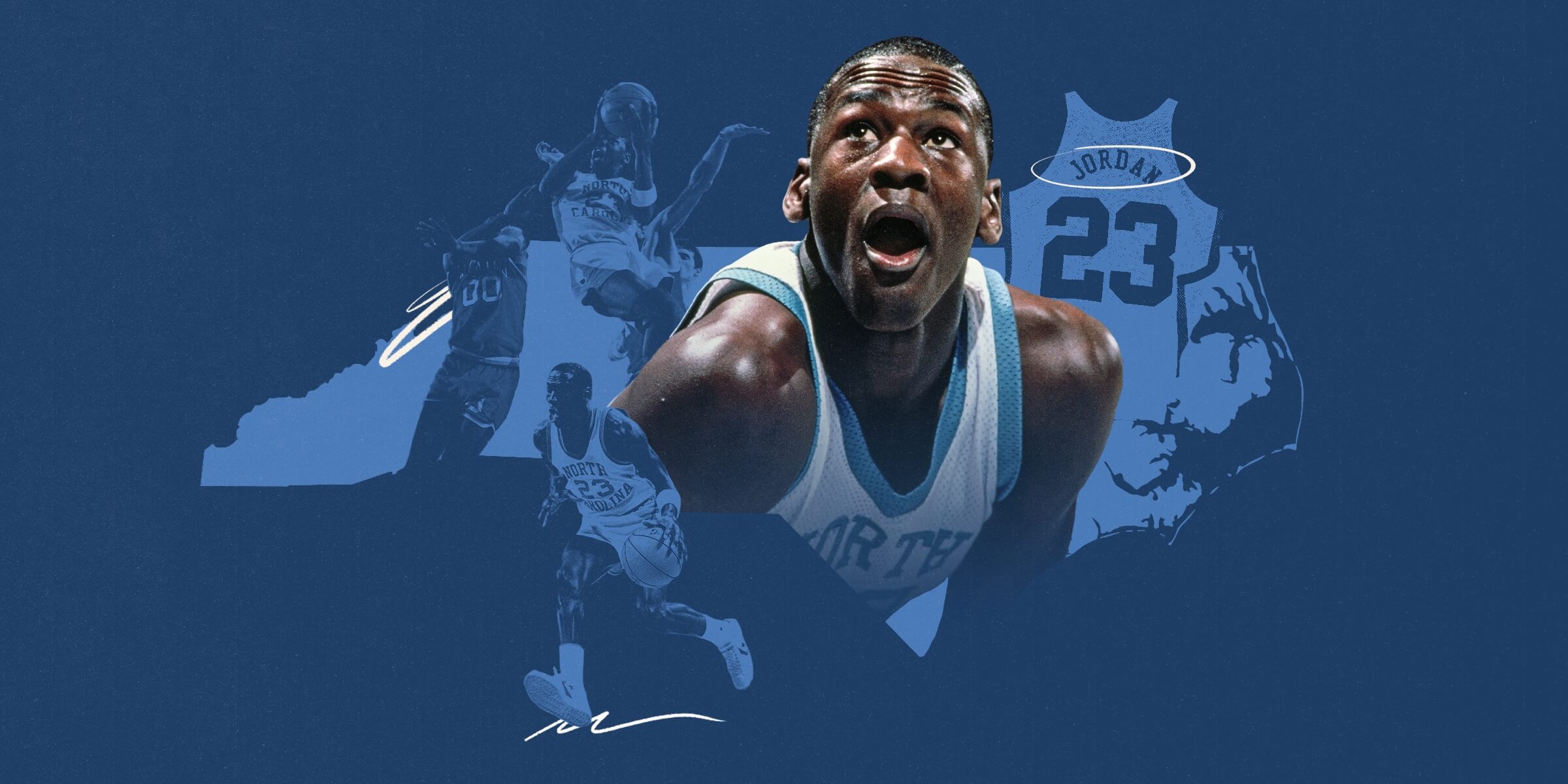
CHAPEL HILL, N.C. — When Roy Williams abruptly retired in April 2021, Bubba Cunningham knew finding his successor wouldn’t be easy.
Nor would it be the athletic director’s hire to make alone. Williams, of course, had thoughts on who should be North Carolina’s next head coach — he advocated for his longtime assistant, Hubert Davis, who ultimately was promoted — but so too did school administrators, key boosters, and high-profile alumni … including one in particular whom Cunningham knew he needed to reach out to.
Michael Jordan.
“I called him after Roy announced his retirement and wanted his advice and thoughts on where we should go next,” Cunningham tells The Athletic. “He was gracious enough to give me his ideas and thoughts, and we had a couple of calls as the process went along. So he’s deeply invested.”
Cunningham describes Jordan, North Carolina’s most iconic alumnus, as more acquaintance than friend, but notes that the five-time NBA MVP has been a resource for him since he took the job in Chapel Hill in 2011. (Their relationship actually predates Cunningham’s hiring; when Jordan was starring with the Chicago Bulls in the late 1980s and 1990s, he sometimes played golf with Cunningham, a former Notre Dame golfer still working for his alma mater in nearby South Bend). And while that’s just one example of how Jordan’s presence lingers on his old college campus, it’s far from the only way.
In fact, whether it’s speaking directly with current players or facilitating the university’s partnership with Jordan Brand, His Airness’ legacy in Chapel Hill is more than just alive and well — it’s still actively growing.
“Everyone wants to wear the Carolina blue and be like Mike,” says Basia Wojcik, vice president of sports for The Marketing Arm, “and that’s not changing anytime soon.”
Case in point? On Wednesday night, North Carolina takes on Michigan in the inaugural Jumpman Invitational in Charlotte — aka, when Jordan’s former team plays in a tournament bearing his namesake, in the building where his NBA team now plays. That perfect confluence is proof that even four decades after Jordan’s game-winner against Georgetown in the 1982 national title, you can’t tell the story of UNC basketball without gratuitous mention of the G.O.A.T. Few know that better than Davis, the second-year UNC coach who played against and alongside Jordan during his own 12-year NBA career.
“I was so happy for ‘The Last Dance,’ because these guys could actually see,” Davis says, referencing the 2020 ESPN documentary on Jordan. “I can’t tell you how many of the guys came back and went, he was that good. I’m like, I’m telling you guys! I know that. I’m telling you: He was the best ever.”
The brain trust, so to speak, was huddled in the hallway.
It was 2016, minutes after North Carolina’s last-second loss to Villanova in the national championship game. Kris Jenkins’ buzzer-beating 3 was on replay in every Tar Heel’s mind, the agony of coming up seconds short of a seventh national championship banner. Inside the UNC locker room, players sobbed, tears soaking their trademark blue uniforms. Just outside, in the hallway, were the adults: Williams, Davis, Cunningham, the rest of UNC’s staff … and Jordan, who had made the journey to Houston to support his alma mater. Eventually, Williams asked Jordan — whom he recruited to North Carolina as an assistant under Dean Smith — if he’d mind saying a few words to his heartbroken team.
“I wasn’t actually in the locker room because I was in the hallway bawling crying,” Davis says, “but I knew that it meant a lot to Marcus Paige and Brice Johnson and all those guys on that ’16 team for him to be there.”
No message of consolation was going to make up for not winning the title, but hearing it from someone with Jordan’s resume at least softened the sting a little.
“He’s been in that crucible so many times, and he’s won most of them — he’s lost some — but he knew exactly what they felt,” Cunningham says. “For him to communicate his feelings and thoughts at that time is something that obviously all of us will remember forever.”
What North Carolina fans would give for Jordan to have been congratulating that team instead of consoling it. But the larger takeaway is this: Jordan, in the flesh, meeting new generations of Tar Heels who were still in diapers (or not even born) when he last suited up. It’s a massive perk no other college can compete with. Anyone can tune into Netflix and turn on “The Last Dance,” but how many people get to actually corroborate those stories with the original source?
There are limitations to Jordan’s interactions with the current squad, and not just because of his supremely stacked schedule. As Davis notes, given Jordan’s status as an NBA owner — the Charlotte Hornets don’t currently employ any Tar Heels, but may be interested in adding some via future drafts — he operates under similar NCAA restrictions as general managers. That means he’s limited in when he can attend practices, speak to players, and anything else that might be viewed as trying to get a competitive advantage at the next level. (Through a spokesperson, Jordan declined an interview request for this story).
“I’m sure he wants to be around the team and around the program a whole lot more,” Davis adds, “but because of the rules, he really can’t.” Instead, Jordan’s appearances are constricted to specific games or celebrations, like this January, when UNC honored the 1982 title team at halftime of its game against NC State.
🎥: Win Column ➡ NC State#CarolinaFamily pic.twitter.com/p1c19FqJHp
— Carolina Basketball (@UNC_Basketball) January 31, 2022
Jordan spoke to the team before that game, and the response from players was exactly what you’d expect.
“I was scared to talk to him. I didn’t want to say nothing to him,” jokes senior big man Armando Bacot. “When you see him, it doesn’t seem real. He has this aura … I mean, that’s Michael Jordan.”
Hearing Jordan’s booming voice over the Smith Center loudspeakers — “This is Carolina basketball,” he says in one promotional video — is one thing; actually standing face-to-face with him is another entirely. The value of those interactions to players, teenagers and young adults in the throngs of their formative years, is immeasurable. But knowing those interactions are possible?
Well, Davis doesn’t go door-to-door on the recruiting trail touting about Jordan’s next campus visit, but it’s something that inevitably comes up.
One example? Earlier this year, in April, before Class of 2023 forward Zayden High committed to UNC, he told a recruiting website why he’d become increasingly interested in North Carolina: “Been a dream since I was a little kid,” High said, “to even have an interest from the same school Michael Jordan went to.” (High, by the way, was born after Jordan’s final NBA season in 2002-03.)
In some ways, it’s not dissimilar to Michigan State touting Magic Johnson, or Duke and its various No. 1 NBA Draft picks, or any school that produces a high-profile superstar. But Jordan’s staying power and pedigree is unmatched, making for a recruiting pitch that only North Carolina can offer.
“When I’m going recruiting, I don’t go, ‘Hey, come to school, this is where Michael played,’” Davis says. “But all the kids, they love MJ, they love Jordans, and that’s connected to greatness. They know the impact, and they know the spotlight that Michael has, and that makes it the spotlight on this program.
“Saying that you went to school where Michael Jordan went is a big deal to kids; it still is.”
In just over six months, the story of the switch has become almost like lore.
It was halftime of North Carolina’s Sweet 16 matchup against UCLA this spring, and Caleb Love was struggling. He’d made just one of his eight shots to that point, and accordingly, the Tar Heels trailed the Bruins by three. So in the locker room, director of operations Eric Hoots recommended to Love that he change shoes: from the black Jordan 11 Pantone pair he’d been wearing, to the same exact shoe in a Carolina blue hue. Love acquiesced, willing to try anything to flip his fortune.
Then came his second half: 27 points en route to a career-high 30, including a stretch of 10 straight points that ultimately pushed UNC into the Elite Eight.
Love’s performance was the story, but so were the famous shoes.
Not the first time that’s been the case at North Carolina.
A quick history lesson: During Jordan’s playing days in Chapel Hill, the program proudly wore Converse, which also had an individual deal with Smith. (In those days, coaches often had separate partnerships and corporate agreements in addition to those held by the university.) It wasn’t until the early 1990s — after Jordan had already won the first of his eventual six NBA titles — that North Carolina made the switch to Nike, which had just introduced the concept of all-sports sponsorship. Considering UNC’s various athletics teams sported different sponsors — the women’s soccer team wore Adidas, for instance, and even the men’s basketball jerseys were produced by a separate manufacturer — the idea of getting every program on the same page was appealing to Smith.
“The apparel killed Converse,” Smith said in an Associated Press report at the time, which described UNC’s initial deal with Nike in 1993. “They didn’t have it.”
At that time, Nike had already been producing Air Jordans for years, the namesake’s signature shoe line. It wasn’t until 1997 that Nike allowed Jordan Brand (then Brand Jordan), a former subsidiary, to operate as its own standalone entity. But in the years after Jordan left Chapel Hill, and especially once UNC switched its apparel allegiance to Nike, the two brands — North Carolina, and Jordan as an individual — became increasingly intertwined.
“Michael magnified the North Carolina brand while he was playing for the Bulls,” Cunningham says. “You know, he’d wear Carolina shorts (during games); he even wore the Carolina shorts in the Looney Tunes movie (Space Jam), so he always has been proud of his North Carolina history. He’s proud of his alma mater. He talks about it, how special the experience is, and obviously when he does that, we reflect that same thing back.”
No athlete had ever been the marketing master that Jordan was, though — and it can be argued none have surpassed him still, even 20 years into his retirement. Because what Nike realized in 1997, when Jordan Brand became its own pillar, was that it no longer needed to prop up or give special promotion to the Air Jordan line. “Nike, probably under the direction of Michael, gave it more relevance than a pair of shoes,” Wojcik says. “It’s a brand, but it’s a way of life. It’s integrated into society — rather than some of the others, which just happen to be shoes and some sports apparel.” Basically, Jordan’s unparalleled on-court success and larger-than-life persona had created not just a series of basketball shoes, but a brand that stood for the idea of greatness. (Jordan Brand representatives were unavailable for comment for this piece.)
But that also meant, to reach its current heights, Jordan Brand would have to operate outside of the basketball universe. So, it did. Slowly but steadily, stars in other sports — Randy Moss in the NFL, Derek Jeter in MLB — started joining the Jordan Brand family, allowing the organization to spread its wings of influence. Which, fast-forward to 2017, eventually made its way back to Chapel Hill.
Almost 25 years into its partnership with Nike, North Carolina announced — during a basketball game Jordan attended, of course, where he famously said “the ceiling is the roof” — that its football team would now also wear Jordan Brand, following Michigan as the second football program nationally to do so. “The switch from Nike to Jordan Brand had to be them, because of him. That was kind of the, ‘OK, this will work,’ because of North Carolina,” Wojcik says. “We’ll start with that fan base, because they’re passionate and everyone wants new jerseys, but without him, that doesn’t translate.” A year later, in 2018, UNC re-upped its overall Nike contract and extended it for another decade, to the tune of roughly $95 million; that makes it, at present, one of the 10 most lucrative apparel deals in college athletics.
Per the agreement, during the 2022-23 calendar year, Nike will provide Tar Heel athletics programs with $4.8 million worth of apparel, a figure that increases by $100,000 every subsequent year. Nike will also pay UNC $3.25 million in base cash compensation over the same period. There are other benefits, too, including custom Jordan Brand merchandise for players, as well as the one-of-a-kind Jordan shoe wall installed in the team’s latest locker room update in 2016. That wall, understandably, has become a focal point during recruiting visits, when potential Tar Heels have photoshoots in front of it.
“As the Jordan Brand became more popular, and Michael being an alum,” Cunningham says, “that really strengthened the Nike relationship and it created a unique path for North Carolina that we became synonymous with the Jordan Brand, in addition to the Nike brand.”
All that Jordan Brand gear, obviously, also doesn’t hurt Davis’ sales pitch.
“Kids love Jordans — plain and simple, period, the end. They wanna wear them on and off the court, and they want to be associated with greatness,” Davis says. “There’s no other shoe, there’s no other company, there’s no other brand that kids want to wear and be a part of more than Jordan. So to have that type of connection here at Carolina, that’s a game changer for us in every way: for recruiting, for our current players, for our coaches. For everything.”
Get an exclusive look inside the newly rebooted locker room complex featuring @Jumpman23 shoe wall w/ every Air Jordan ever#CarolinaFamily pic.twitter.com/ob3RkfqUy0
— Carolina Basketball (@UNC_Basketball) October 14, 2016
Of course, Jordan’s reach in Chapel Hill also extends beyond the basketball court.
In 1996, he opened the Jordan Institute for Families (JIF) in the university’s School of Social Work. He’s donated millions of dollars to disaster relief funds in the area and closer to his hometown of Wilmington. And just last year, he announced a $1 million grant to the journalism schools’ Ida B. Wells Society for Investigative Reporting to increase diversity in that field, “with outreach efforts aimed at aspiring young journalists of color.”
“He’s a quiet philanthropist,” Cunningham says. “He’s a very private person because of the very public nature of who he is, but I just think that how he goes about doing things, and what he selects to support — like everything else in his life — he’s all-in.”
Combine those charitable givings with Jordan’s in-person appearances and the Jordan Brand partnership he’s helped facilitate — not to mention the recruiting boost both those provide — and it’s clear that Jordan’s impact on UNC is as strong as ever.
And there are no signs that’s changing anytime soon.
“Through all of his success,” Wojchik says, “part of his heart and soul will always be part of the UNC DNA, right? That’s where it started, and that’s where it’s gonna stay.”
To Davis, who was in middle school when he first met Jordan at one of UNC’s basketball camps, that’s not a surprise. He still remembers being in awe of the first autograph he received, and the winding relationship they shared in the NBA. When the New York Knicks — one of Chicago’s rivals during Jordan’s heyday — drafted Davis in the first round in 1992, he had to adjust his perception of the game’s greatest player. “It was a weird situation,” Davis jokes. “It was like, oh my gosh, Michael — oh wait … I’m supposed to hate you.” But their shared history at North Carolina, having worn the same iconic uniform and played for the same Hall of Fame coach, meant the two always had a tie together.
“I know he loves this place,” Davis says, “I know he wants to be around this place, and I know that this is who he is.”
(Illustration: John Bradford / The Athletic; Photos: Jerry Wachter / Getty Images)