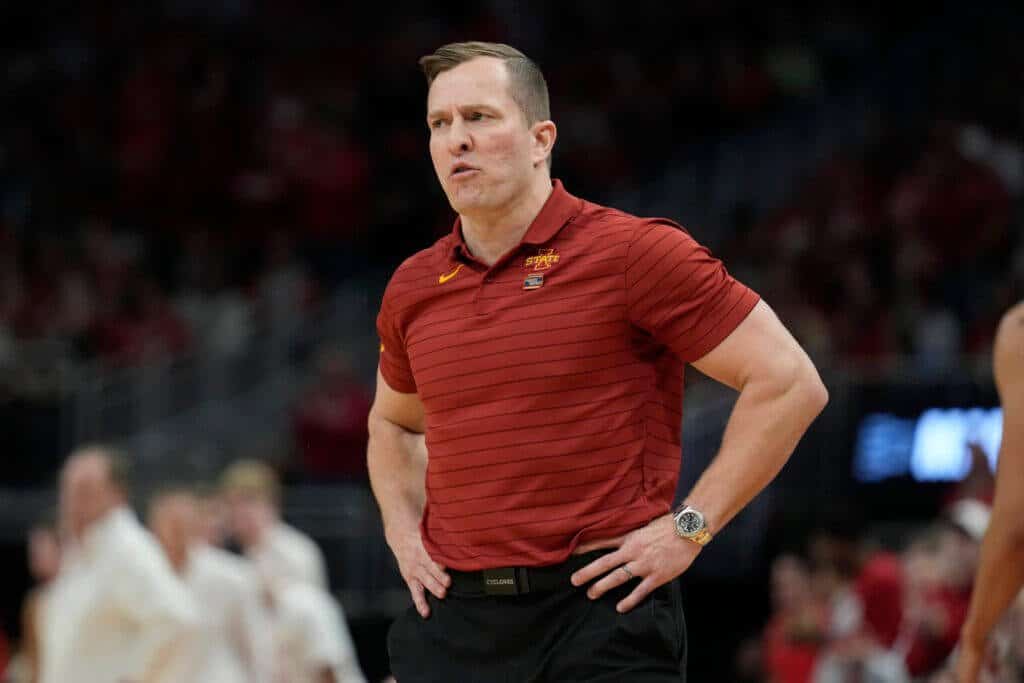
When reevaluating Iowa State’s fairly revelatory first season under T.J. Otzelberger, it’s not insulting or reductive to put it like this: Teams that get key stops and make key shots give themselves a chance, never mind the aesthetics. The Cyclones generally did all of that, including the lack of overly pretty basketball part. The defense was elite. The offense was … well, not. But it was good enough often enough when it needed to be, primarily because one guy got a bunch of important buckets at important moments, and such was life in Hilton Coliseum and beyond.
That is how Iowa State men’s basketball went from two wins to the Sweet 16 in a calendar year. And when appraising what lies ahead in the next few months, after some roster upheaval and restocking and a full summer of on-floor workouts, it appears we can put it like this: It’s not going to go much different. The core identity will be the core identity. How Iowa State wins in 2022-23 probably will look a lot like how Iowa State won in 2021-22.
“I would say that’s accurate,” Otzelberger says, a couple days after his players returned to campus, and a couple days before the official preseason workouts begin. “For us, we’re always going to be blue-collar. We do the work, and that sort of thing. I think those habits showed up for us on game nights, and they’ll continue more of that same element or dynamic with this year’s group.”
That may change over time, yes, particularly when considering Otzelberger and Co. have secured commitments in the Class of 2023 from five-star forward Omaha Biliew and four-star, top 40 forward Milan Momcilovic. It doesn’t mean anything for the present, of course, which requires replacing the top two scorers from a year ago — Izaiah Brockington, the aforementioned key bucket-getter, and Tyrese Hunter, who transferred to Texas — while integrating four transfers and three freshmen and losing none of the defensive connectivity. “We have to start to figure out, with as many new guys we have, who plays well together? What lineups? What combinations?” Otzelberger says. “As much as we’re probably built more defensively, I think we got to try to balance our lineups out. Role definition, so guys know exactly what their job is, is going to be important.”
With an already eye turned toward the Nov. 7 season opener, Otzelberger talked with The Athletic about a summer of insights and a look-ahead to Year 2.
What was the primary emphasis over the summer? What had to get done, or what few things had to get done on your end?
So we’re fortunate, we’ve got a lot of older experienced guys that have had success at other programs and winning programs. If you look at a lot of the transfers that we’ve brought in, they’ve been guys that have had success and been in programs that are winning programs. And so we tried to start out with building on the work habits we established last year. Building on defensively, how we compete, how we pressure the basketball and try to turn people over and have very effort-based defense. And then we really focused offensively on cutting and moving so we can get better ball movement and pace to our offense that we know we’re going to need to have to beat good teams.
With some returning guys, but obviously more than a handful of new guys, how much was it reteaching from Year 1? Or did you not have to reteach much?
Gabe Kalscheur, Caleb Grill, Aljaz Kunc, Robert Jones — they were all here with us. And so they were very proactive in what they did every single day, which set the tone for the other guys of like, hey guys, this is how we do things here. Not like, hey, this is what we did last year, but this is how we do things. It’s incredibly helpful for our coaching staff to have players that we’ve experienced some successes with, and those guys having the pride to set the tone for the summer. It’s invaluable. We’re way far ahead on some of the basketball stuff, because those guys have been so proactive and setting the tone.
How do you improve offensively?
We turn people over a lot. We’ve got to do a better job scoring off turnovers than we did last year. So that’s specifically scoring in advantage situations, converting and transition, that sort of thing. I also think we need to keep the ball on the move a little bit more, and not be as apt to catch and hold, catch and dribble. Get it side to side, get the defense to force more closeouts. And I think the third way is on the offensive glass we can be more effective. Some of the more efficient offenses, when you really look at them, they do a good job on the offensive rebounds, get easy baskets and free throws, things along those lines. So those are some areas we put emphasis and feel like we’re going to continue to improve.
When you went into the portal to get guys, was there a profile that you’re looking for? Or is it just the mad dash in and finding the dudes that are good and seem like fits?
We’re looking at guys that showed good teammates, and defensively, guys who were good defenders, played in programs that were well-coached and had success. We wanted guys who were really grateful and thankful to be here, fortunate for what they have. We’ve got three transfers from Atlantic 10 and one from the American that come in this year. And then Tre King, who was sitting out for half of last year from the OVC. So we looked at guys who were on winning teams, have a clear niche of things that we think will translate well at this level, and then they’re excited to be here and play at this level in the Big 12 for Iowa State.
Osun Osunniyi was an All-Atlantic 10 player for St. Bonaventure, three years running. What did you learn about him, having him on a day-to-day basis, and how you can use him?
He’s extremely intelligent. Very, very knowledgeable. High basketball IQ. I feel like he’s probably even a little more skilled than maybe what we had realized he was. And a guy who’s very coachable. He’s had success, because he’s a worker, and he takes coaching really well.
Osun Osunniyi averaged 2.9 blocks and 7.5 boards per game for St. Bonaventure. (Gregory Fisher / USA Today)
Did it spark some imagination with you guys in terms of how you can use him or where you can use him?
We think he can facilitate some offense. And then also we’re going to empower him to shoot the 3, which he hadn’t done yet in his career. But we feel like with his stroke and the work he’s put in, he’s made a lot of progress there. So it’s something we’re going to ask of him offensively. And then defensively, he’s played more just around the basket, and that’s where his shot-blocking numbers are so high. And we’re going to challenge him to use versatility a little more, maybe switch some things, and guard some smaller guys at times as well.
Any of those other transfer guys that, again, once you had them in the gym, became pleasant surprises?
Jaren Holmes has an unbelievable personality, team-first energy, enthusiasm, just always has a smile on his face, loves to do the hard work. And that really had a huge positive impact on our summer, because guys like playing with him, and the ball seems to move better, and they know he cares about them. So Jaren was a huge positive and really stood out for us this summer.
Doubling back to Tre King: Where has he grown from Day 1 when he arrives at Iowa State, as a sit-out transfer, to where he is now?
It’s seeing defensively, here, how hard you have to play and what you’ve got to do from a versatility standpoint, guarding multiple guys to play. But I think what he’s done, I think he’s become more self-aware of how he impacts winning. And when he focuses effort and energy on cutting, rebounding, slashing, he’s a big physical mismatch-type of guy. We need to, as coaches, find as many ways as we can to get him cutting, slashing, finishing on the offensive glass, because his energy can really be impactful.
You could use as much shooting as you can get based on where you were last year. I don’t think a lot of these guys from the portal are going to come in and be lights-out right away. Is there evidence, in your number-tracking and the workouts, that it’s going to get better?
I think where it gets better is better passing, so we’re getting shots more in rhythm. That was part of the problem for us at times last year: We didn’t pass it great, so it wasn’t the same shot that you’d really like to get. Being stubborn with our shot selection is going to be important, of guys understanding what’s the right shot for them.
We’ve got four guys on our team, with Jaren Holmes, Gabe Kalscheur, Aljaz Kunc, and Caleb Grill, that have all made a good amount of 3s throughout their career. So for those guys, it’s going to be hunting opportunities. For the others, it’s going to be taking the right shots at the right time.
What was your impression of the freshmen? Everyone always wants to hear about those guys.
They’ll all earn minutes for us this year. They all will. On one end of it, based on what happened last year in the Big 12, that’s scary because there were really only three freshmen that played in the entire league last year.
But they’re all mature. They’ve all been well-coached. They’re all very self-aware. They’re in the mix. They bring some things that our team needs. Does that mean any of them will be starters? I don’t know that. We’ve got a lot of older guys, so that might be tough. But Tamin Lipsey’s a pure point guard. He’s a quarterback. He moves the ball, runs the team and guards the basketball. Eli King is an extremely talented passer, very smart IQ, kind of a combo guard that does a lot of things. And then Demarion Watson is a big wing. He’s got tremendous upside at 6-7 with a 7-foot wingspan. He can make shots and defend multiple positions. So all three are in the mix for playing time. And I think that’s a credit to their work habits for sure.
When you look at those older veteran guys who come back, who’s the most important guy for you in terms of taking a leap and getting it to another level even after four or five or six years of college?
It’s Gabe Kalscheur. We’re putting him in a spot now where we trust him. We believe in him. We know what he can do. He’s helped us win a lot of key games, big games last year. And so now it’s taking that next step. When you’re a go-to guy, when you move up the scouting report, or when you’re given more responsibility, more defenses are preparing for you and keying on you. But Gabe has had a terrific summer. I mean, he was playing really well at the end of the season for us, for sure. And we think he can make a big jump for us.
What was good about his summer? What gets you optimistic that he is a guy who can handle that role?
Understanding where he needs to be more aggressive offensively. I think he has a better grasp on, this is what I do well and I need to create those things more. Whether it’s coming off screens, getting to his mid-range shot, just hunting more opportunities to shoot the basketball.
Sometimes last year he’d say, ‘Hey, I’ve taken X amount of shots and I’m going to put it on the floor.’ And we’ve pretty much told him in catch-and-shoot, or in his mid-range, every shot he can get up, we’re great with it. And we believe, and we’re confident. And he did an excellent job knocking them down all summer.

Gabe Kalscheur wil have the green light next season to shoot as much as he wants. (Reese Strickland / USA Today)
Was there a guy who really opened your eyes over summer in terms of the progress he made one way or the other?
Robert Jones was an on-again, off-again starter at the five for us. He may have been our brightest spot this summer in terms of just being more of a leader, being someone that every day just plays so hard and is aggressive. He had a terrific summer. Again, not a guy that is necessarily a prolific scorer, but a guy that can you throw it to him on occasion on the block, you can throw it to him at the elbows and he can facilitate some offense. His offensive rebounding effort and finishing around the goal has gotten better. His foul-shooting has gotten better. I was really encouraged with the summer he had.
The on-floor success has translated to the results in Class of 2023 recruiting, it appears. I know you can’t talk specifically about those guys until they officially sign, but what do you think people bought into?
You can sell hope or you can sell what it’s going to be like. And I think when people see it work, then that creates a different level of belief in what can actually happen.
And so for us, we’ve been able to continue elevating our recruiting because of the hard work the guys have done in our program, and the successes we were able to have last year. When you’re playing in the Sweet 16 or winning big games at the Barclays Center, recruits take notice of those things and are aware of it, and it gives them a greater deal of confidence that they can come here and maybe have those same successes or even beyond. Most guys want to feel like they can win and compete for championships. And hopefully as we move forward, recruiting-wise, the guys have confidence that we can do that in our program.
Retention is obviously a challenge for everybody, not just Iowa State. What do you guys do to avoid repeats of the Tyrese Hunter situation? What kind of discussions are there on campus of, OK, what can we do for these guys to make sure, on every level, they come to Iowa State and stay at Iowa State for as long as they want to?
Part of the challenge with Tyrese was that he signed with the previous coaching staff. So we didn’t have the time out in front to build that relationship and that trust quite the same way as you do in a normal recruiting process. It was speed dating. So we didn’t have that same investment in one another that you normally have.
Our program is built on the development and the time we spend with our guys. We believe that we spend as much time in that process of development, and pouring into our guys, as anybody. And so the guys that they believe in their abilities, they’re going to see us as a great place to be. We’re going to be a place that continues to try to make it the best experience for our guys, whatever that means in terms of how well we feed them, and our facilities, and how we coach them, NIL and all capacities. We’re continuing to keep pushing everything forward. But I do think the relationship is the most important piece. When you look at guys that we’ve recruited for a year or two years before they get to campus, there’s a different level of trust and investment that everybody has in one another.
Do you have a feel for what success in Year 2 looks like?
We need to keep moving the standards forward. We’re fortunate for what happened last year. And I know that most want the outcomes to be better than what they were a year before, and I understand that that’s what we sign up for. We work in a bottom-line business. But for me, success in Year 2 is far more about continuing to have guys in our program that are developing, and they’re reaching their individual goals. We’re continuing the work habits that are a constant, and they know what it is. So we’re building a program that’s sustained. We can sustain success over the next five, 10, 15, 20 years.
We want to win every game this year, but more than that, think I’ve been very vocal about how much I love Iowa State and want to be here. And this place means everything to me. So we just want to keep building on it, and we know the wins will follow if we do the work every day.
(Photo: Patrick McDermott / Getty Images)