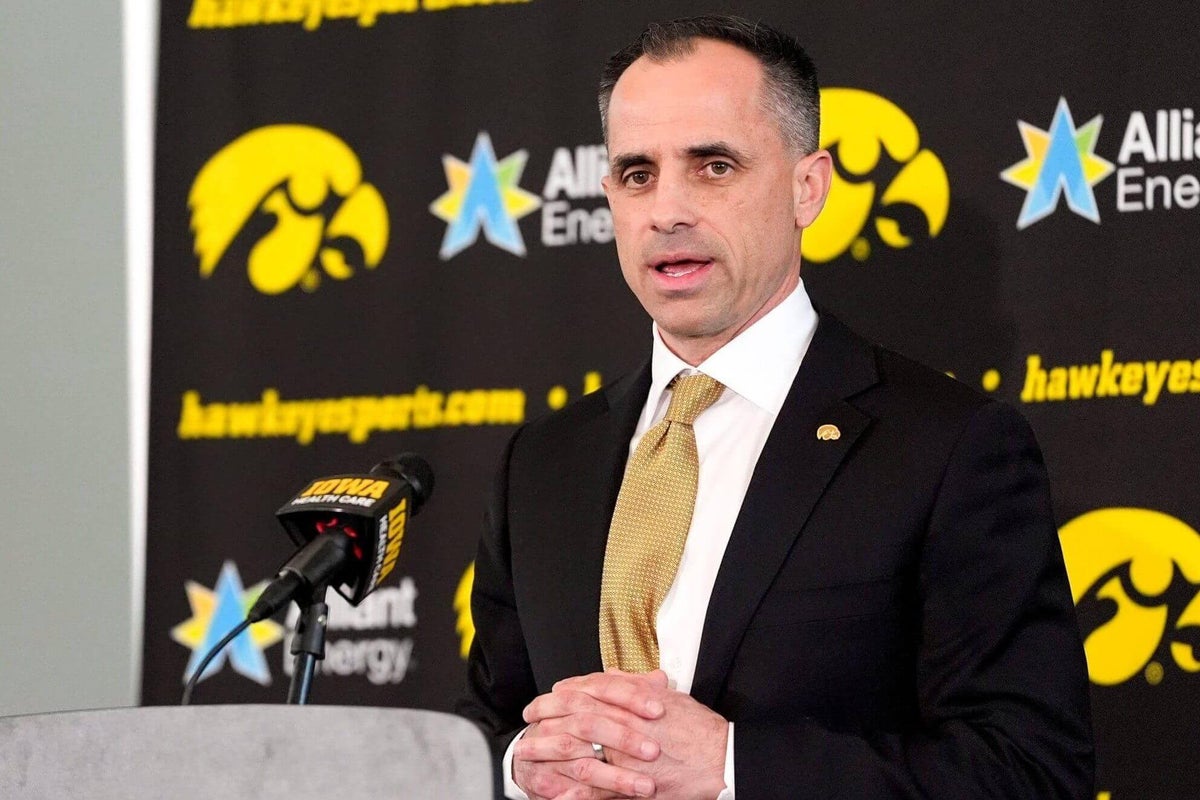
IOWA CITY, Iowa — Ben McCollum and his family pulled up to Carver-Hawkeye Arena as passengers in a black Chevy Suburban 15 minutes before his scheduled introductory news conference as Iowa’s new men’s basketball coach on Tuesday.
McCollum stepped from the vehicle, opened the door for his wife, Michelle, met his three children and approached two lines of students and cheerleaders awaiting him in gold-colored ties.
“Let’s go, guys,” McCollum said as AC/DC’s “Back in Black” immediately switched to the “Iowa Fight Song.” At that moment, a new era of Iowa men’s basketball began, and McCollum knew exactly which buttons to push to move Iowa in the right direction.
Every coach and athletic director wants to win news conferences, but McCollum pushed it to another level. McCollum was born in Iowa City, grew up in northwest Iowa and attended Iowa basketball camps as a youth. His heroes weren’t NBA players; they were Hawkeyes. And the 43-year-old former Drake coach made that point clear multiple times during his 40-minute introduction.
“You’re who I idolized,” McCollum said while looking at several former players throughout the club room. “All the way back from B.J. Armstrong. I could rattle off — Wade Lookingbill, Val Barnes, Mon’Ter Glasper. These are just the random names. Acie Earl, obviously Chris Street.
“I always dreamed of playing for the Hawkeyes, and I just wasn’t good enough. So, I didn’t get to play for them, but now I get to coach them and hopefully bring success here.”
Always a Hawkeye.
🤝 @CoachMcCollum pic.twitter.com/y0hWCCqDPJ
— Iowa Men’s Basketball (@IowaHoops) March 24, 2025
McCollum has a picture with former coach Tom Davis, which was shared on social media. The new coach earned multiple awards at an Iowa camp held in Storm Lake and earned high praise from a former Iowa assistant under Davis.
“The coach went up to my mom and said, ‘Man, he reminds me a lot of myself, just from a competitive perspective,’” McCollum said. “And the coach was Bruce Pearl. He was my coach for the camp.”
McCollum’s stories appear genuine and not contrived. For a fan base starving for something positive about its men’s basketball program, McCollum’s story was like a slab of juicy meat. Or in terms made famous by former Iowa football coach Hayden Fry, “From where I come from, it’s called selling the sizzle before the steak.”
It was the perfect inauguration for McCollum toward restoring a men’s basketball program with a proud history but a waning tradition. McCollum was an all-state guard at Storm Lake St. Mary’s High and graduated in 1999. That was the last time Iowa qualified for the Sweet 16, which 97 other programs have done more recently. Davis’ contract expired that spring and wasn’t renewed. During the next quarter-century, Iowa’s attempt at reaching the next level is like a song trapped on repeat with Steve Alford not connecting and Todd Lickliter failing miserably.
McCollum replaces Fran McCaffery, whose legacy is complicated. McCaffery was the winningest coach in program history and had only two losing seasons in 15 years. But the disconnect between the program and the fan base widened during his tenure. This season, the Hawkeyes finished with the lowest paid attendance in 60 years. Even worse, only 5,176 fans on average showed up per game. When compared to women’s basketball and wrestling — both of which have sold out games for multiple seasons — that level of disinterest cannot be ignored.
Kenyon Murray played from 1992-96 when the program was on an equal footing in popularity with the football program. He scored 1,230 points and still ranks third in career steals at Iowa. Today, he’s better known as the father of twins Keegan and Kris, both of whom became NBA first-round draft picks. Kenyon Murray saw the support his sons received earlier this decade paled when compared to what he experienced.
“The funny thing was, like, ‘Hey, I know you guys are better players than I was, but we always played in front of a packed house,’” he said. “I wouldn’t say it was disappointing. It just honestly created more of a nostalgia for us, showing them videos and like, ‘This is what we played in front of every night.’
“Do I think it can get back there? Yeah, but we’ve got to get creative and do some different things that we hadn’t maybe thought about in the past.”
Coaches are crucial in fan engagement, but Iowa’s descent from passionate to indifferent stretches beyond whether Alford wanted special treatment from Iowa City-area businesses or McCaffery didn’t shake enough hands. Too often, Iowa’s marketing plan for the program was the equivalent of releasing a schedule and unlocking the doors on game night.
Carver-Hawkeye Arena was built into an on-campus crater in 1983, and there’s no concourse level except at the top. The best seats are near the floor, but they’re 35 or more rows from the top. There’s only one public restroom and no concessions near the court, so fans must walk to the top to visit either option. Even in-shape patrons get winded from that hike.
For more than a generation, Iowa’s administration has resisted calls to move the students from behind the south basket in order to placate long-time ticketholders. Then when the students wouldn’t show up, the brass would bribe them with pizzas once a year. This year, both the students and general public stayed away, which makes it the optimum time to reseat the arena, Murray said.
Iowa coach Ben McCollum signs the tie of a Hawks Nest member after his introductory news conference Tuesday. (Julia Hansen / USA Today Network via Imagn Images)
“We’re at a different time now,” Murray said. “Whether you’re talking about NIL or the transfer portal, we have everything here to recruit the best athletes. But how do we make the experience even better? Whether it’s for the athletes or for the fans, we have to do that.”
Beth Goetz, who became the full-time athletic director in January 2024, wants to shift the student seating area and take on a $60 million arena renovation. But with an apathetic fan base, securing donations for a capital project was a non-starter, especially when name, image and likeness funding is paramount toward recruiting and retaining quality athletes. McCaffery couldn’t energize enough fans to attend games or donate to The Swarm Collective, so changing coaches was mandatory.
“The filling up of Carver, certainly from a business perspective, is really critically important,” Goetz said. “I can’t deny that, but I think that’s an outcome of what happens when you build that connection, when your team’s excited to watch, and when genuinely people are interested in investing in your success.”
To bring fans aboard, Iowa must tear down its men’s basketball model and start anew. Hiring McCollum is the first step. Now come the challenges of building interest through grass-roots networking that once was a given. A decade ago, Iowa coaches disbanded a summer league with around 500 fans in attendance for each game. Before home football games, Iowa’s basketball program held scrimmages commonly called “Shirts and Skins” with a few thousand fans in attendance. McCaffery ended it without a replacement. The Hawkeyes had a “Black & Gold Blowout” in mid-October after a football game that was well attended. That, too, was shoved aside, as was a midnight madness event.
“The Black & Gold Blowout, we stayed in the arena until we signed every freaking poster that came in front of us,” Murray said. “Those things go a long way to creating that connection.”
McCollum feels a responsibility to grow the product but not unilaterally. Those wearing the black and gold are on the front line, but for a mutually beneficial outcome, it must come in lockstep with the students and university with assists from the former players.
“You gotta be out, man,” McCollum said. “It’s Iowa. Like you gotta shake hands. When you’re in the grocery store, and they come up to you, you gotta say ‘Hi.’ What do they say, Iowa nice? It’s God’s country, as we say. So just do the little things like that, and I think it goes a long way.”
“We want somebody that wanted to do that, not that understood it was a part of the job but that was genuinely interested in being a part of that process.”
McCollum gets it. So does Goetz. The program needs help to build a bridge to its past but more importantly, set a sustainable course for its future. It won’t take a quick fix, but if Iowa gets it right in conjunction with every key stakeholder, the program has a chance to end the apathy and become the program that McCollum remembers so fondly. And if that happens, McCollum will outpace his nostalgia and turn Iowa’s dreams into reality.
(Top photo: Julia Hansen / USA Today Network via Imagn Images)