[ad_1]
Sitting in position for a postseason spot, the Tampa Bay Rays will look to supplement their roster at the trade deadline. Of course, they’ll do some buying and selling, but at the major league level they will primarily be buyers. The moves they make will be determined by a few key things early this month.
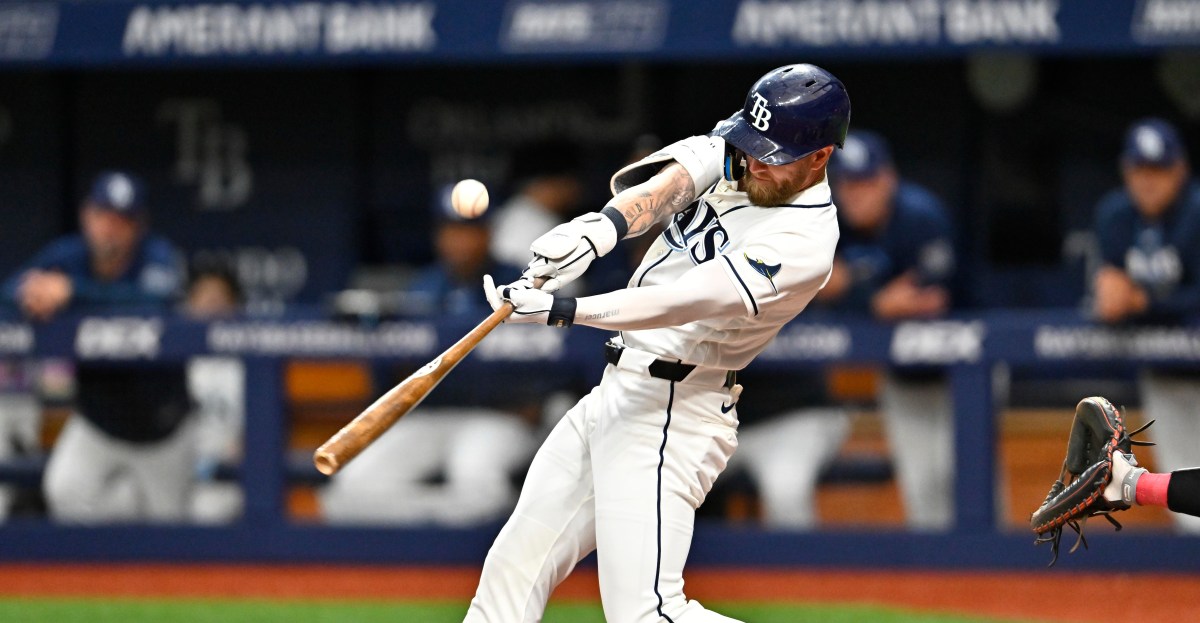
What does OF Jake Fraley look like in his return from the IL?
Fraley is a steady veteran who owns a career 110 wRC+ against right-handed pitching. While this isn’t an outlier level of production, it does represent a meaningful improvement over Victor Mesa Jr. (career 83 wRC+ vs RHP) and Chandler Simpson (career 94 wRC+ vs RHP). However, his lengthy injury history makes it difficult to count on that production over the final two months – especially when considering he was recently removed from his rehab assignment.
Should Fraley give the Rays a reason to explore other left-handed outfield options, they would first look internally. Jacob Melton was a major acquisition this winter, but unfortunately he got hurt in late April and missed a large chunk of the season. He’s unproven at the major league level so there’s some risk. However, his near 70-grade power, plus speed, and plus defense at all three outfield spots gives him significant upside. Melton’s underlying data have taken a real step forwards this season so he may be ready for a role in the majors.
If the Rays decide to take a conservative approach and keep Melton in AAA, there are plenty of affordable left-handed outfielders. I’ve already written about Lars Nootbaar, but here are a couple more names:
- MIN OF Matt Wallner (career 137 wRC+ vs RHP); recent struggles may have lowered the acquisiton cost
- COL OF Troy Johnston (career 137 wRC+ vs RHP); plus hitter but comes with defensive questions
- MIN INF/OF Kody Clemens (career 96 wRC+ vs RHP); 117 wRC+ against righties in his last 500 PAs
What does 2B Gavin Lux look like in his return from the IL?
Lux is feeling the best he has felt all year and is rehabbing in Durham. Similar to Fraley, Lux brings a steady veteran presence with him to a lineup. His 109 wRC+ vs righties for his career represents a real upgrade over what Palacios (92 wRC+ vs RHP) and Williamson (82 wRC+ vs RHP) are currently providing. I think Williamson’s best baseball is still ahead of him and moving him to short-side platoon work at 2B and back-up duties at SS could help him get into more optimal match-ups that improve his production.
As with Fraley, there’s a chance that Lux doesn’t get healthy or his production isn’t what the Rays need it to be. In that case, there aren’t really any internal candidates to come in and hold down bulk platoon work at 2B. Brayden Taylor could be that guy if he wasn’t still in AA. His performance this year has restored his prospect status following a swing adjustment late last season, but there’s a lot of risk in bringing him up to play most days without him having any AAA experience.
It looks like the Rays would explore an external candidate if Lux is unable to regain his form. Luis Arraez would be an ideal acquisition given his track record (126 wRC+ against RHP for his career), and his defensive improvements that have allowed him to play a solid 2B. Some other names they could explore are:
- PIT 2B Brandon Lowe (career 134 wRC+ vs RHP); proven track record, but comes with injury risk
- MIN INF/OF Kody Clemens (career 96 wRC+ vs RHP); 117 wRC+ against righties in his last 500 PAs
- ATH INF/OF Zack Gelof (career 114 wRC+ vs RHP); reverse splits, but he’s currently injured
How will starter workloads be managed?
The Rays have several members of their rotation who will have varying degrees of innings limits. Nick Martinez is the only starter likely to reach 170-180 innings this season.
There are a couple internal options in AAA who could come up and cover innings in spot starts or bulk roles out of the bullpen:
- Mason Englert; being stretched out and working as a starter after working in the bullpen for his ML career
- Ty Johnson; throws only two pitches, but could be reliable as a bulk pitcher or multi-inning reliever
- Michael Forret; strike throwing is inconsistent, but could be reliable as a bulk pitcher or multi-inning reliever
- Joe Boyle; working in the bullpen for the rest of the season, could be impactful as a multi-inning reliever
- Michael Grove; long-term plan is for him to start, but he could be effective in a multi-inning role for now
Brody Hopkins is still learning to pitch with the AAA baseball and he underwent some mechanical changes that will take time to get used to so I don’t anticipate him providing many meaningful innings in the majors this season.
The Rays don’t have enough impact pitching ready to contribute in the majors this season, so they’ll likely explore an external addition. I’ve already written about Tarik Skubal, Joe Ryan, and Freddy Peralta. All three have strong track records and could help the Rays in the top half of their rotation. Given the way baseballs are flying off the bat similar to 2019, a groundball pitcher like Sandy Alcantara could also be a good fit if the Marlins fall out of contention in the next few weeks. Jose Soriano, Sonny Gray, and Landon Roupp also fit this mold. The biggest barrier to acquiring a high-end starter at the deadline will certainly be the cost. The Rays have the prospect capital to afford a big name to add to their rotation without depleting their farm system.
Which Rule 5 eligible prospects will need protection?
No doubt the Rays will be looking to get ahead of their annual Rule 5 crunch this summer. They already dealt Ty Cummings for Casey Legumina, but they still have over 50 players who will be Rule 5 eligible. Not all of them will need protection, but some of the names in the upper levels include:
- C Tatem Levins
- 1B Tre’ Morgan
- INF Cooper Kinney
- OF Homer Bush Jr.
- RHP Brody Hopkins
- RHP Ty Johnson
- RHP Michael Forret
- RHP Owen Wild
- DH/1B Xavier Isaac
- INF Brayden Taylor
- RHP Jackson Baumeister
- RHP Santiago Suarez
- RHP Gary Gill Hill
- RHP TJ Nichols
There’s a chance that the Rule 5 Draft may not happen given the expiring CBA after this season, and that would certainly benefit the Rays because then they wouldn’t have to make a decision on these players. However, it would still be wise to look to move some of these prospects as part of a deal for help in the majors or for lower level prospects – like when Duncan Davitt and Ben Peoples were part of the package for Adrian Houser last season. The Rays could also look to move some of these Rule 5 eligible guys for a prospect in the lower minors – like when they traded Tobias Myers for Junior Caminero a few years ago.
The Rays’ deadline priorities will ultimately depend less on what other clubs make available than on the health of Fraley and Lux over the next few weeks. If both return and perform, Tampa Bay can focus almost entirely on adding rotation help and consolidating their minor league rosters ahead of a potential Rule 5 crunch. If either Fraley or Lux struggles/suffers another setback, the front office has enough prospect capital to address those needs externally while still pursuing an impact starter.
[ad_2]
Source link