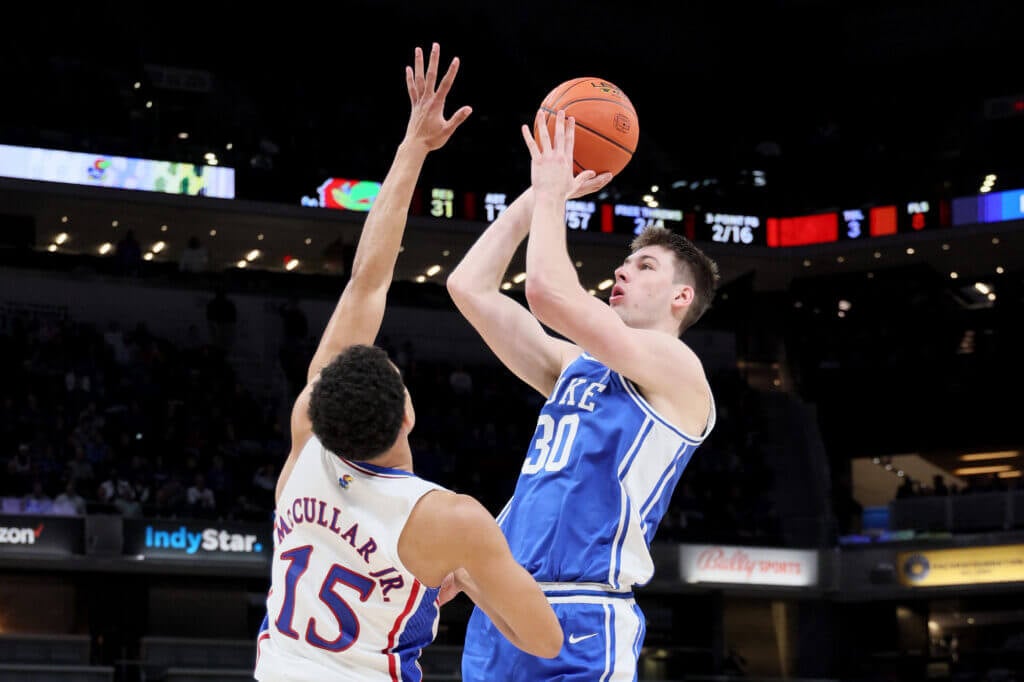
DURHAM, N.C. — It was an ordinary missed shot — a tad overzealous, perhaps — but pretty normal otherwise. After No. 8 Duke won the opening tip Tuesday against Bellarmine, the ball found freshman forward Kyle Filipowski at the top of the key. Given Filipowski’s shooting success to start this season, well, why not rip it? So Flip did … and it fell wide left, clanking off the rim, as he fell to the floor in sync.
Right away, junior guard Jeremy Roach went over to Filipowski with a few words and a twirling finger: “Slow down, man. Move the ball.”
So the next time down the floor, what did Duke do? Exactly that — and once again, the ball ended up in Filipowski’s hands, this time just marginally to the left of his last attempt. But because of that ball movement, he had space. Time. He slowed down, set up, and then let loose.
Swish.
Message received, if the rest of the evening was any indication. After roaring out to a 16-point first-half lead, the Blue Devils mostly kept a double-digit distance between themselves and the Knights thereafter (save for a stretch before halftime where Bellarmine made 10 of its 14 attempts). Count the team’s ball movement atop the list of reasons that was possible; Jon Scheyer’s squad finished with 18 assists on 25 made shots, for an assist rate of 72 percent. (Duke was at 53 percent this season entering the night, per KenPom, ranking No. 136 nationally.) Be it by dribble-drive and kick, using the posts as passing hubs, or simply swinging the rock around, Duke looked as connected offensively as it has through its first five games this season.
“This is gonna be the recipe for us going forward: sharing the ball, playing together,” Scheyer said after Duke’s 74-57 win. “We just need to continue to embrace it, continue to learn where the next read is.”
And it takes time, with a new head coach and 11 new players, to develop chemistry, that natural on-court camaraderie. But that Duke is seemingly settling in at this point in its season, at least somewhat, is a good sign — and even more so considering what comes next: the Phil Knight Legacy tournament in Portland, which begins on Thanksgiving. Kansas was Duke’s first notable nonconference foe, but not its final one; this week alone, the Blue Devils could face Florida or Xavier, and then potentially Purdue or Gonzaga in a championship game. Though a 4-1 start is nice, considering the caliber of competition, we’ll learn much more about Duke when it heads west.
But that doesn’t mean we know nothing now. Five thoughts on Duke after five games, on the eve of PK85:
1. Filipowski’s emergence, and his role moving forward
Remember this summer, when word trickled out of early practices that Filipowski wasn’t exactly imposing his will? That the No. 4 recruit in the class wasn’t tough enough, or talented enough, to crack the top of Duke’s rotation?
Ha. Right. About that.
FLIP CAUGHT A BODY 😳
📺 ESPN pic.twitter.com/wJP4J011R8
— Duke Men’s Basketball (@DukeMBB) November 16, 2022
That buzz couldn’t have been more off-base. Because through five games — all of which have ended with Filipowski as Duke’s leading scorer — the 7-foot freshman has been pretty fantastic. After dropping 18 points against the Knights on 4-of-8 shooting — including 3 of 5 from behind the arc and 7 of 8 from the free-throw stripe — the New England native is now averaging 15.6 points and 10.4 rebounds per game. He’s even added his name to the history books, becoming the first Duke freshman to start his career with three consecutive double-doubles. For all the worries about Flip’s foot speed, or him being too soft with the ball, the reality is this: The dude’s just a really solid college forward, of the stretchy, floor-spacing variety. That spin move he had against Kansas is something that, frankly, folks his size shouldn’t be able to do.
Now the question: How long can he maintain this level? He did have his least efficient offensive performance against Kansas, especially from 3 (where he went 1 of 6), but the Jayhawks are one of the country’s better teams … and that was his third college game. Filipowski has rightfully become an offensive focal piece for Duke, and he should remain as such moving forward. But if something were to shift that, even slightly …
Duke just got its full roster back. Dariq Whitehead made his season debut on Friday against Delaware, about two and a half months after he fractured his right foot in practice, and the results were understandably uneven. Same deal on Tuesday, when Whitehead made just one of his four shots, committed three fouls, and looked generally discombobulated defensively. (Bellarmine’s barely-dribble, screen-centric offense isn’t exactly the easiest defensive ask for someone playing their second college game.)
But before long, Whitehead is going to round into form — namely, that of the No. 2 recruit in the country and a projected lottery pick. You saw his athleticism and explosion on display on his lone basket against Bellarmine: a full-court sprint in transition, and a dunk with little takeoff space. That is the sort of attacking, aggressive wing Duke needs back in the fold to become its best self long-term. And given Whitehead’s offensive ability, when he ramps all the way back up — hopefully in Portland, if you’re a Duke fan, but more likely in several weeks — he’s going to command a greater share of offensive possessions.
Similar deal for Lively, the top recruit in this class, who also missed plenty of time this preseason with a calf injury. All seven of Lively’s made shots this season — in four games, mind you — have been dunks, so we’re still waiting to see what he offers offensively outside of being a rim-runner and lob threat. “Anytime he sets a ball screen, the pressure he puts on the rim, you can just feel the defense shrink because he’s such a lob threat,” Scheyer said. “The next step for him is just being more aggressive, putting the ball on the floor.” And while Lively has solid movement skills for someone 7-1 and 230 pounds, he isn’t a true post presence; if anything, he’s more advanced as a perimeter shooter. Lively wasn’t ever going to be this team’s leading scorer, but like with Whitehead, Duke needs a fuller-fledged version of him to hit its ceiling. Rim runs are nice and all, but you’d like to see more this week now that he has a few games under his belt.
Dariq Whitehead is slowly making his way back from a foot injury. (Rob Kinnan / USA Today)
3. The truth of Duke’s 3-point production (or lack thereof)
Entering Monday’s game, Duke was shooting 30.6 percent as a team from deep.
After Monday’s game, Duke is now shooting 33.3 percent as a team from deep.
Either way, that number isn’t high enough. But against Bellarmine — and specifically because the Blue Devils were playing Bellarmine, which packs the paint and accordingly encourages 3-point tries — Duke shot the lights out, making a season high 14 3s on a 40 percent clip. So, what’s the truth of the matter? In theory, somewhere in the middle.
The positives are there to be found. Grad transfer Jacob Grandison is a proven college shooter, having made 41.1 percent of his 3s the last two seasons at Illinois. Filipowski has started his college career hitting 36.4 percent from deep. Heck, even Roach — a career 32.3 percent 3-point shooter — has upped his efficiency to 39.1 percent, a nationally-relevant rate. But are those rates sustainable, or replicable on a night-to-night basis?
Maybe. After Duke lost the four best 3-point shooters off last season’s roster, I was admittedly a bit worried about how the team would find that deep production this season. Grandison, I assumed was sort of a gimme, but you never know how guys like Filipowski, Whitehead, Tyrese Proctor, and others will translate to college. Proctor, for example, is hitting 19 percent so far — a figure I expect will climb, but how high? The one guy I’ve been most impressed with, and Duke probably needs to maintain his efficiency the most, is Roach. I’m not sure he’s a 40 percent 3-point guy, but even if he’s in that 36-38 percent range, it’ll change how defenses have to defend him: going over ball screens, for example, which in turn open up driving lanes.
If anything, the reps against Bellarmine of making the extra pass — something Duke did splendidly — should be valuable. But I’m still in wait-and-see mode with that part of this team’s offense.
4. Defensive details are a work-in-progress, but the finished product is pretty solid
Take the stat with a grain of salt, considering the caliber of competition so far, but the 266 points Duke has allowed this season — an average of 53.2 points per game — is the program’s second-fewest of the modern era. That, on its surface, is solid. And anecdotally, the same is true. Bellarmine lives off screens and cuts, complicating a defense’s assignments, and Duke mostly maintained its shape against a unique offense.
“We were all connected,” Proctor said. “Switch connected, that was the main thing. Don’t point and switch, everyone stay attached, and everyone was on the same page.”
So far this season, Duke has employed several defensive strategies, with reasonable success across the board. But as Duke plays better competition, its defense — specifically in ball-screen situations — will continue to be stressed, and that’s the area where there are still a couple cracks. Bellarmine doesn’t run that type of offense, but against other opponents — Kansas especially — Duke is still figuring out some things. There have been missed taggers on the help side on multiple occasions, bigs playing too deep (or too far outside) in drop coverage, and the sorts of general miscommunications you’d expect for a team this young.
Those issues aren’t alarming … so long as they continue to improve. Lively, especially, will be critical to Duke’s ball-screen coverages, so straightening out his drops and positioning will be particularly important — and even more so if his offensive contributions are a little lighter. But it’s encouraging that Scheyer has a roster of guys who can reasonably be expected to switch, something that should pay dividends come the end of the season. I’m maintaining my preseason prediction that Mark Mitchell — who has good lateral quickness and mobility at 6-8 with a 7-foot wingspan — is the linchpin to the team’s switching success by season’s end.
5. Studying Scheyer as a coach, schematically and otherwise
Let’s not forget that as a first-time head coach, Scheyer is still working through some things, too. His rotation, his lineup permutations, his substitution patterns — and, of course, what he runs.
Which is why it’s been interesting to start seeing his tendencies. For example, he hasn’t been opposed to a deeper bench, playing nine guys Monday before the first media timeout. Offensively, he’s toyed with inverting his freshman bigs, playing Lively as a perimeter four-man and Filipowski as more of an inside post, to take advantage of Lively’s passing acumen. (That, by the way, is a skill of his I didn’t fully appreciate coming into this season.)
And in terms of sets, Scheyer is willing to be a little creative. He’s run some five-out “open” offense, even with more traditional bigs like Ryan Young, to try taking advantage of space. He’s running Grandison and Proctor, two thinner-framed perimeter players, as screeners, be it in traditional ball screens or away from the primary action. All those things give defenses another look, something else they have to worry about defending — and the more you can do well, the more options you have if a team tries to key in and take something specific away.
When Whitehead and Lively are both back to 100 percent, I expect Scheyer to continue toying with them and where to move them on the floor. For example: He used Lively in three consecutive screens on a single possession Monday, which constantly contorts a defense’s shape. Against Bellarmine, it was as simple as drilling into drivers to take an extra dribble, which opened up an outside shot consistently. They’re little things, but fun ones to track at the start of Scheyer’s tenure. He’ll surely have more to show this week in Portland.
(Top photo of Kyle Filipowski: Andy Lyons / Getty Images)