[ad_1]
You know who was close to getting on this list Wednesday night? Virginia Tech. Sorry, Hokies fans. But also, more interestingly: Arizona State. Arizona State has been playing really good basketball lately! It was the perfect pick for an off-beat, intriguing team to get on the page, something fun and fresh to break up the relative similarities we’ve established from week to week in this space. There are like 10 or 12 obviously really good teams this year, a couple of which might be extremely good, but we have a pretty good feel for that group going into the holiday. They’re established. It helps to break things up and throw something random on the page every now and then, you know? A little zest.
Then the Sun Devils scored two points in the first 10 minutes at San Francisco. Yes, no, seriously: Two points. Ten minutes. It was 46-16 USF with 2:54 left in the first half, and the Dons won 97-60. You spend all of that nonconference season grinding your way up the college basketball pecking order, get so close to the sport’s preeminent honor — a spot on this very important power rankings — and then bust out a no-show like that. There’s a joke about Icarus and a Sun Devil somewhere in here, but we won’t be making it.
Let’s Power Rankings!
1. Connecticut (13-0)
You have to hand it to Georgetown: They kept us honest.
There are three ways we here at power rankings HQ watch games: live on press row; live at home; on Synergy the following day. At the risk of offering free advertising, Synergy makes watching and researching so much faster and so much more customizable that we don’t necessarily worry about having a bunch of screens on at one time, or about missing a huge game driving back from, say, Charlottesville on a Saturday night. You can always catch up later, and so it’s OK to temporarily write things off. Georgetown at UConn? File that one in the Synergy pile. Safe to ignore.
Except it wasn’t. Georgetown — the same 5-8 Hoyas who just lost 83-64 at Syracuse and then gave up 102 points in 77 possessions to Xavier at home — led 60-53 in Gampel Pavilion with as few as 10 minutes remaining in the second half. Mathematically speaking, that lead with that time left gave the Hoyas a not-insignificant chance of upsetting a dominant unbeaten team on its own floor. It was the first time UConn had trailed in the second half of any game all season. OK, Georgetown! You had our curiosity; now you have our attention, etc. Let’s go ahead and flip back over and oh, yep, looks like UConn has woken up ha ha welp never mind all that.
There was a sequence midway through the second half that epitomized the Huskies’ explosive brilliance, and it started with Joey Calcaterra, who had gone scoreless in the opening 29 minutes of the game. He had a reverse left-hand layup off a back cut, followed by a forced steal, a nifty catch by the sideline, a drive into the heart of the defense, and a behind-the-back dump-off that cut Georgetown’s lead to two and sent the Gampel crowd into ballistics. UConn pressed the next inbounds and got a turnover and an immediate Hassan Diarra layup. After a good defensive play by underrated freshman big Donovan Clingan, Diarra buried a guarded kickout 3, and then Clingan blocked two Qudus Wahab shots in a row before feeding a break that ended with a wide-open Calcaterra 3. Roughly two minutes of game time had elapsed, and UConn had gone from down by eight to up by six. Georgetown looked deeply confused.
Stingy defense, savvy offense, flow, intuition, and a crowd absolutely losing its mind: It was everything that has made UConn so good so far, purified and condensed.
Give the Hoyas credit. They could have been blown away. Instead, they hung around. (They also missed some open looks that could have made things even more interesting.) Connecticut wasn’t at its best Tuesday night for the vast majority of the 40 minutes; it was much more dominant last weekend at Butler, when Adama Sanogo had 27 and 14 and the Huskies held the Bulldogs to 46 points in 67 possessions (gulp). But on Tuesday, when UConn really needed to elevate, when it needed something more, it was damn near transcendent. It looked like the best team in the country to us.
After the first 10 minutes against New Orleans Wednesday night, we were starting to get a little concerned about Purdue. The Boilermakers had not exactly been convincing in their last two outings, the first a three-point overtime win at Nebraska and the latter Saturday’s Indianapolis-hosted 69-61 win over what looks like a down-ish version of Davidson coming off consecutive losses to Charlotte and Delaware. New Orleans is the kind of game that should be a blowout from the first few minutes, but the 344th-ranked Privateers were hanging tough, and we were about to sound the alarm.
Then Purdue went on a run. That was that. Meanwhile, Zach Edey didn’t even play; he missed the game with illness, and as such it was a good night to revel in what Shaquille O’Neal would semi-condescendingly refer to as Purdue’s “others” — almost all of whom were tidy and efficient on the offensive end. Edey’s dominance makes it easy to overlook just how good Mason Gillis and Caleb Furst are, too. They are very different kinds of players from the big Canadian, obviously, and they function well alongside him when he’s on the floor. But Gillis is also a very good interior college player in his own right, and Furst’s two-way talent is really beginning to shine through. And everyone talks about the freshman guards, and rightfully so, but redshirt freshman forward Trey Kaufman-Renn was really good against New Orleans, too. As if the 2022 recruiting class wasn’t good enough already.
Anyway, so much for that alarm. Purdue seems fine. As you were.
Apart from their performance at Virginia Saturday, and their pride in having uncorked it, it was funny listening to the Cougars talk about their loss at Alabama the previous week. Look, no one likes to lose. College basketball players are elite athletes relative to the general populace, and so they are inclined to like it even less than the rest of us. Much, much less.
But Houston? The Cougars acted like they had committed a grave sin. Losing to Alabama wasn’t just an off night, or the product of a quality team executing against them defensively in ways that unsettled them; it was an indictment of their characters, of their souls. Bad basketball wasn’t something that just happened to you; it was the product of selfishness, immaturity and petulance. The defeat wasn’t just a bummer; it was reason for deep, abiding shame. When Jamal Shead said the Alabama loss would “resonate” with Houston all season, well, you believed him. Houston spoke like it had betrayed itself.
And so the win at Virginia was a healthy glimpse of the culture Sampson has built. Yes, Houston is very talented, and Jarace Walker was incredible, so comfortable in his role and so obviously the best guy on the floor. But the team’s mental and emotional approach to the game, in a tough environment, against a high-level opponent, mixed a steadfast, quiet confidence with a humility and desire to prove itself anew. It was an impressive mix. Sampson builds good basketball teams, but it’s the way he psychologically prepares his kids that still manages, all these years later, to take us aback.
GO DEEPER
How Houston’s loss to Alabama prepared it for a massive win at Virginia
It feels like there’s a common theme developing about whether or not this college hoops season features a truly dominant, elite team, and that question is sort of unanswerable, especially this season. Maybe so (UConn looks awfully good!), maybe not (the definition is always fungible anyway!), and really not a huge deal either way. But could anyone argue that the sheer quantity of very good teams is extremely high?
Take Kansas: The Jayhawks are, in our view, pretty fairly ranked fourth this week. They probably shouldn’t go higher, right? And yet they have one loss to a good team (Tennessee), several high-quality wins after Saturday’s 22-point home win over Indiana, which followed successive demolitions of Seton Hall and ostensibly frisky rival Missouri (at Missouri). Jalen Wilson has made the star leap. The floor is spread offensively. Kevin McCullar is leading the defense. Things are looking pretty comprehensively good. But for whatever reason, you don’t hear people really sweating Kansas as a national title contender, at least not yet. Frankly, it feels like KU, gets sort of lumped in with the rest of the eight or 10 or 12 best teams in the country — when you could argue that no one has been more impressive the last two or three times it’s taken the floor.

Jalen Wilson and Kansas are on a hot streak. (Jay Biggerstaff / USA Today)
Is that more tempered approach to analyzing the Jayhawks even wrong? Is Kansas definitely better right now than, say, Arizona or UCLA, let alone UConn or Purdue or Houston? Not really sure! But the point is that this feels like a very good problem to have. Even if there isn’t a 2020-21 Gonzaga or Baylor type of team in the field this year — and adjusted efficiency margin thus far suggests there is not — it does feel like there are a bunch of really good teams out there, teams all good enough to beat, and beat up on, each other for the next three months. Let them fight.
(How good is Ken Watanabe by the way? That now-famous gif is actually a very unsubtle scene as written from a solid but mostly unsubtle movie, and yet he manages to bring real depth to it, to the point that the short scene itself is very good and the soundless gif also always hits. Anyway, tangent, but man, what a good actor.)
5. Arizona (11-1)
If there is any team that should be able to stop, or at least contain, Arizona’s interior, you’d think it would be Tennessee. The Volunteers are arguably the best defensive team in the country, full-stop, but more than that it’s a matter of personnel: You have to be big to play with Arizona up front, and Tennessee is big. Uros Plavsic is 7-foot-1, 265; Olivier Nkamhoua is 6-foot-9, 236; and guys like Julian Phillips, Jonas Aidoo, and Tobe Awaka, all varying degrees of “large human being,” are available to Rick Barnes, too.
And yet the Volunteers couldn’t handle Arizona down there. Azuolas Tubelis, whose game remains an underrated mix of positioning, footwork and off-kilter soft lefty touch, had 19 points on 7-of-10 shooting. Oumar Ballo, who gets to whatever spot he wants, whenever he wants, went 6-of-10. The duo combined for 13 free throws and 17 rebounds. They were, fundamentally, the difference in a close, otherwise even game.
They are the reason the point-generation scales almost always tilt toward Arizona. Tubelis connects on 67.6 percent of his shots at the rim; Ballo makes 79.5. Both attempt the vast majority of their field goals from that range. Arizona as a whole is middle-of-the-pack in terms of at-the-rim shot rate; the rest of Arizona’s squad spaces things out, shoots plenty of 3s, and also isn’t shy about the occasional jumper or floater in the paint. But the two bigs’ ability to get to the front of the rim and score there, both in half-court sets and in more transition-y looks, is the reason why this is arguably the best offense in the country — and one able to sustain solid scoring against what is normally an extremely difficult Tennessee assignment.
(This is the part where Vols fans will point toward the foul disparity in Saturday’s game; understandable, because UT did have a few missed calls, but we’ll get to that in Tennessee’s blurb, promise.)
6. UCLA (11-2)
For most of the season, Connecticut has been the sole citation in the classic “top 10 in both offensive and defensive efficiency at KenPom.com” statistical reference point that doesn’t exactly roll off the tongue, and frankly should be easier to say/write, given how often it gets mentioned. Anyway, move over, UConn: UCLA has since joined the club.
Say what you want about Kentucky, but the Wildcats, as ugly as they are to actually watch, do tend to churn over fairly efficient offensive totals. On Saturday, UCLA held them to 53 points in 67 possessions. Oscar Tshiebwe finished with eight points on 12 field goal attempts. Jacob Toppin — who lost his starting spot Wednesday night against Florida A&M — had five points on eight shots. Again, the Wildcats have plenty of offensive issues, but they usually brute-force the ball into the net at an above-average rate. UCLA was dominant on that end of the floor. Pair that with the 87-60 win at Maryland that had us in paroxysms of ecstasy this time last week — a performance that was built around offensive brilliance but which also featured some truly elite D, particularly from Jaylen Clark — and UCLA has suddenly skyrocketed in our estimations. (The Bruins were predictably just as good against UC Davis Wednesday night.)
We can’t logically find a spot for them higher than this right now, not that it really matters all that much anyway, but we could be convinced this is maybe the second- or third-best team in the country right now. Maybe even better than that. Mick Cronin has it rolling.
The freshmen showing out on both ends!
📺: Pac-12 Network
💻: #GoBruins pic.twitter.com/5Fn0Xl9c14— UCLA Men’s Basketball (@UCLAMBB) December 21, 2022
7. Texas (10-1)
The Longhorns’ situation appears to be stabilizing, in as much as that is possible. On the same day last week that Texas coach Chris Beard was arrested at his home for a felony third-degree assault charge and suspended by the Texas administration, his team, undoubtedly reeling in the wake of the news, barely survived at home against Rice, needing overtime to do so. Saturday’s game against Stanford at the American Airlines Center in Dallas was not exactly peak level, but it was, at least, a fairly steady win, and against a team that seems pretty definitively better than Rice.
Wednesday night’s 100-72 win over a decent Louisiana was the first time Texas looked like Texas again. That’s a relief. As some commenters mentioned when we left UT out of the rankings a week ago, the broader situation and the uncertainty surrounding it is hardly the players’ faults (we weren’t saying it was, either, but we do understand the sentiment). In as much as that is the case, it would have to be calming, in their third game under associate head coach Rodney Terry, to see themselves play that well. Next week, they finish the nonconference portion against Texas A&M Commerce, a totally real Division I school. The rigors of the Big 12 await.
8. Alabama (10-2)
What a weird team! Brandon Miller scored 36 points against Gonzaga last Saturday. Thirty-six! Miller has been good since he got to Tuscaloosa, and his size and shooting has made him one of the more interesting prospects to just sit down and watch, and Saturday’s performance was something like his marquee, coming-out, look-out-this-guy-is-not-in-full-control sort of night. It was a big deal! And Alabama — fresh off a road win at Houston — lost to Gonzaga, 100-90. Wait. What?
Allowing 100 points in 83 possessions will do that. It was a vintage performance from Drew Timme, too: 29 points, 10 rebounds, four assists, 12-of-18 shooting. Drew Timme is very good at basketball, and very hard to stop from scoring. Fair enough. But the extent to which the same team that just went to Houston and made the Cougars look selfish and adrift was so completely unable to stop Gonzaga from scoring — particularly on the interior, where Gonzaga shot 33-of-53 — was kind of bizarre.
Consistency was also Alabama’s issue last season. The Tide were capable of beating anyone and losing to anyone, often in the matter of a few days. After holding Houston to 71 points in 72 trips in Houston, the thought was that this team was vastly more engaged on the defensive end, not quite as happy to float along in a uptempo possession-trading enterprise. But just after that game, the Tide couldn’t get stops on their own floor against Memphis. Now this? We remain fascinated and deeply confused.
If we were a Spanish-speaking European football coach, we would say the Cavaliers are “in a difficult moment,” one that will require them to “suffer.” This is not a concept that is totally foreign to American sports, but the general idea is that sometimes you have to figure out ways to win that don’t involve playing your best stuff, that sometimes even the most ambitious, free-flowing teams have to run around and chase the ball and defend and hunker down, whatever it takes to get the result.
Virginia could go for some of that. On Saturday, the Cavaliers were average at best against Houston defensively. Houston is good, and Virginia could lament missed shots, but it was the defensive breakdowns that most bothered Tony Bennett after the game. He doesn’t care if Virginia misses shots. Virginia could score 30 points for all Bennett cared, so long as his team was capable of holding its opponent to 28 on the other end. That wasn’t the case Saturday. Things were better at Miami; after a slow start, Virginia’s defense helped it to gradually grind itself back into the game, particularly just after halftime, but the early hole it fell into was eventually too much to overcome.
“We got off to a good start, but we shot the ball so well early in the year,” Bennett said Tuesday night. “Now when the shot’s not going in, it sort of says to you, OK, where are you strong? Where do you need improvement? We’ve got to keep attacking those areas.”
Again, Bennett could have chalked up UVa’s woes to plain old bad shooting — including a 6-of-23 night from 3 — and those woes are concerning, especially if you think Virginia was simply hot early in the season. If you think this is Virginia’s actual reality on offense, then that’s a problem too. Making shots is a big deal!
But Bennett, as ever, was more focused on what Virginia looks like, and how it figures things out, when the shots don’t go in.
10. Tennessee (10-2)
So, about the foul disparity against Arizona on Saturday: Undoubtedly, the refs missed a few calls that would have helped Tennessee close the ultimately very small gap between a big win and a disappointing loss. No question; fair enough. That happens sometimes, especially on the road, and it’s not totally unreasonable to lament crucial missed calls. (Fans aren’t supposed to be levelheaded and reasonable anyway. It’s not really in the job description, you know? Lament whatever they want to lament.)
That said, as a rule, Tennessee just … fouls a lot. It’s baked into the UT defensive cake. The Vols are arguably the nation’s best defensive team, or at least one of them; they are currently allowing the lowest effective field goal percentage in Division I (and holding opponents to just 20.2 percent from 3, which is wild) while generating the nation’s fourth-highest turnover rate. This is an aggressive, in-your-face, hands-on scheme, in every sense of those terms. And so, yes, that aggression, that desire to generate turnovers and bad shots, often translates into fouls. It just does. Tennessee opponents get to the foul line at an above-average rate. (Those same opponents also make a high percentage of their free throws, which is totally random and not something UT can affect, but is worth noting anyway — those fouls also turn into points at a marginally higher rate than normal.)
So, yes, playing against a good offensive team like Arizona, which plays a much less aggressive (and much less effective!) brand of defense that typically avoids fouls, and yeah: Sometimes you’ll shoot 10 free throws, and sometimes your opponent will shoot 27. That was the case Saturday, and Tennessee still almost won at Arizona anyway. It’s part of the cake, and the benefits usually outweigh the costs. But it shouldn’t necessarily surprise Tennessee fans to see those kinds of foul disparities here and there. Sometimes a lot of fouls is just a lot of fouls.

GO DEEPER
When ‘the DNA’ of Tennessee’s program lost his NYC home, a community rallied

Drew Timme is carrying a huge load for Gonzaga. (James Snook / USA Today)
11. Gonzaga (10-3)
So, that whole thing about Drew Timme being good? He’d better be. On Tuesday night, coming off that massive win over Bama, Gonzaga hosted Montana, just an easy little cruise before an eight-day break around the Christmas holiday. Lovely. Except … Gonzaga didn’t play well. At all. Julian Strawther had an efficient shooting night and grabbed 10 rebounds, but the only guy truly locked in was Timme, who had 32 points on 12-of-16 from the field and 8-of-13 from the free throw line, plus 11 rebounds, five assists, two blocks and two steals. Sheesh.
The rest of the team shot 5-of-17 from 3 and 10-of-19 from 2. There is something to be said for a letdown performance two days after a major victory against a high-profile foe, but this sort of supporting-cast vanishing act is the main reason why Gonzaga hasn’t been on this page for weeks now. Timme is still remarkable, still locked in, but everyone else isn’t quite there yet, at least not on the nightly basis we’ve grown accustomed to with most of Mark Few’s latter Zags teams. This is a good team that appears to be getting better, but you’d still like to see more (maybe especially so on the defensive end).
Eric Musselman and his staff love to dig in, tinker, and figure things out, but this season might take things to a new level. After losing Trevon Brazile to a season-ending knee injury a few weeks ago, ahead of a home game against UNC-Asheville Wednesday night the Razorbacks announced that freshman guard Nick Smith Jr. was out indefinitely for “right knee management.”
Smith’s health has been an issue for most of the year. He missed the first six games, played just six minutes in his debut, had four apparently healthy outings, and then left Dec. 17’s home win over Bradley (with five points on 1-of-8 shooting) after just 20 minutes. Now he’s gone for what might be a very long time indeed.
It makes sense; Smith is a potential top-five pick, and not someone who should risk his health in the short term. But it’s also a huge bummer. Smith is Arkansas’s most talented player, a guy with the ability to be a player-of-the-year-level performer, and instead he’s barely had a chance to show what he can do. Meanwhile, in conjunction with Brazile’s injury, Arkansas’s ceiling just got a bit lower — and what could have been one of the most thrilling teams in the sport now looks like it will have to chug along in slightly more workmanlike fashion.
Arkansas’s staff will come up with something. There are still plenty of talented pieces here. And maybe Smith will get healthy and get back on the floor sooner rather than later, with superpowers intact.
But man, oh, man — what could have been.
Also thinking about: Baylor; Ohio State; Illinois; Miami; North Carolina, which is starting to look a lot more like the team we thought we were getting when the season began; West Virginia, which is going to end up on this list very soon; Indiana’s season going from bad to worse with the announcement that point guard Xavier Johnson had surgery following an injury he suffered at Kansas last weekend, with Indiana’s statement saying Johnson is out indefinitely but that the program is “hopeful” that he can return by the end of the season — it’s not looking good, brev; Dabo Swinney soaring right past all the Twitter parodies; Tom Izzo’s Christmas spirit, and how funny it was to see a grown man wearing a Buddy the Elf replica costume shirt get a technical foul in a basketball game; Eastern Illinois winning at Iowa; Mississippi State; Kentucky never making any game look easy, even when it’s winning by like 20; the five Boston College student dudes sitting in a sparsely attended arena going absolutely nuts as their Eagles upset a good Virginia Tech team in overtime, keep fighting the good fight, fellas; the Cal Bears finally getting their first win of the season; Pentiment; Lionel Messi.
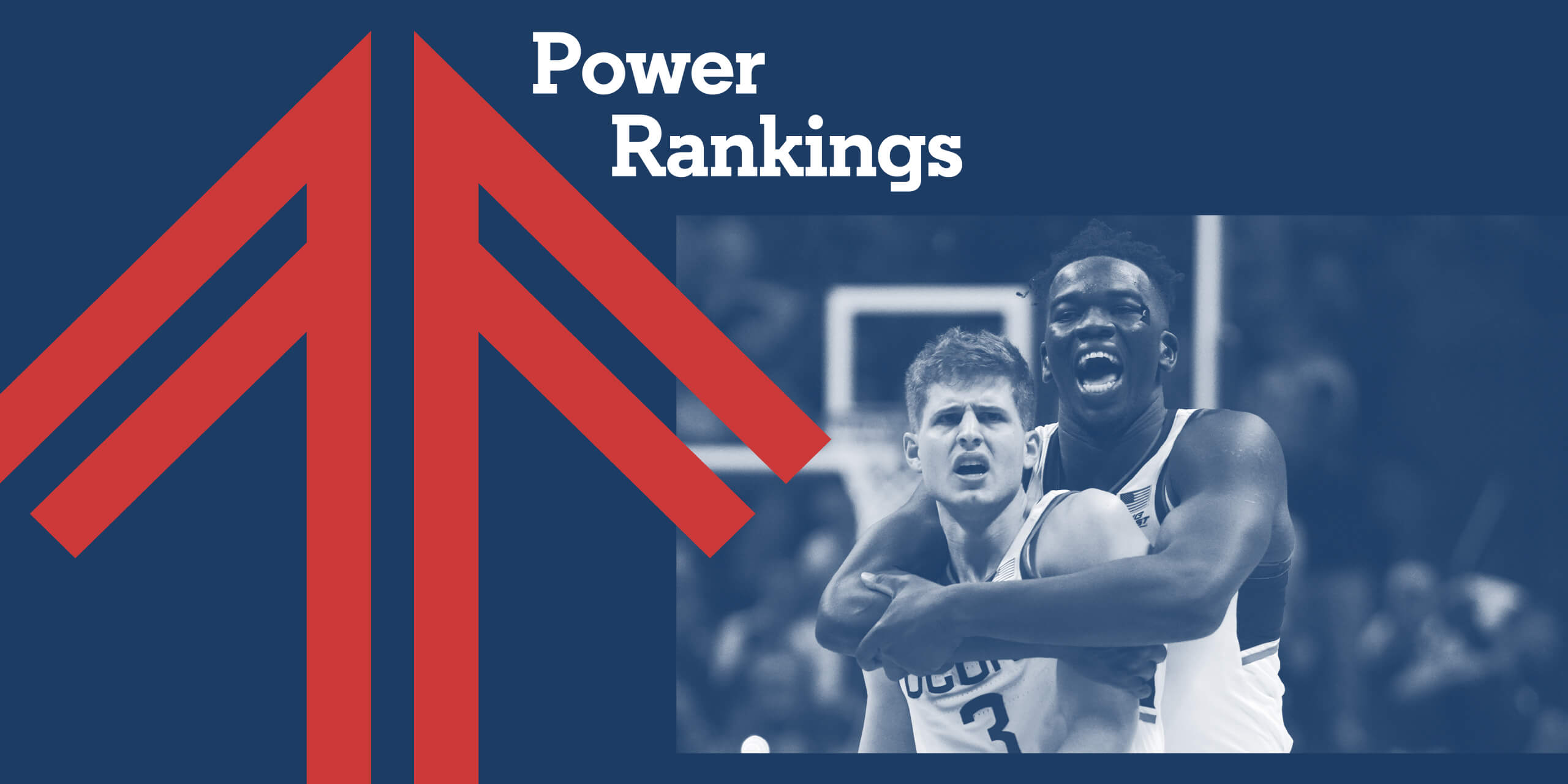
(Illustration: John Bradford / The Athletic; Photo: Joe Buglewicz / Getty Images)
[ad_2]
Source link