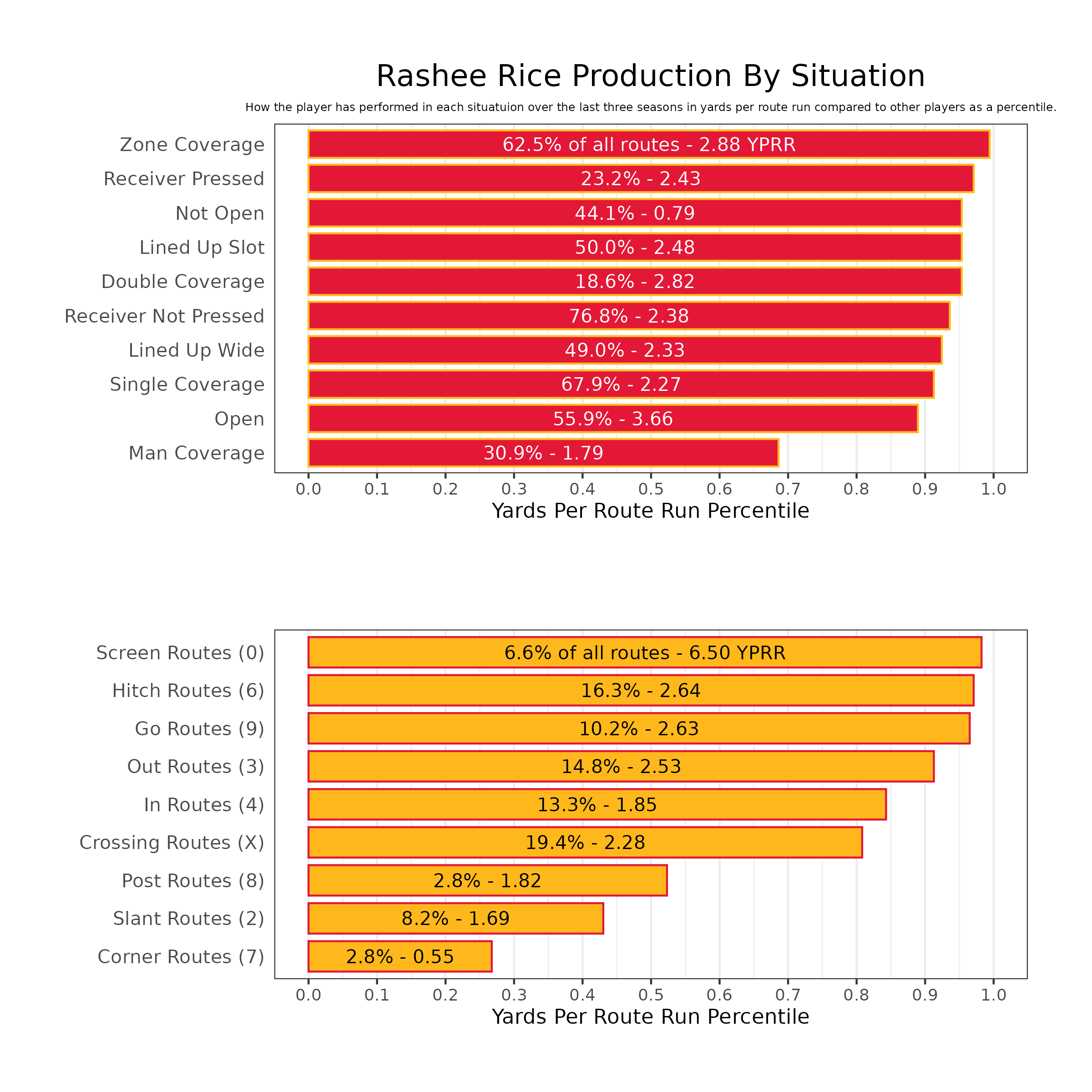
• Rashee Rice was amazingly efficient for a rookie: Rice’s performance on a per-play basis is comparable to that of elite NFL wide receivers.
• Ladd McConkey has a clear path to the slot role: After Keenan Allen and Mike Williams‘ departures, the Los Angeles Chargers depth chart is wide open with McConkey likely to play in the slot.
• Dominate fantasy football season with promo code PFF25: Unlock all of PFF’s fantasy content and tools, including full access to the fantasy football mock draft simulator, for 25% off using promo code PFF25.
Estimated reading time: 7 minutes
These breakouts are three younger players who have an ADP from the fifth to the 10th rounds, have ranked notably higher than their ADP and expect to be consistent fantasy starters this season.
Last updated: 7:15 a.m. Tuesday, August 6
Rashee Rice, Kansas City Chiefs (ADP: 7.08, From consensus ADP)
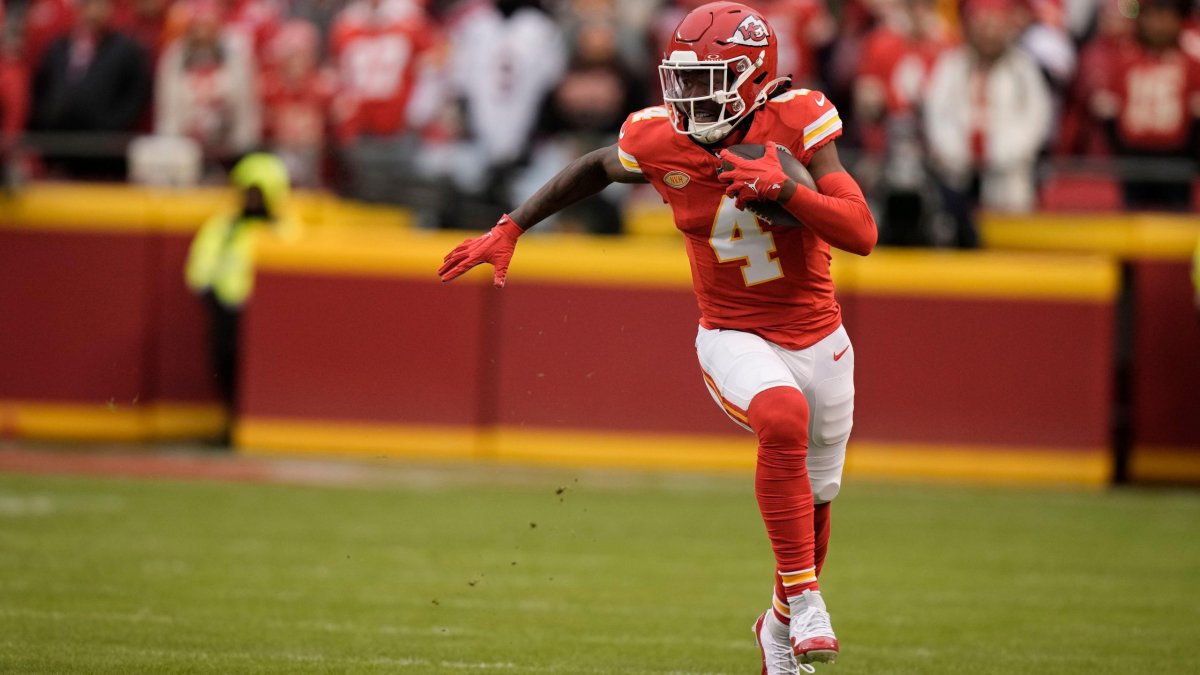
Rice made an immediate impact in his first game, recording 29 yards and a touchdown on three receptions. Despite Kansas City’s inconsistency at the position and Rice’s impressive per-play performance, he didn’t play more than 55% of the Chiefs’ offensive snaps until Week 7.
Rice continued to excel on a per-play basis with this larger sample of snaps. By Week 14, he began receiving playing time comparable to a typical starting wide receiver, playing at least 75% of his team’s snaps from Weeks 14-17. During this period, he ranked eighth in fantasy points among wide receivers. In the playoffs, Rice played at least 75% of snaps in three of four games, averaging 6.5 receptions for 65.5 yards per game against some of the NFL’s best defenses.
Rice is potentially facing a suspension following his arrest after a car accident. He is currently participating in training camp, but the timing and duration of the suspension are unknown. The worst-case scenario for fantasy managers is a mid-season suspension that causes him to miss the fantasy playoffs. We might get clarity before the season starts, but it’s also possible the suspension could be delayed until next season.
Rice was used uniquely last season: He was the primary X receiver in two-receiver sets and the primary slot receiver in three-receiver sets. This is the best combination of roles a wide receiver can have — CeeDee Lamb is the only other receiver expected to have that role this season.
Rice’s primary competition for targets remains Travis Kelce. The Chiefs retained most of their wide receiver rotation from last season, except for Marquez Valdes-Scantling and Richie James. They upgraded with Hollywood Brown and first-round pick Xavier Worthy, both of whom add speed and the ability to separate, likely leading to more deep passes. Fortunately, their skill sets differ enough from Rice’s that they won’t compete heavily for the same targets. The Chiefs have a history of easing in rookie wide receivers, as seen with Rice last year and Skyy Moore the year before, so we might not see much of Worthy early in the season.
If Rice can maintain his 25.5% target rate with increased snaps, it would be excellent for his fantasy value. However, it might decrease slightly as the Chiefs emphasize deep throws more often.
Rice finished as WR27 and was a top-36 wide receiver in nearly 70% of his games despite playing less than 70% of his team’s offensive snaps in all but four games. If not for the potential suspension, he would be considered a top-10 wide receiver this season. Even if he is suspended for the first six games, his fantasy value would increase simply by knowing he would be available for the fantasy playoffs.
Ladd McConkey, Los Angeles Chargers (ADP: 8.10)
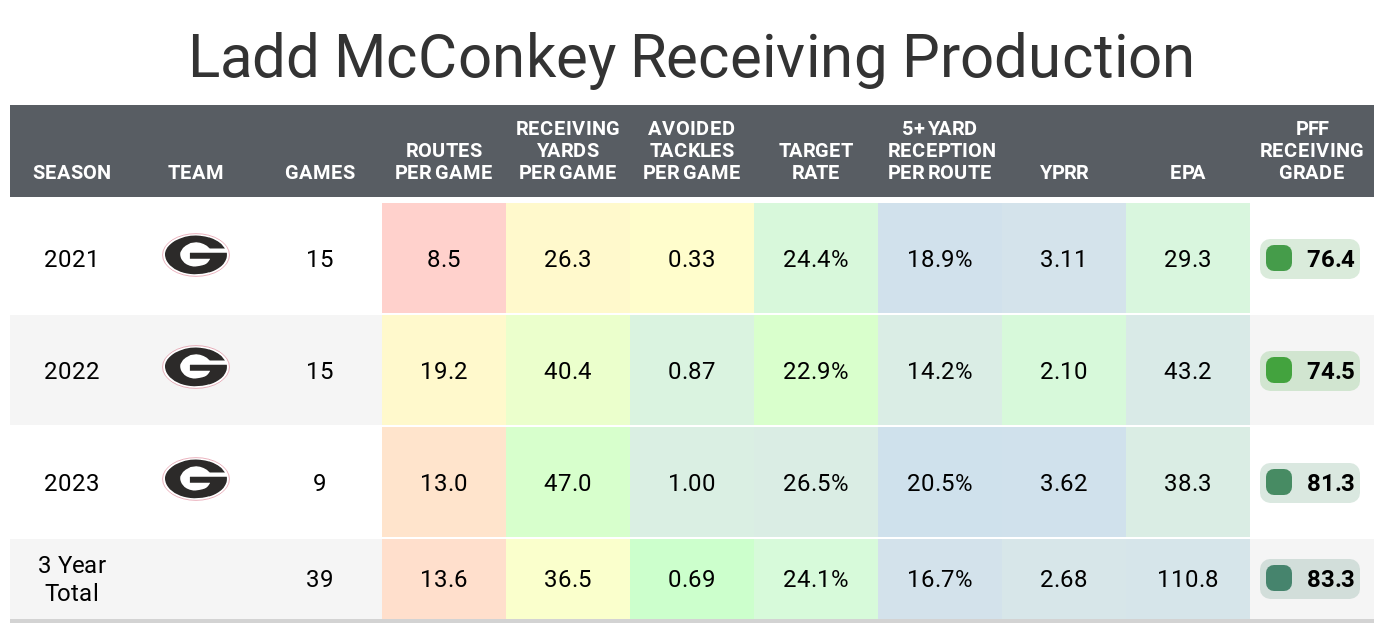
McConkey wasn’t given a lot of opportunities at Georgia, but whenever he was given the chance, he put up elite production. His 4.39-second speed should be an asset for the Los Angeles Chargers after getting drafted early in the second round. He not only had a high target rate, but he also consistently caught his passes for at least five yards, giving him an excellent yards per route run against SEC competition.
He primarily played out wide with Georgia but performed better lined up in the slot against zone coverage. It’s worth noting McConkey didn’t play the first few weeks of his final college season, so all of his stats in 2023 were up against SEC competition or in his Bowl game, rather than having his stats padded against other non-conference games.
Most teams have a very straightforward projection for how their wide receivers will rotate, but the Chargers are not one of those teams.
The majority of McConkey’s first-team reps in OTAs came from the slot, which is where we projected he would play in the NFL in our draft guide. He also took snaps out wide. Just based on past utilization, I’d expect Quentin Johnston and D.J. Chark to fight for snaps as the X receiver while Joshua Palmer and McConkey fight for Z snaps in two-receiver sets. Palmer should take the Z receiver snaps in three-receiver sets while McConkey plays in the slot in three-receiver sets.
McConkey will likely need to beat Palmer for the Z spot in two-receiver sets in order to be a fantasy starter. According to my utilization study from earlier this offseason, it’s very hard for a receiver to consistently be worth starting in fantasy football without being the lead X or Z receiver in two-receiver sets.
A bright spot for McConkey is he has Justin Herbert at quarterback, who is a better thrower than Jim Harbaugh or Greg Roman have had. Herbert has plenty of experience throwing to the slot with Keenan Allen, and Herbert has already started praising McConkey. Herbert is the main reason it’s worth considering any Chargers wide receiver rather than avoiding the entire team’s wide receiver room.
McConkey is worth considering in the middle rounds like all rookie wide receivers with a top-50 draft pick any year. The Chargers’ run-first offense is a major reason for concern, but there is also reason to believe McConkey could lead the team in targets if he can play the Z position in two receiver sets more often than not.
Jaxon Smith-Njigba, Seattle Seahawks (ADP: 8.12)
Smith-Njigba quickly earned the Seahawks’ slot receiving role but struggled in the first three weeks, catching 12 passes for 62 yards over four games and earning PFF receiving grades below 60.0, partly due to two drops.
After the Seahawks’ Week 5 bye, he played marginally better, putting up a 68.1 receiving grade and scoring the 38th-most PPR points from Week 6 onward. He contributed consistently, gaining between 40 and 63 receiving yards in nine of the remaining 13 games, though he never exceeded 63 yards in a single game.
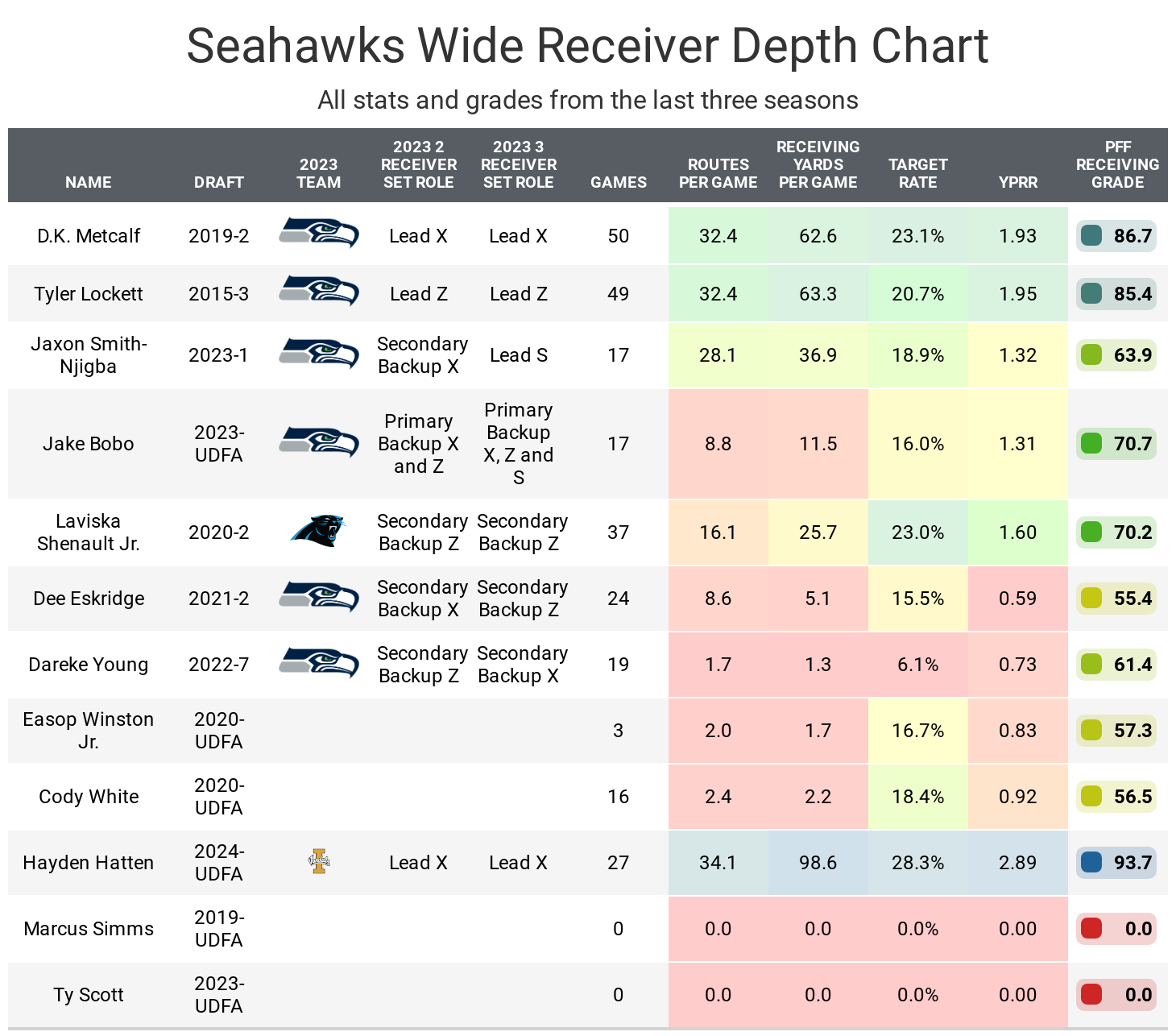
Besides his quality of play, Smith-Njigba’s primary limitation was his utilization last season. It’s nearly impossible for a player who only plays in the slot in three-receiver sets to be a consistent fantasy starter.
D.K. Metcalf and Tyler Lockett were firmly established as the two starting receivers, playing over 80% of snaps in two-receiver sets. Jake Bobo typically stood in when either Metcalf or Lockett was off the field. Smith-Njigba played only 22 snaps in two-receiver sets, 10 were run plays.
The question is whether Smith-Njigba can start playing more in two-receiver sets and, most importantly, overtake Lockett, who is entering his 10th season with the team and will be 32 years old before midseason.
The Seahawks’ new offensive coordinator is Ryan Grubb, who served as the Washington Huskies’ offensive coordinator for the past two seasons. Under his leadership, Washington was a pass-heavy team with Rome Odunze and Ja’Lynn Polk as the primary outside receivers and Jalen McMillan as the primary slot receiver. McMillan played only 9% of his team’s snaps in two-receiver sets over the past two seasons.
Even if Smith-Njigba remains primarily a slot receiver, he could still have a better season this year. Washington’s offense under Grubb ran a high number of plays, particularly pass plays, while the Seahawks ran the fewest offensive plays last season and consistently ranked among the worst teams in play count. By simply increasing the number of pass plays, Smith-Njigba will likely see more targets.
For Smith-Njigba to consistently be in fantasy starting lineups, two things need to happen: he needs to play better, and he needs to play more in two-receiver sets. If neither happens, he should remain on fantasy benches unless there’s a great matchup. If just one of these factors occurs, he will be a value at his current ADP of WR45. If both happen, he could become a top-20 wide receiver.