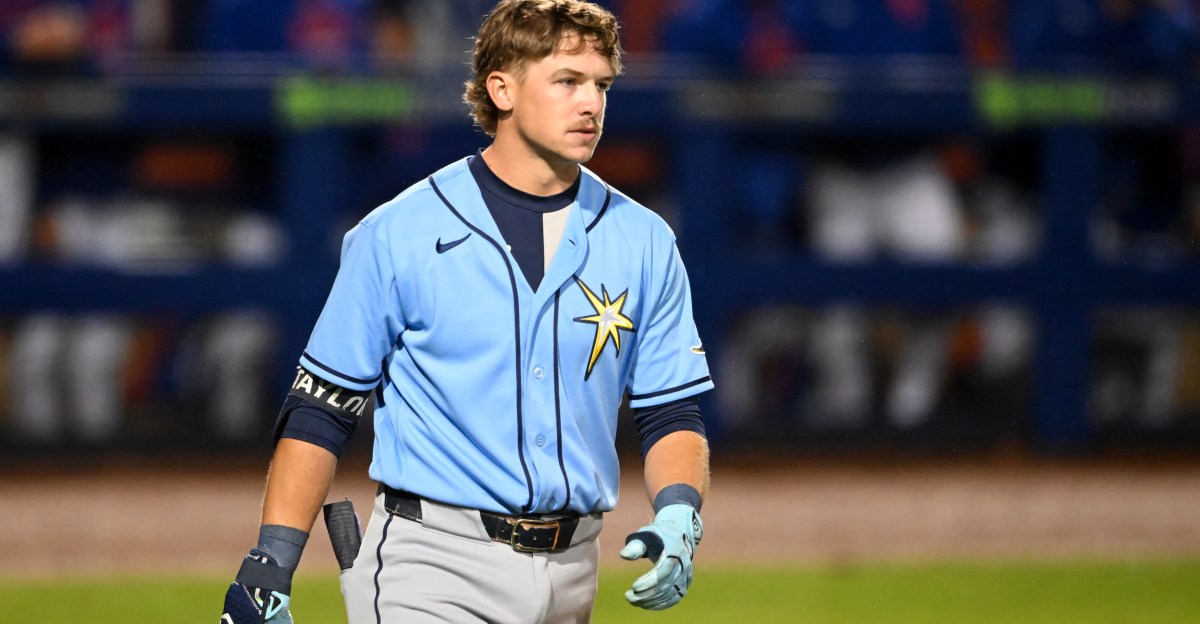
After treading water in Double-A Montgomery for parts of the last two seasons, here’s a hot take: Brayden Taylor appears ready for a promotion to Durham.
If you look him up, his 99 wRC+ through 14 games doesn’t jump off the page, but the underlying data suggests he’s ready for a new challenge.
Taylor was not performing well in his first full season in Montgomery last year. Through his first 64 games, he produced just a 64 wRC+ driven largely by elevated swing-and-miss, as his contact rate was sitting at just about 70%. He was removed from games for a few weeks in July to reset and adjust his swing. After he returned to action, his production improved to 97 wRC+ across his final 44 games, and his contact rate rebounded into the mid 70s.
One of the key adjustments Taylor made was reducing the hitch in his swing while getting stacked on his back leg. He still has a bit of a bat wrap and average hand speed so some swing-and-miss will likely always be part of his profile, but it’s now seemingly more manageable.
Taylor didn’t sacrifice his average power with this change either because he still holds his weight back fairly well and he’s always had a knack for getting the ball in the air pull-side. There may have also been an adjustment to his bat angle or tilt as it appears slightly flatter than in the past. That would align with the improved contact rates, though it’s difficult to confirm given the limited minor league data and video available.
While Taylor may not be filling up the box score just yet this season, his underlying data looks encouraging; his contact rate is up over 76% so far. He’s also hitting line drives and fly balls over 70% of the time in this small sample. It’s a rate that will almost certainly regress, but one that reinforces a meaningful trend: he’s continuing to get the ball in the air even with a shorter swing.
Maintaining near-average contact rates and consistently elevating the ball pull-side will allow Taylor to out-slug his roughly average exit velocities. The Southern League is a notoriously pitcher-friendly environment, so getting to Triple-A could help that underlying performance translate more consistently.
If these contact gains are sustainable, Taylor’s combination of solid defense at 2B and 3B and above average base running can help make him a productive major league player. He’s been notably passive early and taking his walks, so a promotion to Triple-A — where pitchers are in the zone more — would be a more appropriate test for his new mechanics.
Overall, his profile still looks similar to what it was coming out of the 2023 draft: a bulk platoon second baseman with no major holes in his game who can also fill-in on the left side of the infield if needed.
At the lower end of outcomes, Taylor profiles as a versatile up-and-down option. But with the swing changes, defensive value, and track record against right-handed pitching, there’s a strong case for a more meaningful role. His development against left-handed pitching may ultimately determine whether he reaches everyday status. The key question now isn’t whether Taylor can produce in Double-A; it’s whether these underlying gains will hold against more advanced pitching.