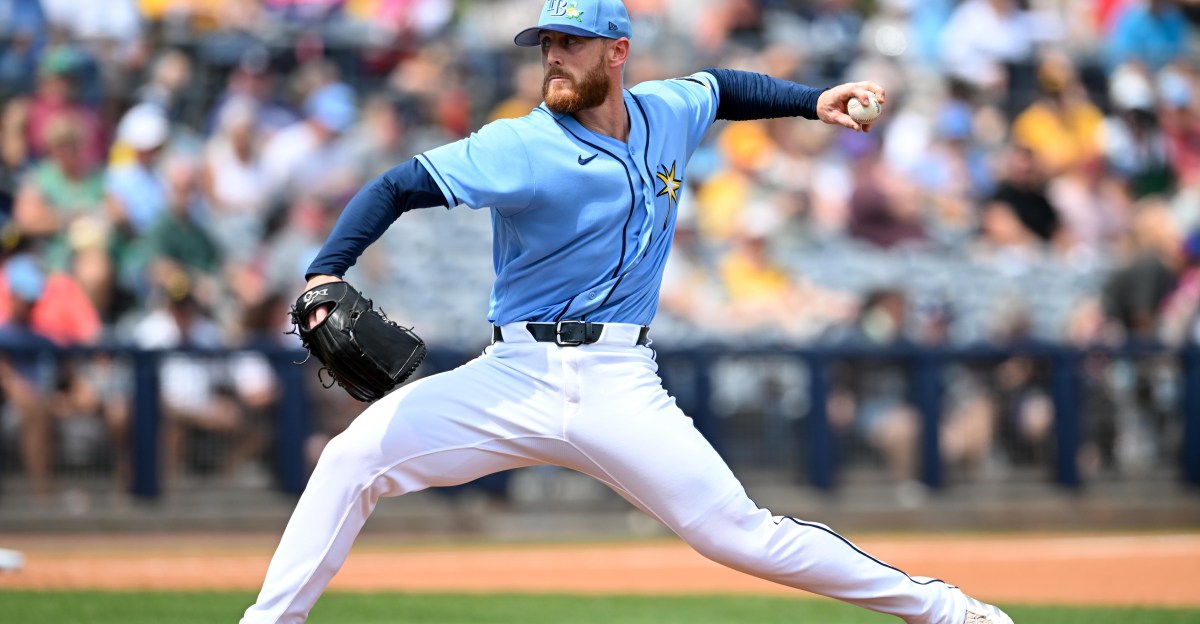
The Rays signed Cam Booser this past offseason as a non-roster invitee. He performed well enough during Spring Training to earn a spot on the Rays’ 40-man roster and remain in the organization’s plans despite opening the season in Durham.
Booser has the lowest walk rate of his career while still getting above average swing-and-miss on his stuff. The Rays have helped Booser accomplish this by getting him in the zone more with his cutter. Cutters are naturally platoon-neutral offerings, so optimizing his cutter shape has helped him handle both righties and lefties. Below are the differences in his cutter from 2025 in the majors to what he has shown in Durham this year:
Prior to the adjustment to the shape, Booser’s only in-zone weapon was his four-seamer. It’s a good pitch with solid velocity and ride from his slot – especially from the left side – but major league hitters are talented. Hitters could reasonably narrow their decision-making process. If a pitch was going to finish in the zone, it was most likely Booser’s four-seamer.
Now that Booser has a second pitch he can reliably land in the zone, hitters can no longer assume every strike will come from the four-seamer. Stuff models will likely favor his old cutter shape because the additional depth gave it more bat-missing potential. The tradeoff is that Booser now throws the pitch for strikes far more often. To mitigate the risk of the flatter shape getting hit hard, the Rays have altered his usage.
Hitters are less likely to swing early in counts; the league swing rate this season is just 38.1% in the first two pitches of an at-bat compared to 55.3% after the first two pitches. The Rays have Booser throwing his new cutter nearly 60% of the time within the first two pitches of an at-bat. He was doing it at just 20% last season. Booser throwing his cutter more when hitters are less likely to swing helps hedge the risk of it getting hit while still accomplishing the same goal of keeping hitters from sitting four-seam.
Booser has adapted well to the Rays pitching philosophy of pounding the zone with less than two strikes and then looking to expand the zone. He now has two distinct shapes in two distinct velocity bands that he can attack the zone with before using his plus breaking ball to generate chases and whiffs outside of the zone. On paper, the shape change may look like a step backward because it sacrifices some movement. In practice, it appears to be making the entire arsenal play better by giving Booser a second pitch he can confidently attack the zone with. If the strike-throwing gains hold, this version of Booser looks much more capable of handling meaningful major league innings.