[ad_1]
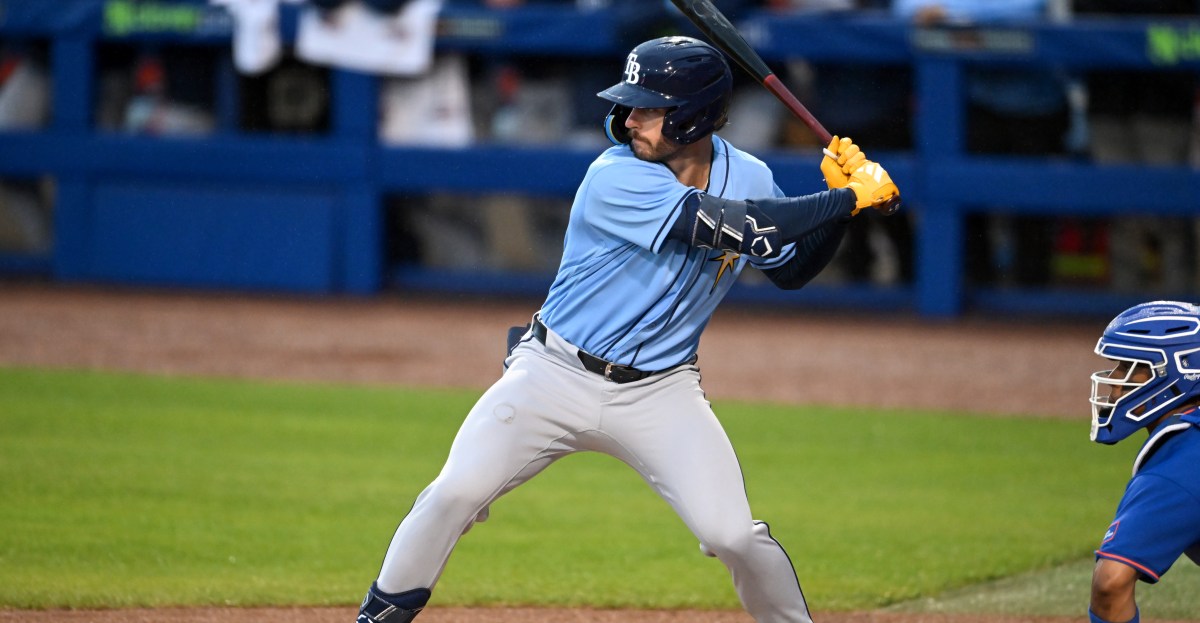
Jacob Melton was acquired by the Rays as the centerpiece in the Brandon Lowe trade. He brings a high-impact toolset: fringe 70 power, plus defense across all three outfield spots (including center field), and above-average speed.
Through his first 15 games with Triple-A Durham, that hasn’t translated to production. Melton is currently running a 74 wRC+. Why would someone with a strong track record of upper-minors performance be struggling in AAA?
There are a few reasons for this. First, it’s likely just random variance in a small sample. It’s not even May yet, there’s no need to be concerned. Another reason is that Melton is currently undergoing an adjustment to his approach, so his early struggles may be less about regression and more about recalibration.
In order to get the most out of his profile as a power hitter, Melton needs to ensure he’s consistently hitting the ball at optimal angles. He has seen year-over-year improvement in his SLG on contact (SLGcon), measured per “BBE” (Batted Ball Event, e.g. anytime a bat makes contact with the ball).
- 2024: .560 (127 BBE)
- 2025: .729 (97 BBE)
- 2026: .750 (22 BBE)
League average SLGcon in AAA typically sits in the mid to upper 500s each season, so we can see that he has gone from accessing his power from an average rate to a well above average rate so far this season. His launch angle (LA) distribution helps explain why.
Analyzing LAs in buckets adds an important layer than is often overlooked when one exclusively considers average LA. Categorizing LAs in groups paints a more detailed picture of a player’s batted ball distribution – something we can see with Melton’s LA buckets below:
It’s too small of a sample so far in 2026 to say that the data will be the same for the rest of the season, but the trends are more important than the exact numbers. Melton is getting into line drive and fly ball angles more consistently, and his hardest contact is coming at optimal angles for damage too. His average hardhit LA has climbed from just 9 degrees in 2024 to 19 degrees so far in 2026. I’d expect those improved angles to translate to more in-game production over a larger sample, but that production comes with a trade-off.
Melton is whiffing significantly more this season as a result of his shift in approach. In many ways, this looks like a deliberate trade-off: sacrificing contact to unlock more impactful contact. After maintaining a solid 23.4 whiff% across 2024 and 2025 in AAA, it has significantly increased to 41.4% this season. That level of swing-and-miss would be difficult to sustain at the major league level.
Melton can hedge against this by improving his swing decisions and figuring out a two-strike approach. The two data points I’ll be following are his zone-minus-out-of-zone (Z-O) swing% with less than two strikes and his whiff% with two strikes.
He’ll need to be selective and disciplined to maintain his plus damage on contact. His Z-O swing% so far this year is a 38.9%. This number is currently better than average but getting it closer to 40% and higher would be ideal for Melton’s profile. It appears that he’s doing well in this area so far.
His two-strike approach is less polished as Melton is currently whiffing on 53.7% of pitches with two strikes. One possible adjustment is incorporating more opposite-field intent in two-strike counts. That would allow him to see the ball deeper and naturally shorten his swing, which could help reduce swing-and-miss. Importantly, this kind of situational adjustment wouldn’t necessarily come at the expense of his improved damage on contact.
Those two markers – early-count swing decisions and two-strike whiff rate – will be key to monitor as he works toward impacting the major league roster later this season and pushing for a role in 2027.
[ad_2]
Source link