Patrick Williams, TheAHL.com Features Writer
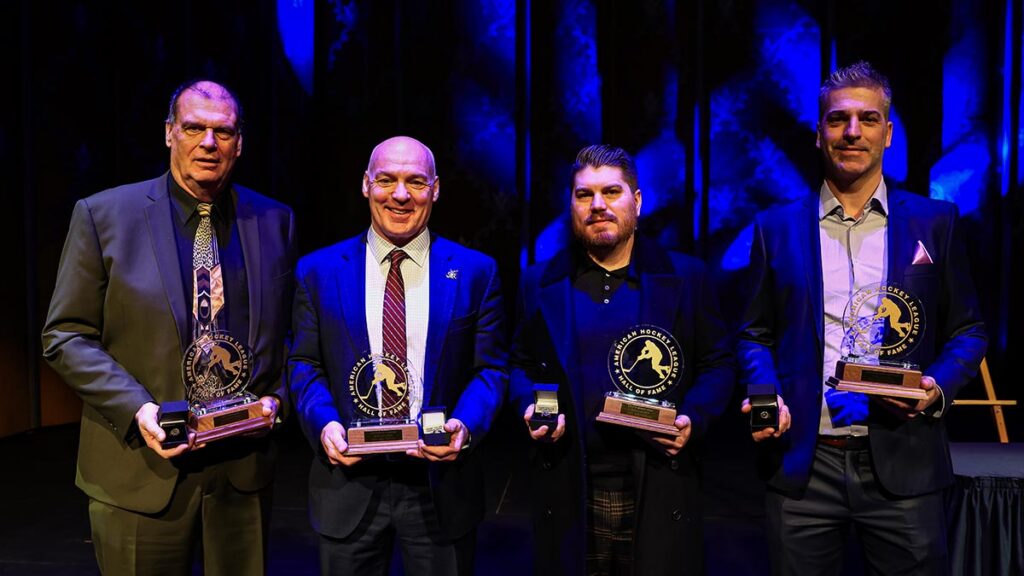
ROCKFORD, Ill. … On the surface, at least, the 2026 AHL Hall of Fame Induction and Awards Ceremony was about hockey and accomplishments.
Goals. Assists. Points. Calder Cup championships – 10 of them among the four inductees. Personal awards. Reaching the NHL.
Success.
Chris Bourque, Alexandre Giroux, Jim Wiemer and Wendell Young became the latest members of the AHL Hall of Fame in a ceremony at Rockford’s historic Coronado Theatre on Wednesday. Bourque’s playmaking ability got him there. Giroux was one of the best goal-scorers of his era. Wiemer transitioned from a forward to a defenseman on his way to 325 NHL games. Young stopped pucks for a living before moving into management and winning some more.
But the ceremony really was about relationships and life lessons. With spouses, children and grandchildren. With parents and siblings. With friends and teammates. With coaches, even those who dealt them some tough love as young AHL prospects.
For Bourque, the family name achieved legendary hockey status long before Chris came to the AHL as a 19-year-old late in the 2004-05 season.
His father, of course, is Hockey Hall of Fame defenseman and Boston Bruins icon Ray Bourque. Coming into the AHL with that surname, Chris had to deal with that kind of pressure. But he was brought up in exactly the right environment in the Washington Capitals’ system, begin his pro career full-time with the Hershey Bears in 2005. He had Bruce Boudreau as his head coach. By the end of the first season, he was a Calder Cup champion.
Then his career really took off, as Giroux joined the Bears the following season. It was the perfect union. Bourque’s eye and playmaking skills. Giroux’s NHL-caliber shot. Hershey went back to the Calder Cup Finals in 2007. After a half-season detour to the Atlanta Thrashers, Giroux came back to Hershey and reunited with Bourque. Another Calder Cup title followed in 2009. Bourque had his own move to the NHL before coming back to Hershey for the rest of the 2009-10 season. Hershey won a league-record 60 games and skated the Calder Cup once again.
When Bourque looked out across the audience at the Coronado Theatre on Wednesday, he said, “It is surreal to be standing here.”
With Giroux sitting off to his left on the stage, Bourque said to his long-time accomplice, “It’s only right that we’re doing this together.”
The AHL is young. Really young – and sometimes it can be easy to overlook that fact. Players are in their early twenties. Some of them, like AHL All-Stars Konsta Helenius and Ilya Protas, are still teenagers.
When we are young, we often want to reach our goals quickly. Giroux was no different when he came into the AHL in 2001 as a seventh-round pick of the Ottawa Senators.
Slow down, Giroux told the many young players in attendance for the ceremony.
“When I started playing in the American League,” Giroux recounted, “I didn’t plan or play for the Hall of Fame. I was just really happy to be there, happy to play the [sport] that I love. (Looking back) I was really proud of what I was always doing. I was happy to be in the American League. I was proud to do what I love, and it was a privilege to do it for a living.
“Don’t wait for something better to be happy. Enjoy the ride because it’s worth it, and be proud of who you are now. Every day you go to the rink and spend moments with hockey teammates should be the best day of your life. “I had a lot of ups and downs, but the people you meet along the way help you go through those times.”
The video recapping Giroux’s career before his induction speech brought back many of those connections from when he was himself a 20-something prospect.
“Seeing my ex-teammates talk about me like that makes me feel really special,” Giroux said. “I’m lucky to have them in my life now as a friend.”
Wiemer learned the pro game from one of the toughest: Mike Keenan. “Iron Mike.” Coming to the Rochester Americans as a fourth-round pick out of the Ontario Hockey League, Wiemer had some early success as a forward. A 19-goal rookie season seemed to indicate that the parent Buffalo Sabres might have had something with their young prospect.
Then came that one night against the Fredericton Express. In need of a body for the blue line because of, well, some miscues by one of Keenan’s defensemen, the coach barked at Wiemer to take a shift on the blue line.
Wiemer soon became an outstanding two-way defenseman in the AHL, winning the Calder Cup with Keenan and the Amerks in 1983. He played 64 games in Buffalo the following season.
“Hockey shaped me,” Wiemer said in his induction speech. “It challenged me.”
And so did Keenan, someone plenty of players bristled at through the years. But for Wiemer, Keenan was exactly who he needed. Able to blend some of his offensive eye with the 6-foot-4, 200-pound brawn that the 1980’s so often called for, Wiemer blossomed on the back end. He had a 24-goal season with the New Haven Nighthawks in 1985-86 and really found his NHL role with the Boston Bruins in the second half of his career.
Young’s last stop in his 18 pro seasons has proved to be his longest as well.
He came to the Chicago Wolves already having accomplished plenty. There were back-to-back Stanley Cup championships with the Pittsburgh Penguins. A magical spring of 1988 with Hershey in which the Bears went 12-0 on their way to the Calder Cup. He got into 187 NHL games, winning two Stanley Cups with Pittsburgh.
He had made it.
But Chicago provided him a second act. He played seven seasons with the Wolves in the International Hockey League, winning two more championships. From there he went into Chicago’s front office in 2001, then became an assistant coach, and eventually became the team’s general manager. Along the way, he added three more Calder Cup titles to his resume in 2002, 2008 and 2022. He went 571-375-136 (.591) as Chicago’s general manager, navigating the team through several different NHL affiliations.
The Wolves, Young explained in his induction speech, have a “core covenant.” Wolves chairman of the board Don Levin has been there since the team’s start in 1994. Young is a franchise fixture. Staff members find their niche with the Wolves and build long careers with the team. Young had many of those same people in the audience for his speech. And all of that came before he even got to a lengthy thank-you list to his wife, Paula, and their family. The couple met before Young had even gone off to Ontario Hockey League in 1980 to begin a career that continues today.
Be it actual family, friend, or teammate, that Wolves covenant always holds.
“No matter what, family first.”