[ad_1]
In fantasy baseball, breakouts are where leagues are won. These are not the names buried at the end of draft boards or the mid-round discounts that still require patience. Breakout hitters are players already on the radar whose skill growth, role security, or statistical foundation points toward a real leap into early-round relevance. They’re the ones who turn strong rosters into dominant ones. After working through deep sleepers and sleepers over the past two weeks, this is the next rung on the ladder. These hitters are being drafted with clear expectations, but their current prices still assume stability rather than acceleration. With another step forward, they can push into All-Star-level production and anchor fantasy lineups for the season ahead. Using early ADP trends alongside recent performance and underlying indicators, we’re focusing on hitters positioned to make that jump from solid contributor to potential cornerstone. This is where projection meets conviction and where the payoff can direct the shape of a season.
Kyle Stowers (ADP 142)
In roto formats, Stowers checks one of the hardest boxes to fill with bankable power without a batting average drain. In 2024, he posted a .288/.368/.544 line with 25 home runs and 73 RBI in only 117 games. Pro-rated over a full season, that production lands comfortably in the 30–35 homer range, a level of pop that usually costs a top-75 pick. An oblique injury ended his season early and continues to weigh down his draft cost, but nothing in his underlying data suggests lingering concern. Platoon splits against left-handed pitching remain the one contextual risk, though projected everyday at-bats in the heart of Miami’s lineup should allow his strengths to carry full-category value. At age 28, he’s firmly in his prime and no longer fighting for role security.
Statcast backs up the breakout. Stowers grades out in the top 15 percent of the league in bat speed, barrel rate, and average exit velocity, putting him in the same batted-ball neighborhood as established power bats. The strikeout rate is elevated, but that’s an acceptable trade-off when the quality of contact is this loud and the batting average foundation has already proven playable. You know that the profile looks oddly similar to last season’s MVP, albeit a toned-down version. From a comparative lens, the profile looks most similar to Teoscar Hernández’s peak seasons or a lighter-strikeout version of early Pete Alonso, being hitters who can anchor home runs and RBI without actively sabotaging average. If the plate discipline stabilizes even marginally, Stowers has a realistic path to returning top-75 roto value while being drafted nearly 70 picks later. This is a clear breakout opportunity at an affordable price point.
Ben Rice (ADP 50)
If you somehow made it through the offseason without seeing Ben Rice’s name pop up, consider this your formal introduction to one of the cleanest breakout bets for 2026. A left-handed bat in Yankee Stadium already gives him a head start, but what really matters is that he showed last season he can handle both the production and the pressure that come with the job. Posting a .255 average with 26 homers over 138 games while maintaining catcher eligibility is not a small feat, especially for a player stepping into a major run-producing role. Taking over Paul Goldschmidt’s spot in the middle of the order was a significant transition, and Rice didn’t just survive it—he looked comfortable. Even with Goldschmidt returning to the Yankees, Rice should remain locked in as the primary cleanup hitter thanks to his bat and positional flexibility. He’s already being drafted inside the top 50 overall, but the price still leaves room for profit given the combination of role security, park factors, and skill growth.
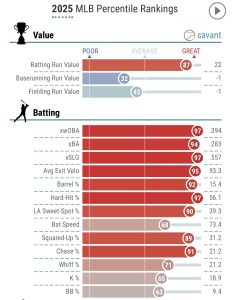
The surface-level batting average undersells what Rice actually did at the plate. The .255 mark looks artificially low based on his underlying contact quality and should normalize closer to the .280 range going forward. As the season progressed, he clearly leaned into a more fly-ball–oriented approach, a shift that pairs perfectly with his home park and should translate into additional home run output. Rice’s minor league track record backs this up. He consistently ran HR/FB rates in the low-to-mid 20 percent range, well above the 17 percent mark he posted in 2025, suggesting there’s still untapped power coming as he enters his age-27 season. The positional edge is a big part of the appeal here—he should be the second catcher off the board in most formats while still logging regular at-bats thanks to his ability to handle first base. If everything clicks, it’s not hard to envision a ceiling season where Rice hits .280 with 35 homers, 100 RBI, and sneaks into double-digit steals. He’s not fast in a traditional sense, but he runs well enough—think Cal Raleigh–swift—to chip in a handful of bags when pitchers get lazy. At that point in the draft, that’s the kind of profile that can tilt a league.
Drake Baldwin (ADP 92)
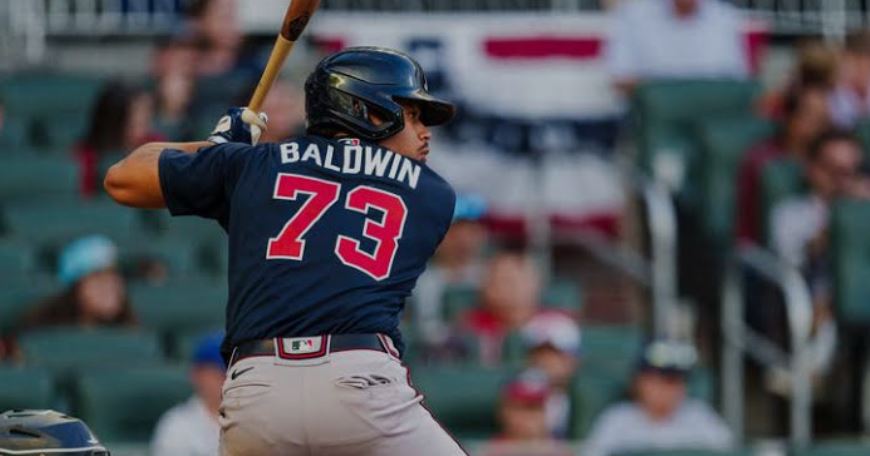
Drake Baldwin quietly checks a lot of the boxes fantasy managers look for when hunting the next catcher to make the leap. In 2025, he grabbed a job out of spring training and delivered a season with .274 average, 19 homers, and 80 RBI. Switch-hitting catchers with real offensive upside are rare, and Baldwin’s combination of plate discipline (15% strikeout rate), contact ability, and developing power gives him a much higher ceiling than the typical backstop profile. He’s not being drafted as a difference-maker yet, but the skill set suggests he should. What stands out most is Baldwin’s approach. He doesn’t sell out for power, and that restraint works in his favor at a position where batting average stability is often nonexistent. His ability to spray the ball to all fields while keeping his strikeout rate in check gives him a strong foundation for everyday production. As teams increasingly prioritize catchers who don’t crater the lineup offensively, Baldwin’s bat should keep him in the lineup more often than the average catcher, even on days he’s not behind the plate.
From an underlying metrics perspective, Baldwin looks like a hitter still climbing toward his power peak. His contact rates and zone control suggest the batting average floor is higher than most catchers, and there’s reason to believe the power output will continue to tick up as he matures physically and gains confidence attacking pitches he can drive. His batted-ball profile points toward room for growth in pull-side authority. Baldwin has shown flashes of loft gains without becoming overly fly-ball dependent. As that power develops, even modest improvements in HR/FB rate could push him into the mid-20s homer range over a full season. A realistic outcome looks like a .275 hitter with 20–25 home runs and solid counting stats relative to the position. He has a clear path to finishing as a top-five option at the position without ever being drafted as one.
Jakob Marsee (ADP 149)
Marsee made a strong first impression following his August call-up in 2025, finishing the season with an eye-opening two-month stretch that put him firmly on the fantasy radar. Over 55 games, he hit .292 with five home runs and 14 stolen bases while consistently slotting into the top third of the lineup and providing steady defense in center field. That combination of speed, on-base ability, and lineup placement quickly translated into fantasy relevance. Even a simple extrapolation of that sample paints a useful player, landing in the range of a 14-homer, 39-steal season. Skeptics will point to a .357 BABIP as a driver of the success, but the underlying indicators offer some reassurance. A .275 expected batting average suggests the production wasn’t purely luck-based and that there’s a legitimate offensive foundation for the 24-year-old to build on.
Repeating last season’s output alone would put Marsee firmly in the breakout conversation, but there’s reason to believe there’s more ceiling here. Speed has always been his calling card. In the minors, he swiped 51 bags across 137 games in 2024 and followed that up with 47 steals in just 98 games the following season, showing both volume and efficiency as a runner. What makes the profile particularly intriguing is his approach at the plate. Throughout his minor league career, Marsee consistently posted walk rates in the mid-teens, a notable contrast to the 9 percent mark he ran in the majors in 2025. That skill set matters for any speed-first player, as it raises the floor by creating more opportunities to get on base. He still managed a .363 OBP last season while pairing it with a chase rate nearly 10 points better than league average, a strong indicator that his plate discipline can support everyday playing time.
At his current cost, it’s easy to dream on a season where Marsee hits .275, pops 15 home runs, steals 50 bases, and contributes healthy counting stats simply by staying near the top of the order. For the price of a 13th-round pick, that blend of speed, discipline, and emerging power makes him one of the more appealing upside plays in the middle rounds.
[ad_2]
Source link