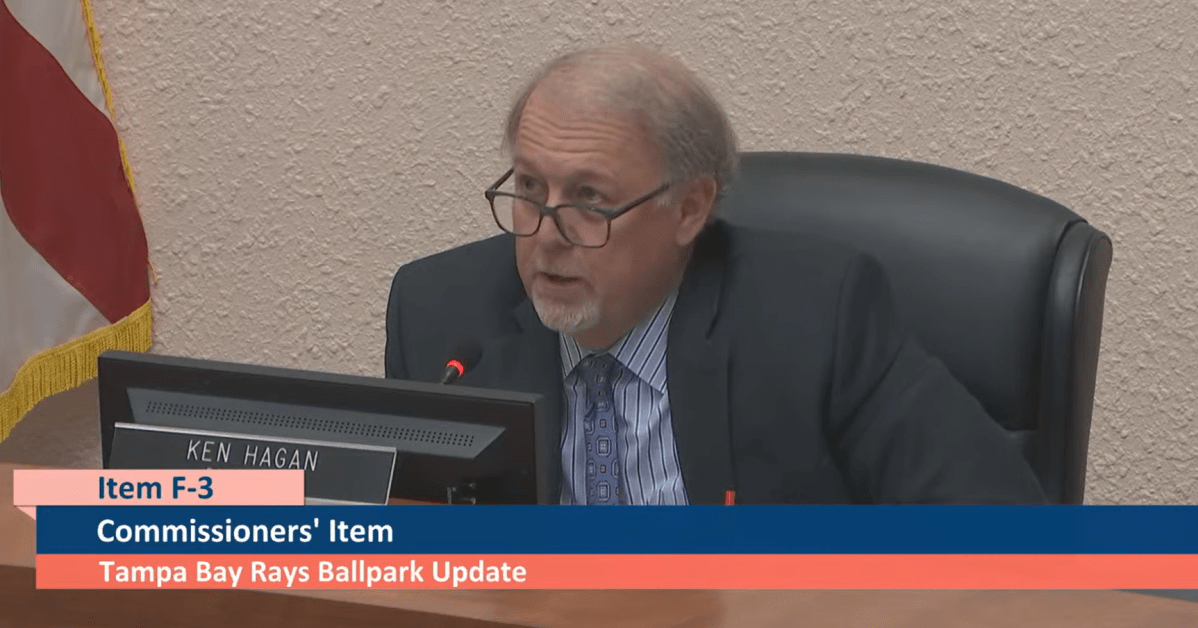
The Hillsborough County Commission today unanimously approved a motion to discuss a “framework” for negotiating a deal with the Rays to build a stadium and a mixed use development on the current site of Hillsborough College, providing a first glimpse into how the stadium might be funded.
Commissioner Hagan introduced a motion based on this document. It outlines a $2.3 billion stadium, with the Rays expected to pay half plus cost overruns, and the public sector — likely Hillsborough County and the City of Tampa — covering the other half. The stadium would anchor a broader development project where the team says it would invest $8–10 billion.
The document includes a list of potential county funding sources, including proceeds from the county’s 6% hotel tax and “excess” funds from the county’s voter approved Community Investment Tax (CIT), which initially built the Buc’s stadium.
Four of the remaining six commissioners commented during the meeting.
Commissioner Myers referenced the full house that turned out to see the Lightning play in NHL’s Stadium Series, and Commissioner Cohen noted that if our county lost the team and sought to get another one through expansion, we’d be looking at over $2 billion in fees just for the privilege of having a team, and we’d still have to build a stadium.
The concerns came from Commissioners Wostal and Boles, who describe themselves as fiscal conservatives. Both have opposed county spending on programs such as affordable housing and the county Crisis Center. They questioned whether CIT funds could legally or appropriately be used for this project.
When voters renewed the CIT in 2024, restrictions were added so the money could not go toward building new stadiums — only for stadium maintenance, public safety, and road improvements. Hagan’s document suggests that if tax collections exceed expectations, those “extra” funds might be used for the Rays’ stadium. Wostal and Boles made clear they oppose that idea and signaled they would not support a deal that depends on those funds.
Overall, commissioners seemed excited about the scale of the project, but finding $1.15 billion in public money will be difficult.
One of the funding sources under consideration, for example, is the hotel tax, which Hillsborough County raised to 6% in 2019. One idea is to use part of the hotel tax. The county raised this tax to 6% in 2019, and some discussion centered on using the “sixth cent” for the stadium. But this money is already committed to many other purposes. It helps pay for improvements to the Lightning’s arena, supports cultural institutions like the Straz Center, and funds events such as the Gasparilla Arts Festival. Large portions also go to the Convention Center and tourism marketing, priorities strongly backed by the hospitality industry, which may resist redirecting funds to a stadium.
The city of Tampa will also be expected to participate in the financing. It remains to be seen whether the framework will get a similarly positive response from them, and Mayor Castor has seemed enthusiastic about keeping the Rays, but has never tipped her hand about possible funding sources.
While today’s vote is the first step in the team’s pursuit of funding, it certainly keeps the Rays on track for their quest to have a new stadium ready for Opening Day 2029.