[ad_1]
The Fantasy Football Game Time Effect helps us uncover data trends and identify players who consistently produce stand out performances. Every week, managers face key questions: Should I start a player on Thursday Night Football, or wait until Sunday? Can I trust my stars when their team travels overseas for an international game? And do primetime matchups at night really change fantasy output compared to earlier, midday games when players might be more rested?
In this article, we’ll break down which game time frames have produced the best fantasy performances through the first 7 weeks of the 2025 NFL season. By analyzing the data, we can uncover whether timing truly matters and how you can use these trends to gain an edge for the rest of your fantasy season.
The Avg. Difference shown in each table represents the gap between a player’s average fantasy points per game within that specific time frame and their overall season average.
Sponsored Ad
Does Game Timing Impact Fantasy Football Performance? (Data Study)
🏈 Quarterbacks | Thursday Night Dominates
| Time Frame | Fantasy Points per Game (FP/G) | Avg. Difference |
|---|---|---|
| Thursday Night Football (TNF) | 20.4 | -0.6 |
| Monday Night Football (MNF) | 18.9 | -1.2 |
| Sunday Night Football (SNF) | 17.9 | -3.0 |
| Sunday 4 PM Games | 17.1 | -3.1 |
| Sunday 1 PM Games | 16.1 | -1.9 |
| Sunday Morning (International) | 15.9 | -2.5 |
Data is based on the starting quarterback of each game through the first seven weeks of the 2025 season.
Starting with the quarterback position, the data shows that Thursday Night Football (TNF) has produced the highest average fantasy points per game (FPPG) for quarterbacks compared to any other game window. The gap is notable, about 1.4 more fantasy points than the next-closest timeframe and 4.5 more points than international games.
However, it’s less about TNF quarterbacks over performing and more about them holding their season averages. The average difference between TNF performance and season FPPG is only -0.6, which suggests consistency rather than a true spike.
Of the 13 quarterbacks who have played on TNF this year, 10 scored at least 18 fantasy points, reinforcing that you can usually trust your Thursday QB to perform to expectation. If you have a stud playing Thursday night, you should feel confident starting him.
On the flip side, international games are the trap window. The sample size is small, but the results are extreme. Only one quarterback has topped 20 fantasy points internationally this season (Matthew Stafford, with 27 points). Time-zone changes and travel likely contribute to these results. If possible, avoid starting your quarterback in international matchups unless you have no other strong option.

Now let’s look at the biggest negative swings: Sunday Night Football (SNF) and Sunday 4:00 PM games. Both windows showed an average drop of about 3 fantasy points below a QB’s season average. On SNF, big-name quarterbacks like Patrick Mahomes, Drake Maye, and Jared Goff all finished 5+ points below their norm in primetime spots. Some of this can be explained by tougher opponents and game scripts, but the trend is worth noting.
The larger concern is the Sunday 4:00 PM slate, which has the biggest sample size. Only 3 of 27 quarterbacks exceeded their season average in that window. Even elite options like Lamar Jackson, Dak Prescott, and Jalen Hurts fell into the lower-production range. It’s not always drastic, but it’s a trend to consider when setting lineups.
Bottom line:
- ✅ TNF quarterbacks are safe starts — they hit their averages more often than not.
- ❌ International games are high-risk — avoid QBs in these matchups when possible.
- ⚠️ Sunday evening/late afternoon games show notable regression, even for elite QBs.
Sponsored Ad
🏃♂️Running Backs | Primetime Glory Under the Lights
| Time Frame | Fantasy Points per Game (FP/G) | Avg. Difference |
|---|---|---|
| Thursday Night Football (TNF) | 16.3 | +2.86 |
| Sunday Night Football (SNF) | 13.7 | +1.53 |
| Monday Night Football (MNF) | 12.8 | +1.19 |
| Sunday 4 PM Games | 11.7 | +0.52 |
| Sunday 1 PM Games | 11.3 | +0.52 |
| Sunday Morning (International) | 8.9 | -0.79 |
Data is based on running backs with at least five carries in the game.
Moving over to the running backs, we see a similar trend — Thursday Night Football (TNF) is once again the top-performing timeframe. But unlike quarterbacks, the gap for running backs is even more dramatic. TNF running backs outscore the next-closest timeframe by nearly 3 fantasy points, and they almost double the output of international-game running backs.
The most telling metric is the average difference vs. season FPPG. TNF running backs outperform their season average by +2.86 points, the highest boost among all windows. The consistency is impressive: 13 of 14 TNF running backs scored at least 10 fantasy points, and 7 finished with 16+.

The only exception was Austin Ekeler, who underperformed during that stretch. Players like Jaylen Warren, Cam Skattebo, and Kyren Williams all smashed their averages on Thursday night. Bottom line — TNF is a green-light spot for running backs.
International games, however, continue to be a fantasy landmine. Only three RBs have cleared 10 fantasy points in those contests. Kenneth Gainwell‘s big outing skews the averages (+20 FPPG difference on his own), but removing him reveals the real picture: a -3.74 FPPG average difference for international running backs. That reinforces the trend from quarterbacks — international games are a fade spot.

Another takeaway: Primetime in general = running back juice. TNF, Sunday Night Football, and Monday Night Football all show at least +1 fantasy point above average for RBs. Not every player smashes under the lights, but the data shows that primetime backs tend to elevate their production. If you’re unsure between two RBs and one is playing in primetime, that may be a helpful tiebreaker.
Meanwhile, Sunday 1 PM and 4 PM slates are steady and neutral — solid production but no meaningful spike or drop. There’s nothing alarming here — just consistent output.
Bottom line for RBs:
- ✅ TNF = elite RB spot — strong historical overperformance
- ⚠️ Primetime boosts RB upside
- ❌ International games = avoid if possible
- ➖ Sunday slates are stable and safe
Game Time Trivia | Which QB has the best Monday Night Football performance through Week 9 of the 2025 NFL season?
🎯 Wide Receivers | Under the Lights
| Time Frame | Fantasy Points per Game (FP/G) | Avg. Difference |
|---|---|---|
| Sunday Night Football (SNF) | 11.8 | +1.62 |
| Thursday Night Football (TNF) | 11.7 | +1.21 |
| Sunday 1 PM Games | 10.9 | +0.56 |
| Sunday 4 PM Games | 10.6 | -0.23 |
| Sunday Morning (International) | 10.2 | +0.37 |
| Monday Night Football (MNF) | 9.4 | -0.94 |
Data is based on wide receivers running at least 20 routes in the game.
Next up is the wide receiver position, and here we finally see a shift at the top. Sunday Night Football (SNF) narrowly edges out Thursday Night Football (TNF) as the best scoring window for receivers — only by 0.1 FPPG, but it’s enough to crown a new leader. The more notable difference comes in the “average difference vs. season FPPG,” where SNF receivers gain +1.62 points, a 0.41-point boost compared to TNF.
What’s fascinating is which receivers benefit most. Several elite names — Malik Nabers, Drake London, and Amon-Ra St. Brown — actually saw 7+ fantasy points below their season average in Sunday night appearances. Meanwhile, many mid-tier fantasy wideouts thrived in the spotlight.

Players like Romeo Doubs, Zay Flowers, and Stefon Diggs outperformed significantly, posting +10 or more fantasy points over their season averages. Some of this is matchup-based, but it also reflects the NFL’s scheduling of competitive teams in primetime — meaning tougher defenses for star WRs, but opportunity spikes for secondary options.
The most surprising window is Monday Night Football (MNF) — receivers have the lowest fantasy points per game (9.4) and the lowest average difference (-1 point) across all time frames. Six receivers (such as Drake London, Tez Johnson, and Courtland Sutton) did post +4 or more fantasy points, but a much larger group underperformed. In fact, 14 wideouts saw a drop of 4+ points, including names like Zay Flowers, Deebo Samuel, and Ja’Marr Chase. Even international games slightly outperform MNF, making Monday night the biggest WR landmine.

The Sunday morning, 1 PM, and 4 PM windows remained relatively neutral — steady production that’s far more influenced by matchups, weather, and game environment than kickoff time.
Key takeaways for WRs:
- ⭐ SNF and TNF are strong windows for WR production and upside
- ⚠️ MNF is the danger zone — higher risk of underperformance than any other slot
- ➖ Sunday daytime games = steady, matchup-driven results
- 🎯 Consider upgrading mid-tier WRs in primetime matchups — and temper expectations for stars vs top defenses under the lights
BREAKING NEWS
📊 Our Data Hub is live! Get custom player stats in the Dynasty Nerds App.
📱 Use code data-hub for 20% off any membership!
🚀 Tight Ends | Short Week Early Success
| Time Frame | Fantasy Points per Game (FP/G) | Avg. Difference |
|---|---|---|
| Thursday Night Football (TNF) | 12.5 | +3.42 |
| Sunday 4 PM Games | 10.2 | +1.78 |
| Sunday Morning (International) | 8.7 | +2.31 |
| Sunday Night Football (SNF) | 8.3 | -1.41 |
| Sunday 1 PM Games | 8.1 | -0.59 |
| Monday Night Football (MNF) | 8.1 | +0.87 |
Data is based on tight ends running at least 15 routes in the game.
Finally, we move to the tight end position — and once again, Thursday Night Football (TNF) is the clear king. TNF tight ends hold a 2.3-point edge over the next-closest timeframe and deliver an impressive +3.42 average difference vs. season FPPG. Even accounting for Pat Freiermuth’s massive +20 outlier performance, the average still sits at a strong +2.62.
This means TNF tight ends consistently overperform expectations. Of the 16 tight ends in the sample, 10 scored 10+ fantasy points, making TNF a strong confidence window for the position. The only notable underperformers were Trey McBride (-4.0), Theo Johnson (-4.3), and Jake Ferguson (-9.3) — otherwise, tight ends delivered.
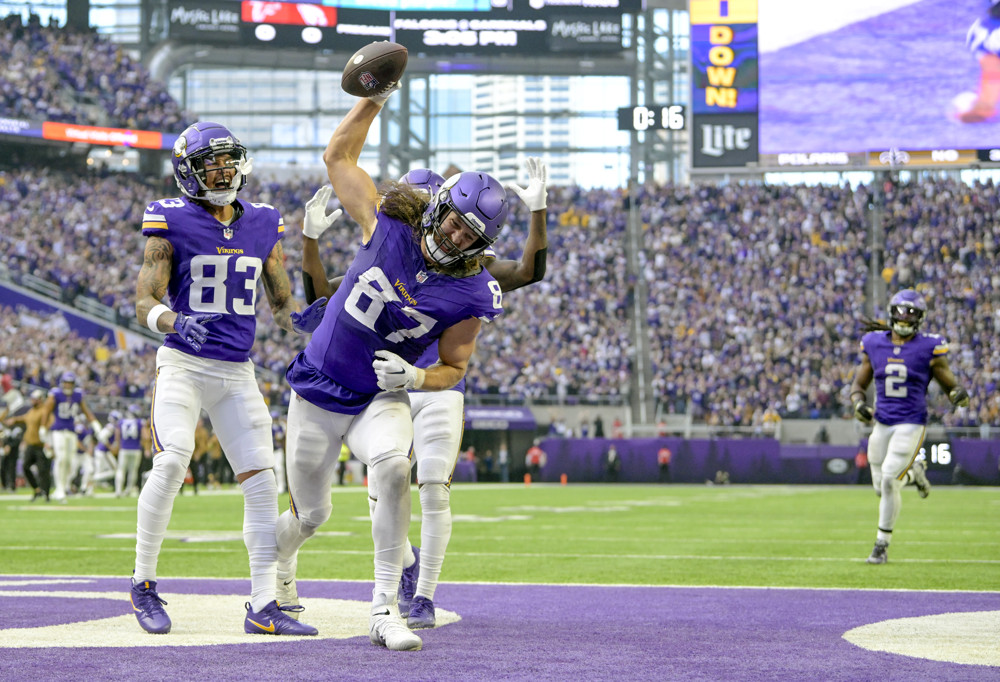
A surprising standout window is international games, where tight ends actually shine while other positions struggle. Outside of Mason Taylor’s dud, nearly every international tight end either met or exceeded expectations. David Njoku, T.J. Hockenson, and Evan Engram all produced above their season averages overseas. The sample is small, but it’s a notable outlier trend: when the NFL travels, tight ends travel well.
On the flip side, Sunday Night Football (SNF) looks like a potential danger zone for tight ends, but it’s not quite as bad as it appears at first glance. The group posted a -1.41 average difference, yet that drop is largely driven by three significant underperformances from George Kittle, T.J. Hockenson, and Theo Johnson. Those outliers pull the average down, and aside from them, most tight ends performed right around their season expectation — they simply didn’t show much upside in primetime.

The ceiling is limited as well: the best SNF performance came from Sam LaPorta, who posted a modest +5 fantasy point difference. So while SNF doesn’t necessarily sink every tight end, it also doesn’t provide much opportunity for breakout production. In short, SNF tight ends are safe floor, low ceiling plays — steady, but not where you typically find spike weeks.
A safe and underrated window for tight ends is Sunday 4 PM, which delivered the second-highest FPPG and a strong overall consistency profile. The worst performance in that slot came from Zach Ertz (-3.9), but most tight ends in this window landed at or above their season average, making 4 PM games a reliable timeframe for stable TE output.
Key takeaways for TEs:
- ✅ TNF remains elite — tight ends significantly outperform expectations
- ✈️ International games — quietly boost TE production
- ➖SNF — tight ends usually hold their floor but rarely pop
- ➖ Sunday 4 PM — stable and safe for tight end performance
🔗 Keep Building Your Dynasty
Key Takeaways | Fantasy Football Game Time Effect
- Primetime Power: Thursday and Sunday Night games consistently boost fantasy scoring, especially for running backs and tight ends.
- International Impact: Overseas matchups produce the steepest scoring drop across every position — tread carefully when your players travel.
- Sunday Stability: Midday and late-afternoon games deliver predictable, matchup-driven results — the safest window for baseline production.
🔥 Take Control of Your Dynasty Today
Want to see where your lineup stacks up? Start building like the pros with our most powerful tools and resources:
👉 It’s time to take control of your dynasty and see where your lineups truly rank.
🧠 FAQ | Fantasy Football Game Time Effect
Q1: Do players perform better in primetime fantasy football games?
A: Yes. Through seven weeks of the 2025 NFL season, players in primetime windows—especially Thursday and Sunday Night Football—have outperformed their season averages at most positions.
Q2: Are international NFL games bad for fantasy football scoring?
A: Historically, yes. International games show the largest average fantasy drop, with quarterbacks and running backs most affected by travel and time-zone changes.
Q3: Which position benefits most from Thursday Night Football?
A: Running backs. TNF data shows an average gain of nearly +3 fantasy points per game above season averages, making Thursday a favorable start window for RBs.
Q4: How should fantasy managers use this timing data for start/sit decisions?
A: When faced with close lineup calls, prioritize players in primetime matchups or standard Sunday slates over those in international games or Monday nights.
Q5: Where can I find more strategy and data breakdowns like this?
A: Visit Dynasty Nerds for more Deep Dives, rankings, and weekly fantasy football tools.
Trivia Answer | The best Monday Night Football performance to date was by Lamar Jackson in Week 3 against the Detroit Lions with 288 passing yards, 35 rushing yards, 3 TDs, and no turnovers for 32 points. (click to return)
Sponsored Ad
[ad_2]
Source link