MINNEAPOLIS — When it comes to payouts and ratings, football dwarfs other college sports during media rights negotiations. But lost amid the eye-popping rights fees in the Big Ten’s latest round of negotiations is how new agreements will impact the league’s men’s basketball programs. And the answer is significantly.
In 2023-24, CBS will televise 11 Big Ten men’s basketball games. When USC and UCLA join the league in 2024-25, CBS’ number grows to 15 annually through the 2029-30 season. Fox and FS1 will air 45 throughout their seven-year deal, while Peacock will stream 32 in 2023-24 and 47 during the final six years of the contract. Big Ten Network (BTN) will pick up the rest of the league games plus some nonconference action to total around 126 contests per season.
There’s one partner missing, and it’s a big one. ESPN has aired Big Ten men’s basketball since the 1980s, and the relationship has mutual benefits. The league remains a midweek ratings draw, and the network provides a well-known national platform. But beginning next year, the Big Ten’s appearances on ESPN will come from road appearances and exempt tournaments, not from Tuesdays at Assembly Hall or the Breslin Center.
“We’re so ingrained with them being a part of it, and they’ll continue to be a big part of sports,” Purdue coach Matt Painter said. “They’re just not with us. Now, it doesn’t mean that in seven years that they’re not back with us in some capacity, which I could see that happening.”
“Personally, for me, it was hard because so much of my life has been synonymous with ESPN being a partner,” Northwestern coach Chris Collins said, “and especially my 10 years here, having that platform, being able to have games on the platform of ESPN. It’ll be sad not to have them as a partner of our games.”
Many of the midweek Big Ten games on ESPN draw around 1 million viewers with both die-hard and casual observers tuning in. There is some concern that games leaving ESPN won’t garner as many eyeballs as before, which could impact recruiting. Big Ten officials, including commissioner Kevin Warren, have met with men’s basketball coaches to offer assurances about the sport’s importance to the league. There also are questions about future ACC-Big Ten Challenge games, which exclusively appear on ESPN’s family of networks.
The addition of UCLA and USC will leave Big Ten men’s basketball with 16 teams. (Stephen R. Sylvanie / USA Today)
“We’re two of the biggest brands in college sports, the Big Ten Conference and ESPN,” Illinois athletic director Josh Whitman said. “I have a hard time imagining that our two paths are not going to continue to intersect on a pretty regular basis, whether it’s through nonconference competition or some of the different events that happen over the course of the year. Obviously, we’re going to intersect on some fields in terms of football, bowl games and the like. So, I think the ESPN relationship, although it may not be as formal as it has been for some time, it’s going to continue to be there.”
“We’re still going to play ACC teams and Big East teams,” Warren said. “You’re going to be on ESPN. We’re working to see how those actual tournament and label games work out.”
The streaming-only component also brings questions. The NBC-owned Peacock requires a separate subscription fee available outside of cable and satellite packages. There still are fans who are not accustomed to streaming services, and the problems could resemble the distribution issues when Big Ten Network debuted for the 2007-08 sports season.
“Being on Fox or us being on BTN and not being on ESPN, from a consumer standpoint, I don’t think it’s that big of a deal,” Painter said. “It really isn’t. But if I’ve got to go stream something or I’ve got to go pay another monthly fee for something, will people do that? Will people do that to watch Indiana versus Purdue? I think so. But will they do that to watch Purdue versus a directional nonconference opponent? It’s a good question. That’s the one you don’t really know the answer to yet.
“But we’ve also got to understand, we’re in a place of change with how things are changing. Just from like, what you can watch and what you can see on from Netflix, Prime Video, on down the line, we’re a lot different than we were 10 years ago.”
The Big Ten was responsible for three of the top five most-watched games before the 2022 NCAA Tournament, according to Sports Media Watch. The Iowa-Purdue Big Ten championship game drew 3.59 million viewers, second only to former Duke coach Mike Krzyzewski’s home finale against North Carolina (3.98 million). The semifinals ranked third (Purdue-Michigan State) and fifth (Iowa-Indiana), while the Ohio State-Purdue game Jan. 30 was the 10th most-watched game. All four of those games appeared on CBS.
Scheduling principles
The Big Ten operates with several scheduling criteria, and its relationship with media partners comes first. Coaches have their own set of principles, and the league tries to make those accommodations. They include no more than two consecutive road games per school, arenas cannot host a men’s and women’s game on the same day, and each team gets at least two days to prepare for a game.
Sometimes, those directives become mere guidelines when television gets involved. A late-season option could turn a two-day prep into a single off day between games. Schools often have on-campus events that take precedence, such as commencement, or a specific request like a concert or another on-campus sport.
“We always look at basketball scheduling in two different areas as we get to the schedule,” said Kerry Kenny, the Big Ten’s senior vice president for television. “There’s the rigid contractual facility issues that you can’t change; those have to be in place. And then there’s the coaching principles, which are advisory to the process.
“We attempt in every way that we can to hit as many of those as possible on both the men’s and the women’s side. But at the end of the day, those really help us round out the schedule into the best possible schedule it can be, but we still need to deliver what’s in the TV contracts. And then when can facilities be used and when can they not be used.”
One core principle is an even home-away schedule in the league’s first and second halves. Because of arena commitments, including multiple sports, it’s not possible for perfect splits. This year, 11 Big Ten teams have five home and five road games in both the first and second portions. Purdue and Michigan State have even home-and-away splits after 12 games, while Ohio State’s are even after eight and 14 games.
Then there’s the division between weekend and weekday home games. That becomes both a financial and competitive issue for many programs. Weather and tipoff time often deter fans from attending midweek games, whereas weekend games might feature crowd sizes 30 percent larger.
“Sometimes we get boxed in by the way that the TV partners select games,” Kenny said. “For example, if one team is playing more road games on CBS because of the way that they selected games in a given year, then that team is going to be away on more weekends than they’re home because of where those games need to appear.
“There’s all of these different, sometimes competing, factors that work in concert with one another that you have to balance and just make sure you’re looking globally across how all 14 schools are impacted, how each of our four TV partners are impacted. You’re putting together a schedule that doesn’t overly burden one school or one program with multiple factors.”
Michigan State, Ohio State and Wisconsin all have only three weekend home Big Ten games, but they all have multiple weekend appearances on linear networks. The Spartans play five weekend road games on either CBS or Fox, while Ohio State has three and Wisconsin has two. Illinois plays only four weekend home games and has four road weekend games on CBS or Fox.
Kenny tries to compensate those teams in-season in other ways or year over year. Last year, Iowa had only three home weekend Big Ten games, and this year the Hawkeyes have six. Wisconsin and Michigan State each had seven home Big Ten weekend games in 2021-22 before flipping the other way this year.
“If this school had less home weekend games, then let’s make sure that we don’t give them a really rough sequence where they’re playing six out of nine away games or something along those lines,” Kenny said. “Because of circumstances that may have been outside of the control of the schedulers, who maybe didn’t have as many home weekend games last year? How can we work to improve that this year, so that they’re not experiencing the same thing for a second consecutive year?
“It may not be a complete wholesale change from where they were a previous year. But we’re just trying to balance across all schools, and then year over year, who’s impacted by what and make sure that we’re not making the same team experience the same thing over and over and over again.”
Big Ten hoops weekend home games
Upcoming travel
The arrival of USC and UCLA in 2024-25 brings numerous concerns about travel issues for athletes in all sports. It will impact basketball travel as much as any sport.
With most schools either flying charter aircraft or riding buses, the Big Ten does not schedule one team to play two opponents on one trip. That may change with the distance between Los Angeles and the next-closest Big Ten school, Nebraska, which is 1,500 miles away.
“It’s too early to get into specific details,” Kenny said. “But what I can say on that is that we’re listening to our current member institutions, we’re listening to USC and UCLA about what is the most efficient way to put together schedules in a way that balances student-athlete welfare, travel, geographic rivalries, all those different types of things. What’s the sequence of games? What’s the travel look like? What does the home-and-away rotation of opponents look like?”
Currently, the Big Ten makes minor travel adjustments by having a school like Minnesota or Nebraska play at Rutgers on a Saturday and then avoid a similar long trip to Maryland or Penn State a few days later.
Among the discussions is one trip to Los Angeles to play both USC and UCLA over two or three days. For the Trojans and Bruins, they could have similar stops to Detroit and play both Michigan and Michigan State, or Indianapolis to play both Indiana and Purdue. That’s similar to Pac-12 scheduling. In January, Arizona and Arizona State are scheduled for games at Washington and Washington State on a Thursday and Saturday.
“I think you will probably see some of those trends, not in football, but I think the Olympic sports and basketball,” Collins said. “I think you’ll have multiple-game road trips, which we don’t really normally have; that’ll be an adjustment. That’ll be more like kind of an NBA-type schedule, ‘Hey, we’re going on our West Coast swing,’ and you might play two or three games, and that might be part of the norm.”
The biggest remaining question mark for Collins is whether the Big Ten will expand again.
“We know we’re going to have the two L.A. schools. But do we go to 20 teams?” he asked. “Do we go to 18? Do we eventually have divisions? I think all those things are open for discussion.”
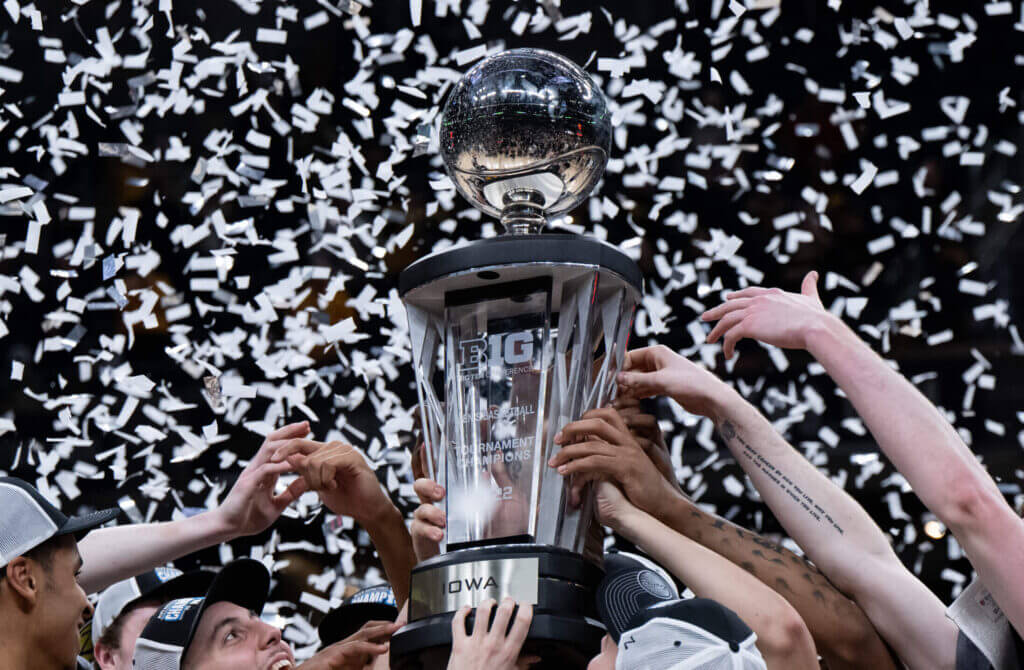
(Top photo: Zach Bolinger / Icon Sportswire via Getty Images)