[ad_1]
CHARLOTTE, N.C. — Midway through his fourth year as ACC commissioner, Jim Phillips has one overarching goal guiding most of his decision-making:
“That we have a sustainable model for college sports, that has a chance to be healthy,” Phillips told The Athletic this week, “and has the chance to have longevity to it.”
If only things were so simple. Instead, college athletics’ already unstable foundation is growing shakier by the day. The Big Ten and SEC will meet in Nashville this week to discuss, among other things, automatic College Football Playoff berths for their leagues, further exacerbating the growing gap between the proverbial Power 2 and every other conference — the ACC included.
Elsewhere, multiple super league proposals have emerged that challenge the existing conference model altogether and may hasten more widespread changes to the infrastructure of college sports. And as if that weren’t enough, on Monday, Judge Claudia Wilken gave preliminary approval to the proposed House v. NCAA settlement, which will allow schools to share revenue directly with college athletes for the first time — and as early as next year.
Many of those issues are outside of Phillips’ direct control, but not all of them. It’s Phillips’ job to prioritize things that will maintain the ACC’s positioning within the current college sports hierarchy — most notably, the league’s upcoming “look-in” period with ESPN in February 2025 regarding the ACC’s media rights contract.
To date, that “look-in” period has been viewed nationally as something of an inflection point for the ACC. Were ESPN to not pick up the option on its deal with the ACC, in theory, the league would be back on the media rights market in 2027 … or, much more likely, susceptible to a new wave of conference realignment — especially with the league’s two recent football powers, Clemson and Florida State, already suing with designs on getting out of the league. But that entire notion appears to be based on a misconception, or at least a misunderstanding of what February’s “look-in” period actually entails.
That’s because the ACC actually has two media rights deals with ESPN: one, its “base” deal, which was originally signed before the ACC Network was announced in 2016, and which focuses on ACC programming on Disney’s main networks (ABC, ESPN, ESPN2, etc.); and another, signed in 2016, which deals specifically with the ACC Network. Why does that discrepancy matter? Because only the “base” deal is part of February’s look-in period; the second, ACC Network-specific deal already runs through 2036 — which has not previously been reported — and overlaps with the ACC’s larger grant of rights.
Translation: Even if ESPN, for some unknown reason, opted not to finalize an extension of the “base” deal through 2036 — to be clear, it is Phillips’ and the industry’s expectation that the extension will be picked up — then the ACC would still have a media rights deal with ESPN that runs through 2036, which would seemingly protect the league from any Power 2 poaching. And what incentive would ESPN have to decline the ACC’s premier inventory?
(In FSU’s lawsuit against the ACC in Florida, the school claims Phillips unilaterally moved the “look-in” period back from 2021 to its current 2025 date.)
Instead, Phillips and the ACC are approaching the “look-in” as a way to negotiate in the margins of its base deal and maximize value for both the league and ESPN. Phillips said that could include negotiating for (among other things) better time slots for ACC games; putting more ACC games on the network’s top channels, instead of the ACC Network; and discussing “ancillary” revenue splits regarding areas like advertising and carriage fees.
“We have had very, very, very good conversations with them,” Phillips said, “and I fully expect that to get done.”
While Phillips spends this week in Charlotte as part of the ACC’s preseason basketball event, his fellow conference commissioners will be having their own shindig.
SEC commissioner Greg Sankey and Big Ten commissioner Tony Petitti will be in Nashville as part of larger talks between the Power 2 leagues and their athletic directors. High on their list of discussion topics, according to The Athletic’s reporting, is the prospect of multiple potential auto-bids for both leagues in the expanded College Football Playoff. The current CFP structure, which is in its first year of expansion, is locked in until 2026.
Count Phillips among those who would like to see the system in action before any further tweaks are made.
“We would all be best suited to just let it play itself out, and let’s watch what happens this year, because we know we have this model the next two years before we go to some new kind of structure,” Phillips said. “I feel like we’ve made significant progress, and wherever I go, people are really excited about the 12-team Playoff, and allowing those four conferences to have a chance to have their champion in it, and then the Group of 5.”
Phillips — who was appointed to the NCAA’s Board of Governors this week, the lone conference commissioner who was designated — had a regularly scheduled call with Sankey, Petitti and his fellow commissioners Tuesday morning. And while he stressed the SEC and Big Ten’s get-together in Nashville this week is “not any different than some of the other one-offs we have at different times,” he’s also a strong advocate for leagues working together, rather than unilaterally.
“The more collaborative we can be,” he said, “certainly I’m in favor of that.”
As he did in July at the ACC’s preseason football event, Phillips stressed the league’s ongoing position in its litigation against Florida State and Clemson. The ACC is currently embroiled in four separate suits in three separate states (Florida, North Carolina and South Carolina) against the Tigers and/or Seminoles, who are considering an exit from the league they’ve won a combined 11 times in the last 13 seasons.
“There’s three paths to this,” Phillips said earlier this week. “One is, you litigate and win. One is, you litigate and lose. And the other is, you have some type of reconciliation. And so you have to continue to think about all of those avenues.”
The cases are moving slowly but progressing nonetheless. On Friday, Florida State and the ACC have a virtual hearing set in the Leon County Second Judicial Circuit Court. They’ll discuss the conference’s motion to pause Florida State’s lawsuit pending review by Florida’s First District Court of Appeal.
The ACC’s lawsuits against FSU and Clemson remain pending. Both schools face Tuesday deadlines to file briefs in the North Carolina Supreme Court.
In July, speaking to reporters at the ACC’s preseason football event, Phillips was as outspoken as at any point in his tenure, emphasizing the league will fight “for as long it takes” to maintain its grant of rights in court. That decided tonal shift comes in the first year since recent expansion took effect, including the ACC’s formal addition of Cal, Stanford, and SMU.
Phillips was less brash in a Charlotte conference room on Tuesday than he was months ago, but his sentiment hasn’t changed.
“I expect a long-term kind of litigated battle, and so it has ebbs and turns to it,” he said, “but I’m confident in our position legally.”
Considering Phillips was speaking at a basketball-specific event, it’s worth mentioning his position on the state of ACC men’s basketball.
Which is that, basically, the league hasn’t gotten its fair due the last few seasons.
“From top to bottom, this league has been undervalued,” Phillips said in his public remarks Wednesday, “but it remains clear that the competition within the ACC prepares our teams for postseason play.”
Five ACC teams made the men’s NCAA Tournament in each of the last three seasons, with at least one team advancing to the Final Four in each instance: North Carolina and Duke in 2022, Miami in 2023 and NC State last season. But those 15 combined bids were the league’s fewest in a three-year stretch since 2012-14, when the league only earned 14 invites — and even then, the eight top-four seeds the ACC produced from 2012 to ‘14 are twice as many as it has the last three seasons.
As a result, Phillips said the ACC conducted an “extensive statistical analysis” this spring to evaluate the league’s scheduling and other ways to enhance its positioning for NCAA Tournament consideration. That resulted in direct conversations with the league’s teams and coaches about aggressive scheduling, especially in nonconference play.
“Whether we like it or not, the narrative starts to get set in November and in December in the nonconference games,” Phillips said. “You have to perform at a greater level.”
One potential tweak Phillips mentioned publicly was about the ACC possibly dropping back to 18 conference games from its current 20. The league hasn’t done so yet, especially because “our TV partners like 20 conference games,” but Phillips said the league remains engaged with ESPN about future scheduling flexibility. One idea was that if the league did drop to 18 conference games, the two newly available games could come with certain conditions that have to be met — namely to appease ESPN, and make sure the network isn’t losing two quality games’ worth of inventory.
“Could you mandate that they would have to be against one of the three or four or five best basketball conferences? It would have to have a certain, maybe, NET ranking the year before,” Phillips said. “I think you could structure it in a way where it wouldn’t go the opposite direction.”
Lastly, Phillips said he is still open to the idea of NCAA Tournament expansion, although not in a sweeping way.
“Maybe it’s time for moderate, slight expansion to the tournament because I feel like we’ve been one of those conferences that’s had one or two teams every year that were on the bubble that fell on the wrong side of the bubble,” the commissioner said. “I do want us to continue to look at that.”
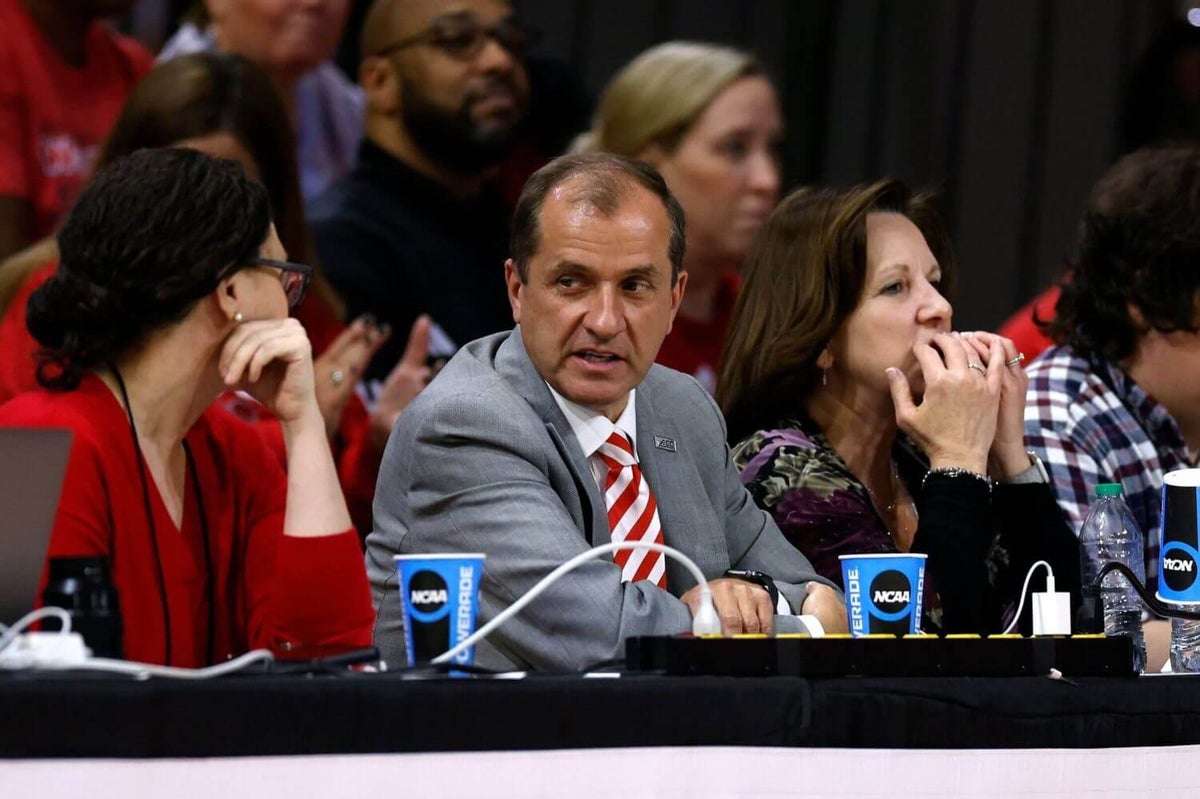
(Photo: Lance King / Getty Images)
[ad_2]
Source link