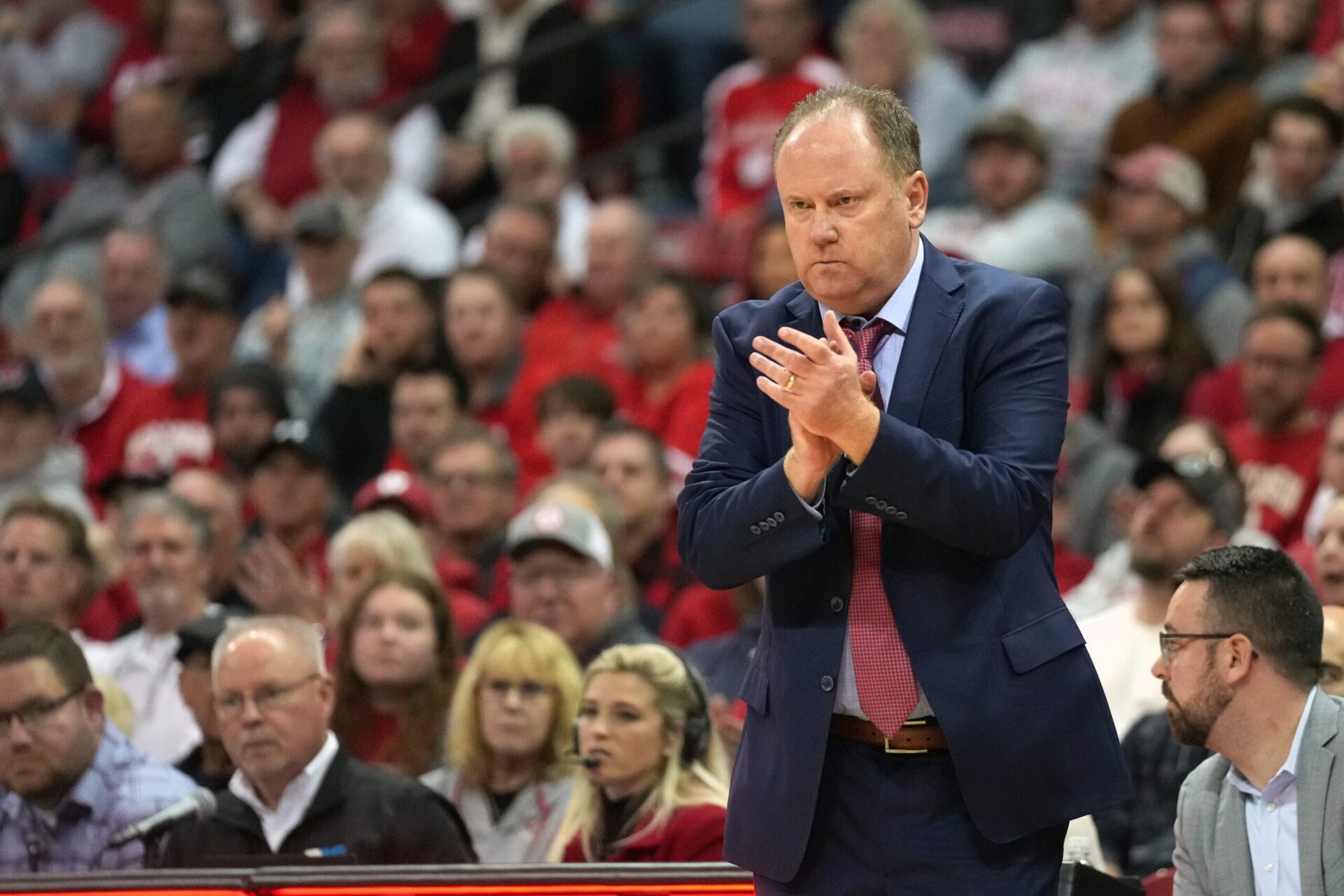
MADISON, Wis. — Wisconsin basketball coach Greg Gard entered last season with his five leading scorers, a small victory of sorts, as other programs attempted to poach the Badgers’ leaders.
But Gard said he could see the shift coming. It was a matter of when and not if the tables would turn on his program in this name, image and likeness era.
“We used to write our classes out, basically put them in ink so you could transition somebody from a freshman to sophomore, you could watch them and you knew when to supplement in behind them,” Gard told The Athletic this week. “Now, everything is in a one-year mindset because you never know what opportunities are going to be presented, coming or going.
“We need an ability to adapt and adjust and not b— and moan about it. We have to continue to move forward and find the best way to keep what’s really made us good at the forefront. But we have to adjust to the world spinning around us.”
That world spun at a dizzying pace during a wild offseason for Wisconsin. Four scholarship players entered the transfer portal, including leading scorer AJ Storr and three-year starting point guard Chucky Hepburn, whose departure felt particularly gutting. Storr declared for the NBA Draft and later transferred to Kansas, while Hepburn transferred to Louisville.
GO DEEPER
Temple: Reality of college basketball in NIL, portal era hits Wisconsin hard
Both players left for considerably more money than they earned at Wisconsin. Storr’s representatives initially asked for a deal in excess of $1 million a year, while Hepburn will earn $750,000 at Louisville, according to a source with knowledge of the situation. Gard said he was aware of the range Storr carried on the open market and that Hepburn had “an opportunity financially that it’s hard to argue with.”
College basketball, like other sports, has changed with unlimited transfers and NIL-earning opportunities for players. As Gard put it, “the loyalty to Old State U and the long, drawn-out recruiting processes of three, four, five years are in the rearview mirror.” The transfer portal has become a free-agent market similar to professional sports. For Gard, this offseason demonstrated the importance of embracing that change.
He embarked on a quest to strike the delicate balance of finding fits for the program and its budget. Gard and his staff helped fundraise for its arm of the Varsity Collective called “The Sixth Man Society,” which tripled its budget from the previous year. But the asking price of a skyrocketing market didn’t match what Wisconsin was in position to provide. Gard said the impact of agents offered “a clearer vision of what’s attainable and what’s not.”
“I think you have to look at it like you’re running a business,” Gard said. “And businesses have budgets and operating expenses and revenue.
“So you can look at, OK, is somebody worth an extreme amount of money? Are we winning the media battle and the headline battle that we paid seven figures to somebody? Or are we really getting somebody that’s going to impact winning? What’s more important? We’ve been able to be very competitive. Will we ever have the most? Likely not.”
Wisconsin was linked to several transfer portal targets that didn’t pan out, including Stanford forward Brandon Angel, UMass forward Matt Cross, Omaha forward Frankie Fidler, Texas guard Tyrese Hunter and Duke guard Jaden Schutt, among others. In the end, Gard and his staff added three portal players: Central Arkansas point guard Camren Hunter, Northern Illinois forward Xavier Amos and Missouri forward John Tonje.

Xavier Amos averaged 13.8 points per game, 16th in the MAC, last season for Northern Illinois. (Jeff Hanisch / USA Today)
Gard said he and his staff approached the portal like it would in building a pro roster by targeting specific positions of need. Hepburn’s departure necessitated a point guard (Hunter), Storr’s departure required a scoring wing (Tonje) and the graduation of Tyler Wahl meant pursuing a frontcourt player (Amos).
All three transfers were successful at lower levels, with Tonje spending his first four seasons at Colorado State. Wisconsin is banking on them hitting their ceilings in the Big Ten — with both Amos and Tonje coming off injury-plagued seasons — after pursuing them in a manner that Gard compared to “speed dating.”
“You don’t dawdle around,” Gard said. “You get an answer real quick whether somebody’s interested or not. The portal guys have been there, done that. They don’t need to be wined and dined and romanced. They’ve gone down that road with recruiting. It’s nuts and bolts, cold, hard facts. ‘What are my playing opportunities? How can you develop me? What are my NIL opportunities?’ And then the agents are involved in making their decision.”

GO DEEPER
Players, coaches, collective reps talk NIL: College basketball confidential
Gard altered his staff, too, with an approach he felt resembled more of a professional model.
He retained Kirk Penney, integral last season in enhancing the offense, as a special assistant to the head coach despite what Gard said were multiple suitors for his services. He hired Greg Stiemsma as director of player development. Stiemsma worked in similar roles with the NBA’s Minnesota Timberwolves and San Antonio Spurs. Gard also hired Isaac Wodajo as director of recruiting and scouting and brought in Lance Randall as an assistant coach to replace Dean Oliver.
Penney, Stiemsma and assistant coaches Joe Krabbenhoft and Sharif Chambliss all were former Badgers who played professionally. Gard said that was important because it meant they understood free agency and could speak to the experience with players. Wodajo already has begun compiling a database of players for when the next portal cycle hits.
“We all have input in it,” Gard said. “He basically mans the mothership, so to speak, of intel. If there’s going to be a computer hacked, the one you don’t want hacked is his.”
As for the team this season, Wisconsin will begin practices in September with a much different look following the addition of six scholarship newcomers: Hunter, Amos and Tonje, as well as true freshmen Daniel Freitag, Jack Robison and Riccardo Greppi. Every player on the team other than Greppi, a 6-foot-10 Italian center who signed with the program two weeks ago, participated in on-campus summer workouts. Gard said he learned he has a roster that is not only “two-plus deep at every position” but also bigger at key spots.
One of the most intriguing storylines will be what Gard does at point guard. Unlike the past three seasons, when Hepburn was the unquestioned starter, Gard said there will be an open competition for the starting point guard role. Five players handled point guard responsibilities this summer: Hunter, Kamari McGee, Freitag, Max Klesmit and John Blackwell.
McGee played as a reserve last season and underwent offseason surgery for a broken toe that forced him to miss 11 games. Gard said McGee didn’t return to full strength until mid-July, but his energy and quickness stands out. Gard described the 6-foot-3 Hunter as a big, strong “bulldog,” while Freitag, also 6-3, arrives as the highest-ranked point guard Gard has signed in nine seasons as coach. Gard said Freitag showed considerable improvement as the summer progressed.
“He slowed himself down,” Gard said. “His decisions were better. He’s quick as a cat, and sometimes that speed gets him in trouble. So it was just a matter of when to use that. I think he learned really quickly that this isn’t high school anymore. But the natural, physical ability is evident. Now it’s a matter of you’ve just got to get experience.”
Gard said Blackwell, the team’s sixth man last season as a freshman, “was the best player on the floor the majority of the summer.” Blackwell and Klesmit, a two-year starter at Wisconsin whom Gard described as an “alpha dog,” likely will pair together on the court. A question Gard must answer is what to do around them. Blackwell and Klesmit could play the two and three spots with a point guard alongside them. But one of them could play the point with Tonje or Amos at the three.
Gard noted Amos “shocked” the coaching staff with how much more versatile he is compared to his film at Northern Illinois because of his ballhandling ability and decision-making in tight spaces. Tonje, meanwhile, plays with a calmness and physicality that reflects his experience as a sixth-year senior.
Wisconsin also returns starting center Steven Crowl and forwards Nolan Winter, Carter Gilmore, Markus Ilver and Chris Hodges. Gard would like to use Winter at the four with Crowl at the five. Gard added Greppi in the hopes of giving Crowl help at the five spot “so he doesn’t have to go punch for punch for more minutes than what he can be effective for.”
Gard said it was important to still have a core nucleus of players who have been around the program, understand his expectations and can relay them to newcomers. Ten total players return off a Wisconsin team that was once ranked sixth in the AP Top 25 last season but closed with a disappointing loss to James Madison in the first round of the NCAA Tournament.
There’s no way to know how all the pieces of the puzzle will fit together. But Gard, after an offseason of twists and turns, is eager to begin the process with a retooled roster.
“There’s a lot of seats at the table,” Gard said. “The plate of food is only so big. So that’s what we want. We want high-level competition.”
(Top photo: Kayla Wolf / USA Today)