Dusty May walked off the floor of the Barclays Center on Friday afternoon, drained by a season of huge expectations that ended with Florida Atlantic’s overtime loss to Northwestern in the opening round of the NCAA Tournament.
Before May arrived, “FAU” and “huge expectations” weren’t often used in the same sentence, at least not in the context of the NCAA Tournament. The Owls had one NCAA appearance in their history before last year’s run to the Final Four, a magical season that established May as one of the rising stars in the sport. With the core of the team returning, this season brought a new set of challenges, including the pressure to repeat and speculation about May’s future.
By the time May left the dais at his postgame news conference, his name was already being linked to the job opening at Louisville, which fired Kenny Payne nine days earlier. Louisville presented initial terms to May three days before FAU’s season ended, according to a source with knowledge of the discussions, and Vanderbilt was also firmly in the mix. Unbeknownst to almost everyone, Michigan had zeroed in on May as its top target, and athletic director Warde Manuel was on his way to Florida to seal the deal.
Saturday afternoon, May and his agent, Andy Miller, arrived at a hotel in Fort Lauderdale for a meeting with Manuel, Michigan chief of staff Doug Gnodtke, Chad Chatlos from search firm TurnkeyZRG and former Michigan coach John Beilein, who’d driven from Naples. For the first hour or so, Beilein and May discussed the ins and outs of the Michigan job: the recruiting landscape, academic requirements, the blueprint Beilein used to lead the Wolverines to the Final Four in 2013 and 2018.
If May had any reservations about the job, the conversation with Beilein put them to rest. News broke Saturday night that the two sides were finalizing a deal, and May arrived in Ann Arbor two days later to get a tour of campus before his introduction Tuesday afternoon.
The consensus in college basketball circles was that Michigan landed one of the most sought-after coaches on the market at a surprisingly reasonable price, an average of $3.75 million over five years.
“I probably showed my hand too early,” May said, “because this was a place that I wanted to be.”
The whirlwind that brought May to Michigan was years in the making. As a student manager under Bob Knight at Indiana, May was known for taking copious notes and going toe-to-toe with Hoosiers guard Dane Fife in pickup games. He put in thousands of miles behind the wheel with Mike Davis, the IU assistant who succeeded Knight, driving to basketball camps and AAU tournaments to learn the ins and outs of recruiting. It was all part of May’s basketball education, which served him well in his climb up the coaching ranks.
“Dusty wanted to be a coach, but he wasn’t above or below anything,” Davis said. “We used to call him ‘Road Warrior.’ He’d go on the road with us, and at one or two o’clock in the morning, he’d be driving. A lot of guys won’t do that.”
May’s basketball biography reads much differently than that of Juwan Howard, the coach he replaced. Howard was a superstar at Michigan who played two decades in the NBA and hadn’t worked in college basketball before he was hired to coach his alma mater. May started at the bottom rung of the coaching ladder and worked his way up, first as a student manager, then a video coordinator, then an assistant coach and finally a head coach at FAU.
GO DEEPER
How did Juwan Howard and Michigan basketball fall so far?
The decision to part ways with Howard after an 8-24 season wasn’t easy for Manuel, who chose Howard to replace Beilein five years ago. Howard had early success, including a Big Ten championship in his second season, but the culture of the program deteriorated throughout his tenure. May had the qualities Manuel wanted in a new coach, including a six-year track record of success at FAU and a spotless reputation among his peers.
“Normally, in every search I’ve ever conducted, you hear something — some issue arose, somebody didn’t think he handled it right, they didn’t think they handled this student-athlete right or this team,” Manuel said. “Nothing (with May). Everything was positive.”
Michigan fired Howard on March 15. Three days later, Manuel met with Michigan president Santa Ono to discuss his list of candidates, starting with May. The following morning, Manuel texted Beilein to arrange a conversation. Manuel said the idea of Beilein returning as coach was in the back of his mind, but the purpose of the call was to break the ice and get Beilein’s perspective on the job.
“When John and I talked, I think he realized, ‘Do I want to get back into this NIL now, and this portal?’” Manuel said. “It never came up where I offered him the job or anything. We just talked. It was a great conversation.”
Manuel and Beilein spoke for 90 minutes, then spoke again the following day to go over the list of candidates. Beilein volunteered to assist with the search however he could, signaling an opening for Michigan to bring a legendary former coach back into the fold after several years of distance.
Hiring May opened the door for Beilein to have a presence with the program, something that wasn’t the case during Howard’s tenure. Manuel said he could envision Beilein taking an advisory role in the athletic department, similar to retired softball coach Carol Hutchins and retired hockey coach Red Berenson.
“John and I will continue to talk,” Manuel said. “It was great to reconnect with him, to reestablish the strong relationship we had before. He’s definitely going to be around more.”
Beilein didn’t attend Tuesday’s news conference but congratulated May on social media, pledging to be available anytime May asked. During Saturday’s meeting, he gave May an honest assessment of the Michigan job, which comes with its share of advantages and challenges. Not every transfer can successfully navigate Michigan’s admissions process, as Howard learned the hard way. Michigan is known as a football school, but Michigan’s basketball programs have strong tradition and fan support without the outsized pressure that exists in other places.
It’s exciting to see @CoachDustyMay as the MBB coach at @umichbball He has had great success as a HC and assistant and has worked hard for many years for this fabulous opportunity. Anytime he asks, I will be available to help him. Congrats Dusty, Anna, and family! #goblue
— John Beilein (@JohnBeilein) March 26, 2024
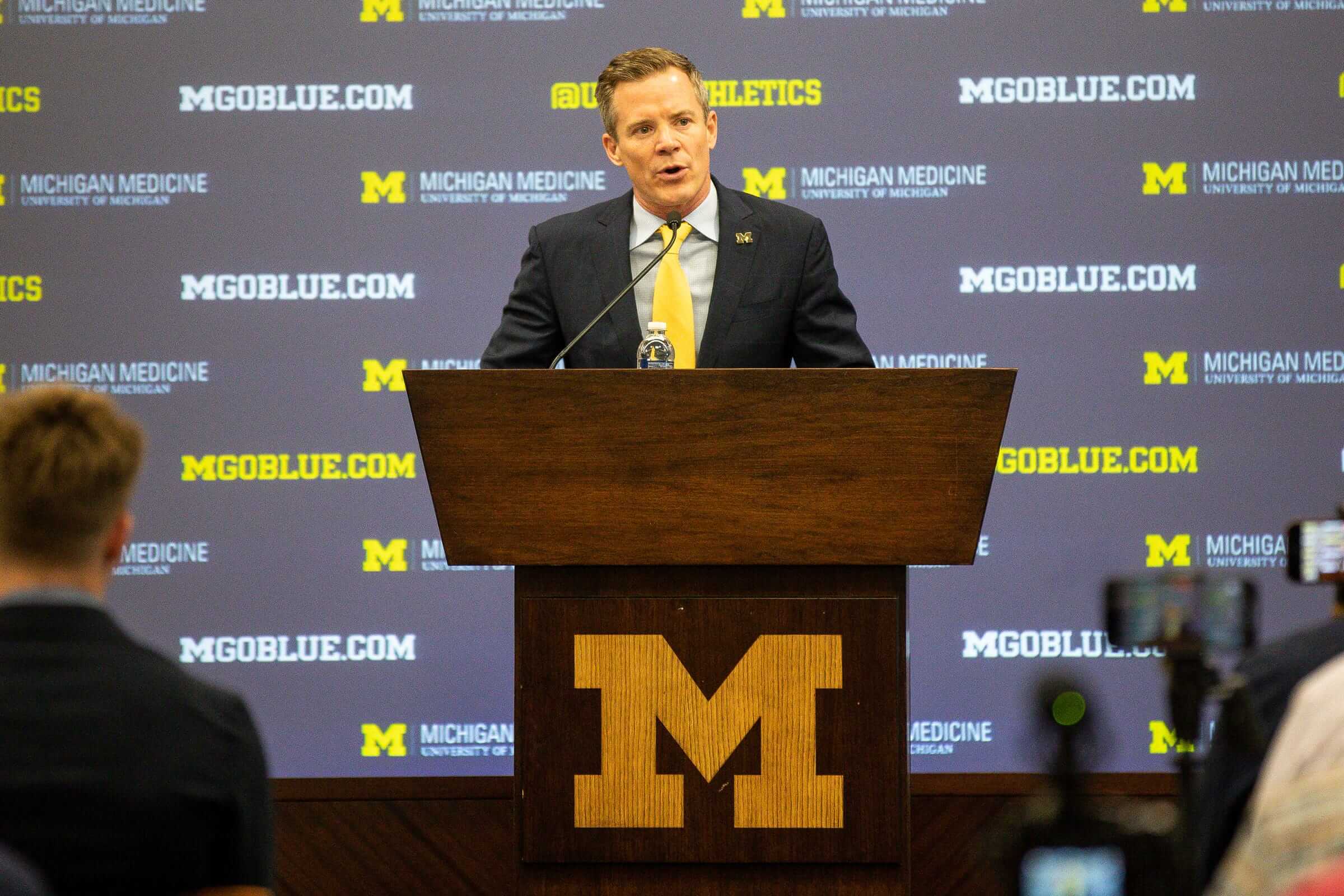
May landed in Ann Arbor on Monday with little fanfare. There were no throngs of cameras awaiting his arrival and no reporters following his every move. His introductory news conference was well attended, with a few rows reserved for students from Michigan’s Maize Rage, but the crowd was small enough to fit inside a single room at Michigan’s Junge Family Champions Center.
May had to weigh Michigan’s merits against the pros and cons of Louisville, a school with a rabid fan base in a conference that lacks the stability of the Big Ten. Though Louisville was the perceived favorite, people who know him well weren’t surprised he ended up at Michigan, coaching in the league where he got his first taste of big-time college basketball.
“He’s a down-to-earth, Midwest guy,” said Charles Ramsey, a former Michigan assistant who gave May his first full-time coaching job at Eastern Michigan nearly two decades ago. “Louisville would be able to sprinkle a lot of dollars, but other than that, I didn’t see the fit.”
Ramsey was in touch with May leading up to the end of FAU’s season and had a sense Michigan would be appealing. Ramsey texted May a photo of the Michigan flag outside his house before Saturday’s meeting, which happened to coincide with a not-so-rare March snowfall in Ann Arbor.
According to Ramsey, May texted back: “Is that snow on the ground? LOL.”
“Yes it is,” Ramsey replied. “But you’re a Midwest guy. You’re used to it.”
May is a Midwest guy. His hometown is Peoria, Ill., and he attended high school in Bloomfield, Ind., about 30 miles from Bloomington. One of his sons was born in Michigan while he was an assistant coach at EMU. He was at home in the sun and sand of Boca Raton, but Michigan fits him in a way that other schools wouldn’t have.
“Louisville is an unbelievable basketball school, but this was the right fit for me, my family,” May said. “It just felt right. I’m a big feel guy. I’m a big fit guy. From Day 1, this was one that I just thought would match me and allow me and those around me to have the highest level of success.”
May isn’t looking at Michigan as a long-term rebuild, despite the 8-24 record and the potential for a near-total roster overhaul. His goal is to build a team that can compete right away by playing fast, spreading the floor and shooting 3s. He wants Michigan basketball to be fun, which will be a welcome change after a miserable season for the program and its fans.
One of the painful parts of Michigan’s decline was the drift away from the principles that made the program so successful under Beilein, which was also a drift away from Beilein himself. Saturday, Manuel got the former coach and the future coach together in a room to talk basketball, a first step in making things right again.
Michigan is May’s program now, but if he needs a hand, Beilein won’t be far away.
“I revere coaches,” May said. “You have legendary coaches that have represented this institution and hung banners. Absolutely, whatever role he wants, I’m going to embrace it.”
— The Athletic’s Brendan Quinn contributed to this report.
(Photo: Junfu Han / USA Today)