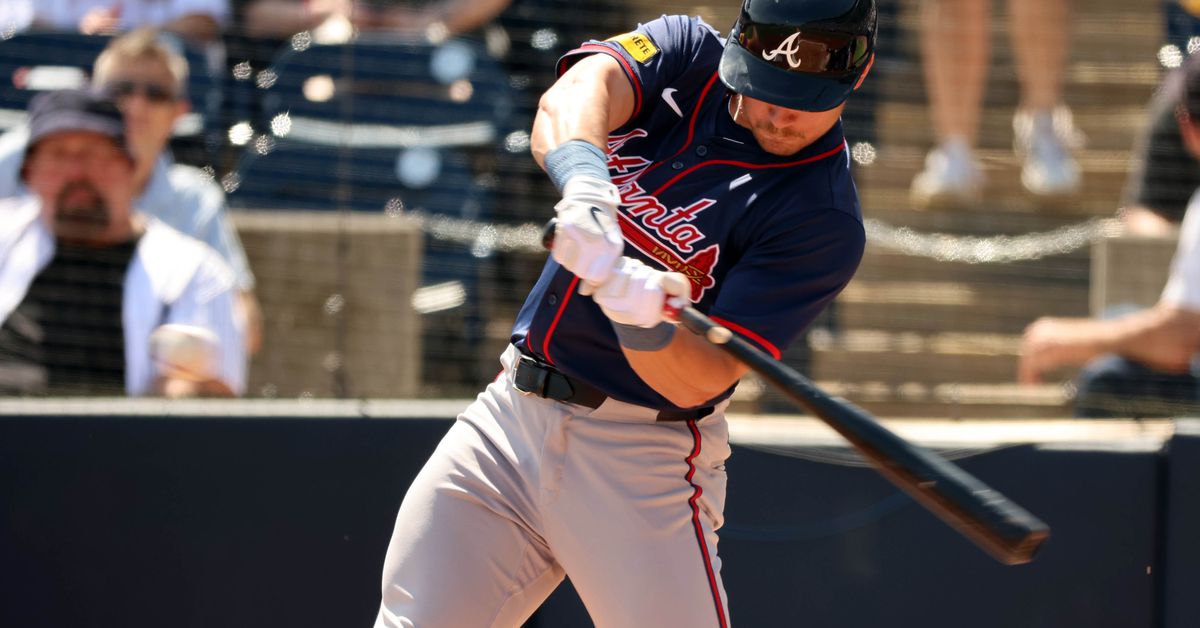
When the Atlanta Braves acquired Jarred Kelenic from the Mariners as part of a five-player deal in early December, it most likely came as a surprise to many fans. Of course, Alex Anthopoulos pulling off a unique trade likely did not come as a surprise as it is becoming more and more of a signature trademark for him.
Once the dust settled, and the fallout of subsequent trades took place it became apparent that Kelenic was the new starting Left Fielder for the Atlanta Braves. From a financial standpoint, the Braves are paying approximately $29.4MM this year. This figure is after calculating luxury tax penalties and payroll role taken on from the other players acquired (and later traded) in the initial deal for Kelenic along with David Fletcher’s contract.
So, why would the Braves pay this type of money for a player that has a career slash line of .204/.283/.373 up to this point in parts of three seasons?
With Kelenic struggling mightily in spring training, it might bring the question as to why the Braves would bring in a player who has yet to live up to his sixth overall pick in the 2018 draft.
There are multiple variables in place as to why the Braves would add Kelenic this past offseason, so there is no singular answer. However, part of it is that beyond this season he is going to be very affordable. He has does not reach his first year of arbitration eligibility until next year. We could spend an entire article on the arbitration process, but arbitration years are typically cheap, are performance based, and the player’s contract is under team control. In Kelenic’s case, he is under team control though the 2028 season.
The only amount of money the Braves will be on the hook for of the aforementioned $29.4MM after this season is the $5.2MM AAV hit in 2025 from Fletcher (according to Baseball Reference) and Kelenic’s arbitration salaries should the Braves continue to keep him.
Of course, a front office would not just bring in a player simply because they will not cost much. The Braves are obviously taking a gamble on Kelenic’s potential. This gamble is not unwarranted. As mentioned before, he was a highly sought after player in the 2018 draft due to his scouting report and tore up the minor leagues with a slash line of .295/.370/.538 in 1331 plate appearances.
His first two seasons in MLB were not good as he slashed .168/.251/.338 in 558 plate appearances. However, his 2023 was much different. He ended up hitting 253/.327/.419, which was good for a wRC+ that was eight percent better than league average (108).
On July nineteenth he went down with an injury from kicking a water cooler, but prior to that we saw signs of what could be to come when he hit .252/.320/.439 which was good for a 110 wRC+ along with eleven HRs. He did have a BABIP that was well above league average of .357 at the time with a strikeout rate of 32.6 percent, but he was still effective in his own right.
Once he came back from injury his power was zapped. He still had a solid OBP of .362 for the remainder of his season, but his slugging dropped to .280 during that span. During sixteen games he had thirteen hits and twelve of them were singles. He did pair that with a healthy walk rate of 13.8 percent.
Of course, when you bring in a player, you do so in hopes of what is to come, not what has happened in the past. If we look at Statcast, we see some intriguing numbers.
When Kelenic contacted the ball in 2023, it was in large part quality contact:
· Sweet-Spot Percentage – Best 9.0 percent of MLB
· Average Exit Velocity – Best 25.0 percent
· Hard-Hit Percentage – Best 27.0 percent
· Walk Rate – Best 32.0 percent
· Expected Batting Average – Best 33.0 percent
For those unfamiliar with sweet-spot percentage, it has to do with the optimal launch angle on contact, which is between eight and thirty-two degrees. This goes in line with his xwOBA on contact being elite. In fact, when he made contact with the ball, his xwOBA was in the top 10.0 percent of MLB.
Kelenic’s barrel percentage, xSLG, and xwOBA were all above league average as well. Factor in his arm strength being in the top 14.0 percent and his sprint speed being in the top 31.0 percent, and we see a very intriguing profile for Jarred Kelenic.
Kelenic has some areas he needs to figure out.
To be clear, Kelenic was never brought in to be the savior of the franchise. He was brought in the be the in the bottom three of a stacked lineup. He has some areas, that if he can improve upon, can escalate his output by quite a bit.
As discussed earlier, Kelenic was elite last season when making contact. The only problem is that he struggled making contact. He had a chase rate (swinging at pitches outside of the zone) of 28.5 percent which put him worse than 54.0 percent of qualified hitters. He also had a swing and miss percentage of 33.8 percent, which ranked him in the worst 9.0 percent of MLB.
He struggled mightily with swinging and missing against breaking and off-speed pitches. His swing and miss rates on these types were 43.3 and 42.0 percent respectively. The positive is that his 23.6 percent rate on fastballs in manageable, but he only saw them 43.1 percent of the time last season.
Kelenic’s kryptonite seems to be the sweeper and slider. Although he only saw seventy-five sweepers, he was clueless against them. He had a 64.3 perfect swing and miss rate against the pitch. The slider also saw terrible results with a 45.2 percent swing and miss rate.
Pitchers seemed to figure his weakness to sliders because the only pitch that he saw more than the slider was the 4-seamer, as well as a substantial increase in slider usage over his last two campaigns.
:format(webp):no_upscale()/cdn.vox-cdn.com/uploads/chorus_asset/file/25342527/JKSl.JPG)
Now, when Kelenic does make contact with the slider, it is solid. He had an average launch angle of eleven degrees will having an xBA of .247 and xSLG of .418. To put that in perspective, the league average xBA vs the slider in 2023 was .224 and the average xSLG was .372.
Although Kelenic has flaws, the gamble could pay off.
Early in the offseason when Kelenic was acquired, there were questions about why him over Eddie Rosario. That debate could be dedicated to a whole article explaining the differences of contracts, future performance, etc. That being said, the fact that Rosario had to settle for a minor league deal with the Nationals essentially puts the argument to bed. Just for what it is worth, Kelenic played at a rate of 2.0 fWAR per 162 games to Rosario’s 1.59.
For added insurance, the Braves brought in fan Adam Duvall to be the right-handed platoon partner on a cheap one year, $3MM deal.
Duvall has historically crushed lefties. In 2022 Duvall had a weighted Runs Created Plus (wRC+) thirty percent higher than league average against lefties. In 2020 it was thirty-two percent higher, and in 2019 it was a whopping seventy-eight percent higher. For his entire career, Duvall has an adjusted OPS that is eleven percent higher than league average during that span.
Last season righties threw 73.62 percent of the pitches, so Kelenic is still going to see a large majority of the playing time in a Kelenic/Duvall platoon. Adding Duvall should take some added pressure off of Kelenic to where he can focus on not swinging and missing on sliders vs right-handed pitching.
In conclusion
The addition of Kelenic did take some serious overhead costs on the 2024 payroll with a gamble on Kelenic’s future. Although this season is expensive, he will be paid a cheap salary beyond this season. If Kelenic does not work out, the team is not on the hook for his contract beyond this season. If he does work out, he will be cheap through the 2028 season.
Being projected to be a bottom three in the order, Kelenic does not have to come in and be the star of the show. He can take his time and work on some of his flaws. He is elite when he makes contact but needs to work on not swinging and missing as often, especially on sliders. If he can lay off swinging and missing as often, the metrics show he would be in for a massive increase in production.
With the addition of Duvall, Kelenic can narrow his focus on right-handed starters. The platoon of Kelenic/Duvall looks to make a formidable duo.