[ad_1]
A sitting governor would, at just about any previous point in NCAA history, be considered an outside-of-the-box hire for the organization’s most public-facing role.
But the long history of the NCAA doesn’t match its current needs. That has been obvious for years, as college sports’ governing body backed itself into a corner amid mounting internal and external pressures.
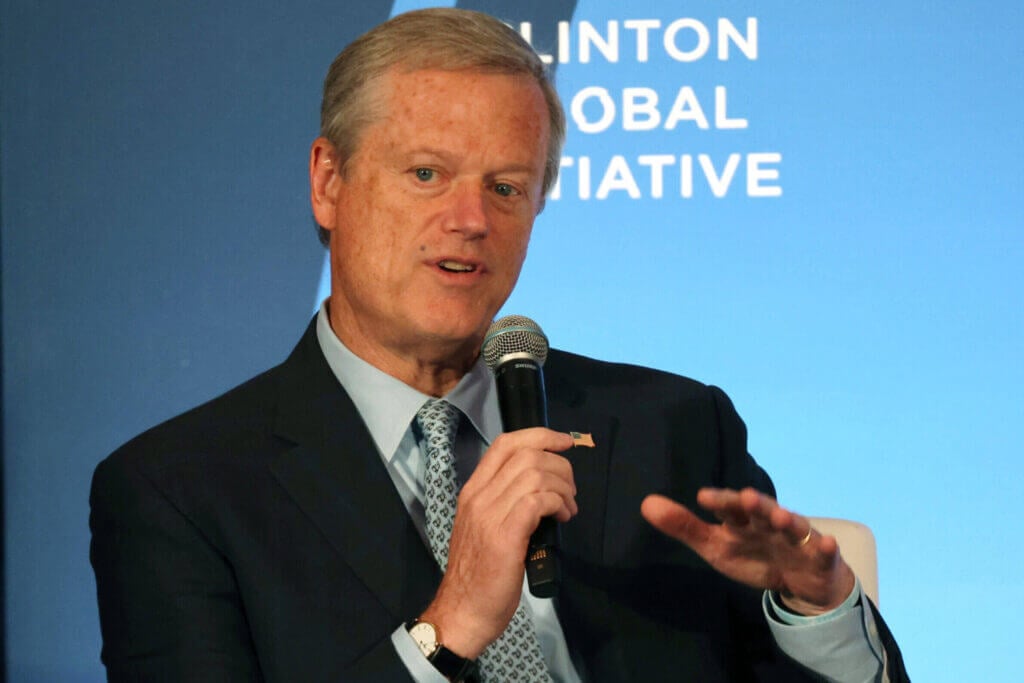
So it is only fitting that the NCAA turned to Charlie Baker, the current governor of Massachusetts who is set to wrap up his second term in the first week of January. He will officially take over as the NCAA president on March 1, 2023, replacing Mark Emmert after a tenure more than a decade long.
As it turns out, this particular job at this particular time does need political expertise. Baker fits squarely in the box after all.
“College sports is really at a crossroads,” said Baylor president Linda Livingstone, who chairs the NCAA’s Board of Governors, on Thursday. “We all know that the challenges that we face are big. They’re complex, and they’re urgent, as we think about the future of college athletics, in legal, political and cultural environments that have changed drastically over the decades, and we need to build the sustainable model for college athletics. … That’s going to take the ability to engage and motivate Congress, to enact legislation that helps us modernize our framework for regulation of college athletics and the support we provide our student-athletes.
“It also requires the ability to lead transformation within the NCAA itself, a process that is certainly underway but one that we know has to be an ongoing effort in the months and years ahead. When you consider the priorities that we have right now in the NCAA, it’s hard to imagine a better fit than Governor Baker.”
The final years of Emmert’s tenure were defined by failures in the court of law and in the halls of Congress as well as a reactionary response when it came to name, image and likeness (NIL) reform. The Supreme Court ruled unanimously against the NCAA in June 2021 in a case related to caps on college athletes’ education-related benefits, a scathing concurring opinion written by Justice Brett Kavanaugh set the stage for future challenges to the business model, and now multiple subsequent cases (Johnson, House) are snaking their way through the judicial process to test out such a hypothesis.
Despite countless pleas and millions spent in more formal lobbying efforts, Emmert could never get federal lawmakers to bail him out on NIL. He has also pushed for some sort of narrow antitrust exemption in the past, or at least some protections to keep the NCAA from immediately being sued for enacting stricter rules for athlete compensation.
These efforts were largely ineffective. No one in Washington swooped in to save the day. Legal strategies Emmert signed off on resulted in disastrous outcomes. Constituents ranging from athletic directors to conference commissioners lost whatever faith they had left in him as he grew more passive and ineffective. Emmert was not able to ensure that the future of college athletics would operate the way things had always worked, with amateurism and academics as pillars. The sky was always falling, if you listened to Emmert’s rhetoric. Yet he never suggested any solutions.
Some would argue that the power of the NCAA president is simply ceremonial. It is, as Emmert liked to say, beholden to the NCAA membership. But his critics always pointed out that even leaders of trade organizations can shape opinion, prioritize issues and mobilize constituents. And that is what will be expected of Baker, whose political background should allow him to do just that — while, ideally, opening more doors across Washington to actually get legislation passed either at the state or federal level.
“That is what I mean when I say he understands politics — he understands assembling coalitions, whether that’s commissioners or 1,100 schools,” said former Maryland congressman Tom McMillen, the president and CEO of LEAD1, an advocacy group representing FBS athletic directors. “After he builds those bridges to his constituency, then he’ll be able to go to the legislatures and really speak with more authority.
“Right now, the NCAA is kind of a battering ram. A lot of times, a lot of members (of Congress) don’t even want to see them.”
McMillen said he spoke with Baker earlier on Thursday and suggested he start with smaller issues that can be resolve quickly, such as clearing the roadblocks for international students to make money off of their NIL rights. That topic has bipartisan support, McMillen said, and offers Baker an easy win that can then lead to compromises on bigger and broader NIL issues. McMillen believes Baker will be very effective at building bridges among college leaders and working with lawmakers throughout the country.
“I must say that when I was first approached about this, my initial reaction was that I was not exactly what you would call a traditional candidate,” Baker said Thursday at his introductory news conference.
But he thought about it some more and realized that the governance model wasn’t so unfamiliar to him after all. He called the NCAA a “distributed decision-making model” with thousands of people participating in the activities it runs and operates; he said he’s spent much of his career working in such environments. And he believed in what the enterprise offered to athletes at all levels and across all sports.
“I’ve always just believed that sports have this tremendous power to bring people together,” Baker said. “You just see it over and over again, the way in which athletics can transcend so many other divisions. I really do believe that we are at a bit of a pivotal period for the NCAA, and I really do think that the enthusiasm, the life and professional experiences I’ve had, the people I’ve gotten to know, the relationships I have can be a big part of helping all the folks involved in the NCAA, wherever they fit in that very significant organization, benefit from what we can put together going forward if we work together.
“The challenge is significant, but the possibilities and the opportunities if we are successful are enormous.”
And those who picked Baker believe he can be successful. They believe his skill set is uniquely suited for the moment. According to multiple people with knowledge of the hiring process, Baker wasn’t the only finalist for the job who had extensive political experience. It’s clear that Livingstone and her peers on the search committee believed it not to be just a plus for a presidential candidate but something of a minimum requirement. But will Baker’s background as a popular Republican governor in a predominantly Democratic state lead to actual bipartisanship solutions to the NCAA’s biggest problems?
The NCAA thinks it’s well worth a shot, as does Baker.
“I think it’s worth doing,” Baker said. “It’s big and complicated — so have been a lot of things I’ve done in my life. But most of the time, they were absolutely worth doing.”
The NCAA will soon see if he’s right. Frankly, an ounce of political acumen is better than what his predecessor had … which was none. That’s how it got to this point of no return, a fork in the road that led to a politician who has never worked in intercollegiate athletics being handed the keys to the enterprise.
Either it will work or it won’t. But it’s clear that the current stewards of college sports believed it was the only option.
(Photo: Spencer Platt / Getty Images)
[ad_2]
Source link