[ad_1]
It was early in the 2014 school year and the Houston Cougars needed somewhere to practice. The main court inside Hofheinz Pavilion was being resurfaced and the athletic department’s only available practice courts were reserved by other sports. Of course, no one told first-year coach Kelvin Sampson any of this. He scrambled to find a gym for the week’s preseason practices.
Sampson booked a two-hour block for the courts at the university’s student rec center. Not ideal, but they’d do. All he needed was 94 feet and two hoops; it’s not like Hofheinz was all that nice, anyway. The roof was lined with fading banners and occasionally leaked. Every once in a while, a ceiling tile would dislodge, wafting down like a stray hang glider.
So the Cougars put on their practice gear and set off across campus to the rec center. They paid for the privilege, mind you. The university charged $50 an hour to use the space. No exceptions.
Problem was, the rec courts were open to the general public. No partitions, no seclusion. Just a Division I basketball program — one with five Final Fours; one built by Guy V. Lewis and Elvin Hayes and Otis Birdsong and Phi Slama Jama — out in the open. A few foreign exchange students wandered over looking to play.
“We’re like, wait, no, guys, we’re practicing,” remembers Kellen Sampson, then and now an assistant on his father’s staff. “They asked if they could jump in.”
“I was like, bro, we have jerseys on, get outta here,” remembers Mikhail McLean, a senior on that team.
Sampson might as well have let ‘em play. Really, what was the difference? The program had been to one NCAA Tournament in the previous 22 years, shuffling through coaches from Alvin Brooks (54–84) to Clyde Drexler (19–39) to Ray McCallum (44-73) to Tom Penders (121–77) to James Dickey (64-62).
That rec gym was symbolic. It represented exactly where Houston stood in college basketball.
On the periphery. Insignificant.
And today, eight years later, it’s maybe the top team in America. Three weeks ago, UH rose to No. 1 in the AP poll for the first time since the final poll of the 1982-83 season, before suffering its first loss of the season.
No one makes a big deal about the Coogs’ residing near the top of the rankings nowadays. As if this is normal. We’re suddenly used to this program being a player again. It reached the Final Four in 2021, the Elite Eight in 2022 and opened this season at No. 3 in the AP poll. So, yeah, no big deal to climb to No. 1 a few weeks into the season.
But go and talk to those guys from Year 1 of Sampson’s rebuild, those guys in the rec gym. Ask them how normal this is. Want to appreciate how far Houston has come?
Start here.
They all talk about that first meeting. Kelvin Sampson, a walking reclamation project, six years removed from what happened at Indiana, entered the room.
Silence. Eyes forward. Those gathered there that day, the returnees from Houston’s 2013-14 group, really weren’t all that bad. They finished 17-16 the year prior, posting three wins over Top 25 teams. When accepting the job offer from UH over interest from a few Power 5 schools, it was the Coogs’ returning roster that particularly attracted Sampson. He saw an opportunity to win.
The job had opened a month prior when James Dickey, in the fourth year of a five-year contract, stepped down. He hadn’t posted a winning record in American Athletic Conference play or taken the program to the postseason, but he did leave Sampson with supplies. Leading returning scorers TaShawn Thomas and Danuel House were legit all-league caliber players. Jherrod Stiggers, Danrad “Chicken” Knowles and L.J. Rose were nice pieces. It was a tight-knit group that stuck together after Dickey resigned, willing to wait it out, see who was next.
They had no clue who Sampson was. Most on the roster were in middle school when he last coached college ball.
“I was like, man, let me Google this dude,” Stiggers says.
They read about all the winning. From Montana Tech to Washington State to Oklahoma to Indiana. A trip to the Final Four in 2002. They read about Sampson’s NCAA violations — impermissible calls to recruits at both Oklahoma and Indiana, a five-year show-cause penalty — and couldn’t care less. They liked that he spent those exiled years working in the NBA with San Antonio, Milwaukee and Houston.
“Realized this man knew what he was doing,” McLean says.
Yes. Yes he did. They met him on April 3, 2014.
“And he comes in and he’s on f—ing 10,” McLean says. “Coach Dickey was cool, calm, collected. Had that Southern charm. We liked him. Kelvin Sampson comes in and he’s right away demanding this, demanding that. ‘We’re going to do X, Y, Z! I’m changing the culture! We’re practicing today!’ People looking around like, holy s—, who is this guy?”
Sampson did the introductory news conference, that whole song and dance. UH players sat in the crowd, listening, still unsure what to make of him. UH’s athletic director, Mack Rhoades, asked them to wave.
A few of those players were already gone by the time that afternoon practice began. The next day, a few more. Jaaron Simmons, a promising freshman point guard, approached Sampson in a hallway and asked for his scholarship release papers. Sampson replied by asking who he was.
Thomas transferred to Oklahoma. House, currently of the Philadelphia 76ers, landed at Texas A&M. Simmons went to Ohio. Valentine Izundu, a reserve center, went to Washington State. Ahmed Hamdy left the program, heading to Lee College, then VCU.
By the time Sampson held his next team meeting two days later, the room was half empty.
The 2014-15 Houston Cougars, featuring five returning scholarship players, entered the season with 16 players in uniform. Getting there was … a journey. The opening night roster looked like a row of tables at a junior college fair. Chipola College, Lee College, East Mississippi Community College, San Jacinto College.
“Rode that juco train, man,” Kellen Sampson says.
In that early summer, after the exodus, new faces seemed to arrive every other day.
“Random dudes, 6-8, 6-9, showing up at the dorm. ‘Who the hell is that?’” McLean says. “Next day, we’d be making intros in the weight room, like, ‘Aye, what’s your name? What position do you play?’ Immediately, it was survival of the fittest.”
The best returnee was Stiggers, a 6-foot-2 guard from Terrell, Texas, near Dallas. He could’ve transferred — he made 147 3s in his first two years at UH, someone would’ve taken him — but stayed once he heard Sampson’s plan.
“Samp came in talking about ‘we’re going to play uptempo and shoot a lot of 3s,’ and I was like, well, someone has to take those 3s, so I’ll just stay here,’” he says.
Stiggers was joined by Knowles, Barnes, Rose and McLean as Houston’s five scholarship returnees. The rest of the roster: six juco transfers, one scholarship freshman, two walk-ons, a redshirt transfer from Purdue and a football player.
Together, they embarked on Kelvin Sampson’s offseason program. Sampson introduced them to what’d become a program staple. The dreaded bubble drill. Shots tossed at a basket with a lid covering the rim. The task — get the damn ball.
“Everyone was like, bro, it’s June, why are we doing rebounding drills?” Stiggers says.
Wes VanBeck, a freshman walk-on, arrived sometime in May. He remembers his teammates’ facial expressions. Confusion. Maybe some fear. Guys wondering if it was too late to find a different school. He remembers Sampson “nitpicking the guys that weren’t going to buy in or weren’t the right fit.”
Four of the six juco transfers made it through the season. Highly touted Torian Graham, a five-star recruit once committed to N.C. State, was seen as a great get, but he transferred before ever appearing in a regular-season game after a dust-up with a teammate. (He ended up at Buffalo, then followed Bobby Hurley to Arizona State. Johnson would play one season at UH, then transfer to Auburn.)
Those who made it to the season opener took the court on Nov. 14, 2014 at Murray State. The Coogs won, 77-74, knocking off star Cameron Payne and the Racers.
“Our reaction,” says McLean, “was, holy s—, all that culture stuff is real.”
The team’s official 2014-15 season poster was handed out at the home opener the following week. In it, Houston players were wearing practice jerseys. Their uniforms didn’t arrive in time for the photo shoot.
“Look at that poster,” McLean says. “I mean, c’mon man.”
L.J. Rose began his college career at Baylor to be near his ailing mother, but was destined for Houston. His father, Lynden Sr., was a member of Phi Slama Jama in the ‘80s and later served as a member of the UH Board of Regents. L.J. transferred to UH as a sophomore in 2013. He was home.
And the thing about being home is, you know where the cracks are.
“I grew up around UH basketball, spent my whole life around UH basketball,” Rose says, “and I knew when I got there that nothing changed but the painting on the lines.”
Guess who else knew that? The cats and the rats. They ran rampant around Hofheinz Pavilion, darting around back hallways, through the concourses, between the rows of red seats lining the bowl. Wasn’t exactly hard to get in and out. A homeless man was found sleeping in the arena.
Hofheinz was opened in 1969. It was 46 years old by 2014-15; its most recent renovation coming in 1998. In a November 2014 story, Joseph Duarte, the Coogs’ longtime Houston Chronicle beat writer, described it as “dilapidated.”
The team gathered in what Kellen Sampson describes as “a broom closet that happened to have lockers in it.” It was a staging ground for the turf war with those rats. It was also a nice spot for anyone snooping around. “Half the campus had the punch code to get in that locker room,” Rose says. Cell phones were stolen. Gear was stolen.
“During practice!” Stiggers says.
The video room — a generous term — was separated from the locker room by a partition. It featured a 30-inch TV slung in one corner. “You shoulda seen this,” Kellen Sampson says. “Cords draping down, man.”
Office space was provided for the coaching staff, but that was it. Additional staff was crammed into a room across the hall featuring the building’s mainframe computer. The ambiance included the soundtrack of a … constant … vibrating … moaning … hummm … testing the bounds of everyone’s sanity.
Pregame meals were served in what amounted to a garage next to the back door of the UH Athletics/Alumni Center. Today, the space stores equipment for football and track and field.
When Kelvin Sampson was hired, contract stipulations were included assuring improved facilities. That 2014-15 group, though, would need to call it home.
Kellen Sampson says he wouldn’t even bother bringing recruits into Hofheinz Pavilion. He’d come up with whatever excuse he could. “We’re, uh, setting up for graduation.”
But they could only put up with so much. Kelvin Sampson was enraged by the break-ins and the rinky-dink setup. A few weeks into the season, he told his guys he was going to get some changes made immediately. They responded with blank stares.
“Everyone thought the same thing — he ain’t got that much juice,” Stiggers says. “But then one day we come from pregame breakfast and he brings us to the locker room. Whole new locker room. He made the school reconstruct that thing on the fly. Told them, do this or else. We were like, oh, damn, OK then.”
A new $25 million practice facility and $60 million renovation of Hofheinz Pavilion (into today’s Fertitta Center) would come in time, but Kelvin Sampson’s first team would have to make do with what it had.
Which wasn’t much.
A 2-0 start was followed by a loss. “Got cooked at Harvard,” McLean says.
Then three wins over Texas-Pan American, Abilene Christian and Houston Baptist. A 5-1 start. Everyone feeling OK about themselves. Each game, though … a little too close for comfort. Kelvin Sampson was forced to play a tight seven-man rotation.
With little room for error, you might imagine Sampson made sure everyone stayed healthy.
And you’d be wrong.
“Load management?” McLean says, laughing the way older guys laugh. “These were three-and-a-half-hour practices, plus 30-45 minutes before practice for player development, 30-45 after practice for player development. The whole year was about establishing the standard. He was going to do that, no matter what.”
The Coogs lost their next two home games, falling to Arkansas-Pine Bluff and South Carolina State. They ended up on the same flight to Las Vegas with South Carolina State the next day. “Southwest. Group B,” Kellen Sampson says. Houston flew commercial, unlike the programs it aspired to be. In Vegas, the Coogs lost to Boise State in overtime before beating Texas Tech.
They then returned home for a game against Mississippi Valley State and the start of AAC play.
Good seats, you’ll be shocked, were available. Just ask Jared Vanderbilt.
The Houston staff thought it had a real chance to land the local five-star recruit. He had ample options, but was considering staying home for his likely one-and-done college season. UH coaches made him an immediate priority. But then the season began and he asked to come to a game.
“And we thought,” Kellen Sampson says, “oh, no.”
Sometime in the middle of the first half, Kellen knew they were screwed. With his father pacing the sideline, he looked up at a sea of empty red chair backs and saw, in the middle of one entirely empty section, all 6 feet, 11 inches of Jared Vanderbilt, sprawled out, his legs dangling into the row in front of him.
“Literally, the only person in the section,” Kellen Sampson says. “A McDonald’s All-American, just sitting there. No one knew who he was.”
In 2014, the year before Kelvin Sampson arrived, UH averaged 3,783 fans for 16 home games.
In Sampson’s first season, the average dropped to 2,635 in 17 games.
Houston ranked second-to-last in the AAC in attendance, outdrawing only Tulane (1,852), and worlds removed from the likes of Cincinnati (9,334), UConn (10,687) and Memphis (13,915).
Rival SMU, up in Dallas, where Larry Brown was getting things rolling, was pulling in nearly 7,000 per game in the newly renovated Moody Coliseum. The Coogs, meanwhile, barely outdrew fellow Division I programs in their own city. Texas Southern, less than a mile away, averaged 2,580. Rice drew 1,889.
As the record got worse, so did the crowds. Dribbles and whistles echoed through Hofheinz Pavilion. “I don’t care whatever (the listed attendance) was,” Kellen Sampson says, “there were fewer than 500 people in the building.”
Amid an eight-game losing streak, the Coogs hosted Tulane for an 11 a.m. tip-off in mid-January. The crowd amounted to friends and family. And maybe some cats and rats.
“I felt really bad for our guys because they were working their asses off and that was embarrassing,” Kellen Sampson says. “I mean, who schedules a game for 11 in the morning?”
As for Jared Vanderbilt? Yeah, he became the fourth five-star commitment in Kentucky’s 2017 class.
The 2014-15 Coogs lost their first eight AAC games, including, yes, that 11 a.m. home game to Tulane. By mid-January, they were 7-12 overall, the season spiraling.
One big issue? No one could make a shot. Rose, Barnes and McLean were especially struggling, so Kelvin Sampson told them he wanted them in the gym every Monday, Wednesday and Friday at 7 a.m., putting up shots. They begrudgingly agreed. The first morning, they expected to find a team manager there to rebound for them.
Instead they found Sampson.
“He met us there and rebounded for us. Every time. We did it for about three weeks,” McLean says. “For me, that’s when it really became, like, this dude is legit. Whatever he wants me to do, I’ll do.”
They snapped the losing streak with a late-January non-conference victory over Rice. McLean scored a career-high 14 points. Then they stunned defending national champion UConn in a 70-68 upset, breathing some life into the group.
“We had no business beating that team,” McLean says. “It was weird, despite all the losing, we thought we could win every game. We kept showing up.”
But another six-game losing streak followed. McLean broke his foot. Then Rose broke his foot. Others were — not surprisingly — banged up. The roster was dwindling, kept afloat by a core of Stiggers, Knowles and Pollard. Sometimes low on bodies, Kellen Sampson and Hollis Price, the program’s director of player development, would slip on jerseys and join practice.
But circumstances didn’t dictate Kelvin Sampson’s style. He began every meeting by telling his team, or what was left of it, “Culture kicks strategy’s ass every day of the week.” Then he’d hold them accountable to that. If someone didn’t dive for a loose ball? He was kicked out of practice. If the team showed up flat to practice? They were all kicked out of practice.
Discipline was non-negotiable. Stiggers learned the hard way. The night before a game at UCF, he walked into CFE Arena in Orlando for shootaround. Seeing a UCF employee walk by, he asked her where to go. The woman walked past without stopping, prompting him to say, “All I did was ask your ugly ass some directions.”
She kept walking.
Getting dressed in the locker room the next day, Stiggers was told Coach Sampson wanted to see him in the hallway. “I was figuring he wanted to give me a pep talk or something.”
Stiggers walked into the hall, finding Sampson standing with the same woman from the day prior.
“What did you say to her?” Sampson asked.
Stiggers looked at him, then at the woman. “Coach, she ignored me. So I said, ‘All I did was ask your ugly ass some directions.’”
“It was disrespectful.”
“But Coach.”
“You don’t talk to anybody like that.”
“Coach.”
Sampson told Stiggers to get his gear and get on the bus. It was an hour till tipoff. “But coach!” Sampson wasn’t hearing it. He told the bus driver to bring Stiggers, the team’s leading scorer, back to the hotel, drop him off and come back.
Houston lost, 56-54, with Stiggers watching from his room.
“He doesn’t care who you are or what you bring to the team,” Stiggers says all this time later. “He will send your ass home.”
By late February, the Coogs were 9-18 overall and 1-14 in the AAC. The season, mercifully, was nearing an end.

(Bob Levey / Getty Images)
Looking back, L.J. Rose sees the 2014-15 season as a subconscious journey. Those who decided to stick it out learned what it meant to be a Houston basketball player by becoming Houston basketball players.
After traveling to Colorado to undergo foot surgery, Rose decided to sleep in upon returning to Houston. He was on strict orders — a period of non-weight bearing for three months. But Sampson called at 7 a.m., asking why he wasn’t at a team lifting session.
Rose explained that he couldn’t lift any weights.
Sampson explained that a real leader would be with his teammates when they lift.
“Had never thought of it that way,” Rose says.
In time, it became second nature.
“I don’t think we understood what was happening,” he says. “At first, it was just, ‘This coach is crazy.’ But there was a method to the madness. Guys changed.”
On March 1, the Coogs beat South Florida to snap a six-game losing streak. Then they went to Tulane and won in overtime. Then they hosted East Carolina in the regular-season finale, blowing out the Pirates, 72-54.
Like that, a three-game win streak to close the regular season.
At the AAC tournament, they got Tulane one more time. Another win.
“Those four wins,” Kellen Sampson says. “I can’t tell what it did for the morale of the program.”
The season ended with a loss to Tulsa, but there was a sense of survival. They made it. The next season, a few newcomers arrived, guys named Rob Gray and Galen Robinson Jr. They came upon a different program than the one that existed a year early.
“They walked into the culture,” Rose says. “It was already there.”
Three years later, in 2018, Gray and Robinson were the cornerstones of only the second Houston team to reach the NCAA Tournament in 25 years.
Three years after that, the program was in the Final Four. Last year, a return trip to the Elite Eight.
And this year? The Coogs are 10-1. The program operates out of the Guy V. Lewis Development Center, a $25 million, 53,000-square-foot basketball-only practice center. Hofheinz Pavilion recently underwent a $60 million renovation and reopened in the 2018-19 season as the Fertitta Center. The building holds 7,035 fans. This season, home dates are averaging standing-room-only crowds exceeding 7,100 per game.
No rats, no cats.
For those who were there at the jump, the place is unrecognizable. “It just doesn’t make sense,” VanBeck says. “From where it was to where it is? Unfathomable.”
That goes for the members of the 2014-15 team, too. Like those interviewed for this story. Today, Rose works in the Houston Rockets front office. McLean is an assistant coach at Lamar. VanBeck, who after walking on at UH was awarded a scholarship as a junior, is playing professionally in Estonia.
And Stiggers? He left UH in the spring of 2015 to pursue pro ball, but the plan never materialized. Nowadays, he’s back in Houston, coaching ball at Louis Middle School, doing his best Kelvin Sampson impression. He’s 26 now, has some perspective. More than anything, you hear the pride — that he stuck it out, that his name has a place in this new era.
“To be part of what that program has become, it’s huge to me,” he says. “I love talking about it. I’ll take that to the grave.
“People ask me all the time, are you surprised they made it to the Final Four, can you believe they’re No. 1? I say, hell no. I knew this was where it was going.”
But there’s still further to go. The Coogs have never won a national title, you know. If there was ever a time, this might be it. In April, the same program once without practice space on its own campus could play in a Final Four at NRG Stadium.
In Houston.
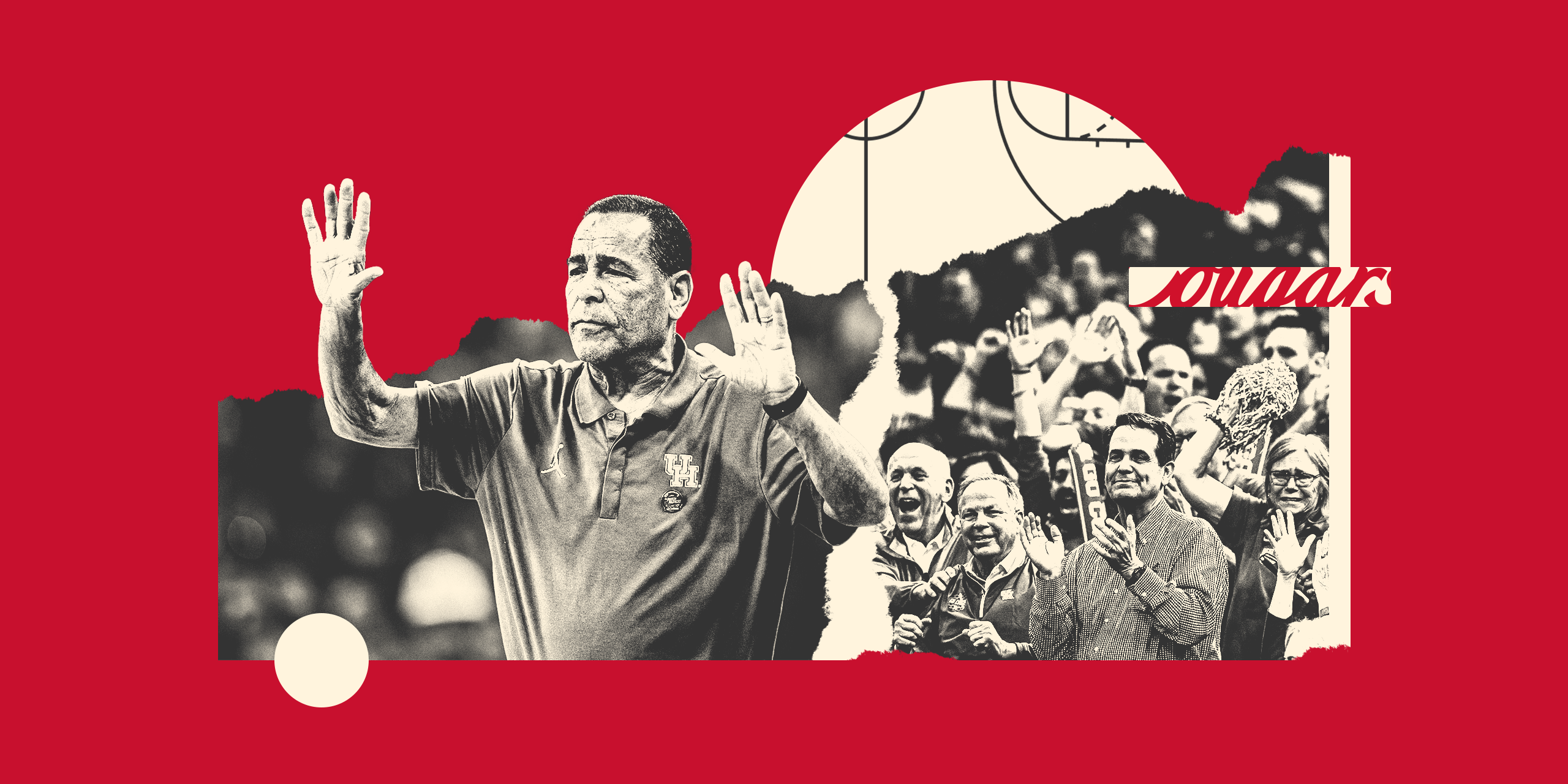
(Illustration: John Bradford / The Athletic; photos: Carmen Mandate / Getty Images)
[ad_2]
Source link