On a Friday night last month, the Roselle Catholic High School gym buzzed with excitement as Overtime Elite, the nascent but growing basketball league, brought its spectacle to New Jersey. This was a homecoming for one of its new stars and a traveling roadshow for the league itself, and there was certainly interest. A group of teenagers flocked to OTE players between games. Agency personnel and a national scout dotted the stands. Seton Hall head coach Shaheen Holloway took a seat catty-corner to the OTE bench.
OTE debuted last season with a shiny new arena and a host of famous investors as a potential disruptor in amateur sports, in part because it took amateurism out of the picture altogether. In this second year, OTE continues to grow and change. It has drawn even more high-end talent down to its Atlanta base and signed a media rights deal with Amazon. It has even found a place for amateurism once again as name, image and likeness deals have proliferated at colleges across the country.
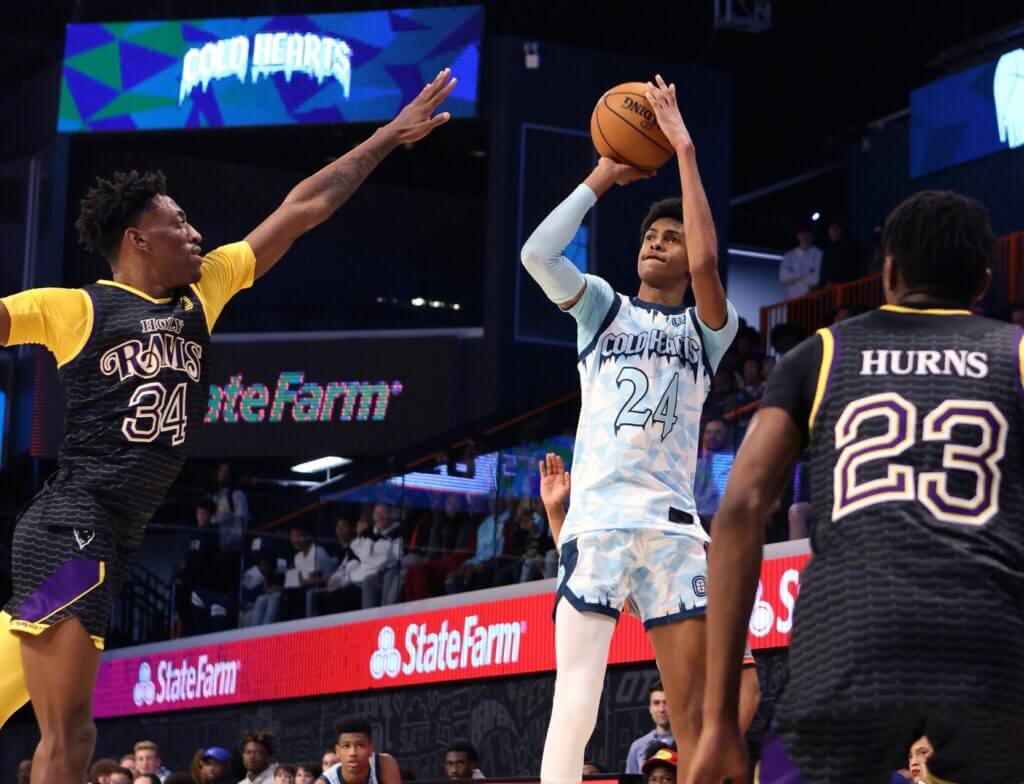
The league’s evolution was visible in that New Jersey gym, which served as a return home for Naasir Cunningham, a consensus top-five recruit in the class of 2024. He had starred at a nearby high school until this summer, when he left for OTE. His recruitment was a coup for the league.
It was also different from the rest. Cunningham, unlike the first class of OTE players, did not take a salary. The 17-year-old is with the league on a scholarship, thereby leaving open a lane to still play college basketball when he is old enough. Punting on a salary to join a league known for guaranteeing at least $100,000 to each of its players was a counterintuitive choice. It’s also one that nine other OTE players made this season.
“The scholarship option (for high-school aged recruits) has been big for us, if not bigger than NIL,” said Damien Wilkins, OTE’s general manager. “Because now we can go out and recruit without restrictions. There’s no real downside.”
This is just one of the ways in which the league has pivoted in Year 2. OTE has further prioritized player development, rearranging its coaching staff and practice schedules to affirm that. It has landed a three-year media rights deal to broadcast 20 games on Amazon Prime, in addition to the bulwarks the league has made on TikTok and Instagram. Salaries for players have returned but so have NCAA-compliant options like scholarships.
If the first year was about setting up the league and creating something new, this year is about fiddling with new ideas to seek out what works and what doesn’t, then implementing them.
Dan Porter, Overtime’s CEO and co-founder, said that course was necessary as the league transitioned between seasons. During an interview with The Athletic several months ago, Porter discussed what he had learned from OTE’s debut season and listed off how Overtime Elite’s identity had been forged through experimentation. By being so new, he said, it had the leeway to shift quickly.
“We are not an NBA team,” he said. “We’re not the NBA. We’re not a college team. We’re not Kansas or Duke or Kentucky. We’re not a high school team. We are our own entity. And there are things you can take piecemeal from understanding how professional basketball works and college basketball works, but none of them are exactly right for us. So you can’t have a voice in social (that) sounds like Duke men’s basketball or sounds like the Lakers. You have to figure out what your voice is and all of that. Same for the experience when the fans come in the arena. Same for all of those things.”
GO DEEPER
Inside Overtime Elite, the start-up that’s disrupting the basketball world: ‘It’s even more than I thought it would be’
This next year will be crucial for Overtime Elite. It could very well end with the league’s first two NBA Draft lottery picks — twins Amen and Ausar Thompson are each projected to go in the top 10. The Amazon Prime broadcasts could open the league to new audiences. It has added not just Cunningham to its stable of players, but also Robert Dillingham, a Kentucky commit and a top-10 recruit in his high school class.
The hope is these expansions will not only show off Overtime Elite as a media product — the Amazon deal gives the league a wider reach, in addition to the success it has already on social media, where it has 1.4 million TikTok followers and 467,000 Instagram followers — but also as a proving ground for future pros. OTE had three players reach the NBA or G League this offseason, with one making an NBA Summer League roster, another a G League draft pick and Dominick Barlow on a two-way deal with the San Antonio Spurs.
Barlow came away impressed by his one year with the league. He joined as a well-rated but hardly highly touted prospect and came out with an NBA deal.
“They did a really great job of player development and really engaging the players and kind of picking their brain on what they want to get better at too,” he said. “It wasn’t just a one-way street. So that was definitely a great experience.”
His opinion carried weight as Cunningham considered his options. Cunningham listened to his former AAU teammate, especially as Barlow stressed how much his time in Atlanta helped him improve. Cunningham was skeptical at first, put off by OTE’s newness, but became convinced after visiting OTE’s multi-million dollar facility and meeting with staff and coaches.
Still, he didn’t want to narrow his future options by taking a salary, so Cunningham’s parents and OTE staff figured out that the scholarship route would be plausible. NIL remains an option for him as well: Scholarship players at OTE can sign NIL deals as long as they don’t conflict with Overtime’s primary sponsors in Gatorade, MetaQuest and State Farm. OTE has hired an NCAA compliance officer to make sure it stays inbounds.
Cunningham has continued to take college visits — he mentioned trips to Missouri, Rutgers, Seton Hall and UConn — and each one reinforced how OTE already offers an environment similar to what he could find at the next level. He sees common ground between the two, from the routines college coaches detail to their facilities.
He has enjoyed OTE’s all-in approach to basketball, something he said he could not get at his New Jersey high school. There, he didn’t have a nutritionist or as dedicated a strength coach, he said. If he wants to get into the gym late at night to shoot — OTE’s gym is open until midnight — he’ll get help or a coach to join him. Rare, too, is OTE draws visits from high-profile stars like Devin Booker, Thad Young and Pau Gasol, all investors who regularly sift through the building.
These perks are each part of the push made by OTE executives to hone in on player development. To top high-school aged players, they can pitch a daily trial by fire, where the best face their peers. That opportunity is what sold Cunningham.
“In regular high school, you have those games where the whole team is — like it’s not fun,” he said. “It’s a waste of time. Nobody on the team is a high-level player. You’re not getting better. Here, every day, there’s somebody that’s gonna push you to get better, and you’re gonna push somebody else to get better. So I feel like the competition here is a lot different.”
OTE brass have also worked to improve its own level of competition this season after taking feedback from players’ parents and agents. It has added games outside of just the six teams within its league, with teams going to New Jersey to play high-level AAU teams or taking on Bronny James and his AAU team in Atlanta. OTE took its draft-eligible players on a trip to play professionals in Spain this summer and went to Phoenix to face the Adelaide 76ers during the Australian pro team’s American tour.

GO DEEPER
The complicated reality of Bronny James, where recruiting meets great expectations
The league rearranged its staff this season to augment that as well. It has more than doubled the amount of skills coaches on its payroll, from three to seven.
Last season, practice was mostly centered on the team, with every player practicing at once at the cost of individual attention. This year, there is more individual training. Teams practice at different times and for shorter periods — each session is no longer than an hour. Coaches now run players through 55-minute individual workouts, including film study. This is during a day that still includes a class schedule and high school students pursuing an education.
“The development is everything,” VP of recruiting and player personnel Tim Fuller said. “OTE would just be another prep school if it wasn’t for the development. We would just be another basketball factory trying to get wins and put players on television. But that’s not our goal. Our goal is to have those children or those student athletes cross the finish line. And the finish line for us is when they shake (NBA commissioner) Adam Silver’s hand. Whereas other people are trying to get wins. They want to win Geico (High School Basketball Nationals), they (want to) win national championships, they want to check more boxes. We’re trying to make sure that each player can play a complete game.”
As OTE continues to focus on how its players can improve, it also fixates on the business itself. It is a consumer product too. Those two are inter-related, Porter believes. Player development is important in recruiting, he said, but also as a compelling reason to watch. It gives the league a narrative to sell and a reason for audiences to tune in.
One day, Porter hopes Silver will give the league a public stamp of approval as a pathway to the NBA. Porter thinks it will take two to three years for that to happen, as OTE optimizes itself for what NBA teams seek.
“It’s a weird balance because if you go to play for Auburn or Kentucky, their goal is to win a national tournament,” he said. “It’s not to send you to the NBA. Our goal is to make an incredible media product that fans love and also send you to the NBA because in part it’s going to be partially interesting because you want to watch the people on the journey, and that’s the story of Overtime. If you’d asked me five years ago ‘What is Overtime?’ It was like Overtime is like ESPN a year or two before because you’re following all these people at a high level of content and a Gen Z voice, but you’re going on their journey. And so I think we’re trying to do the same thing here.”
He’ll consider the league a success, he said, when fans in the middle of the country, far from OTE’s Atlanta base (where each of the six teams is located), will cry in agony when their favorite OTE team lost in the final. For OTE, Year 1 was about getting people to know it exists. Now, it’s about getting people to care.
To achieve that, Overtime will have to adjust, habitually, to the desires of its players and by moving toward its fans. Porter talks of a company he sold a decade ago, on the back of a highly popular iPhone game. That company was a success, he adds, despite launching a year before the iPhone debuted.
“Our competitor is the attention of the young viewer and their willingness to engage,” Porter said. “Video games. Not really the NBA or the NCAA. You can like basketball in a lot of different shapes and sizes. It’s not an either/or. Our competitor is our ability to get their attention and get them to care and to make sure we attract the athletes of the highest caliber. That’s a huge driver for the league.”
(Photo of Naasir Cunningham courtesy of Overtime Elite)