•A lack of efficiency could doom Rachaad White’s fantasy potential: White will remain a top-five fantasy running back if he maintains his current volume, but several indicators suggest a potential decline in that workload.
• Christian Kirk‘s decreasing role: Kirk’s snap count could decrease for the second consecutive year, making it unlikely that he will match the touchdown total he achieved in 2021.
• Dominate your fantasy draft: Subscribe to PFF+ to get full access to PFF’s suite of fantasy football tools, including the fantasy mock draft simulator, live draft assistant, fantasy draft rankings, cheat sheets and more! Click here to subscribe!
Estimated reading time: 15 minutes
According to my rankings, these five players all have ADPs at least one round higher than where they should be drafted. Even if they fall slightly relative to ADP, they are players you should avoid drafting.
Last updated: 7:15 a.m. Wednesday, Aug. 22
RB Rachaad White, Tampa Bay Buccaneers (ADP: 4.04, From consensus ADP)
White finished last season as the overall RB4, thanks to his volume and health. With Leonard Fournette no longer on the Bucs’ roster, White’s carries and routes per game significantly increased from his rookie season to last year.
This increased usage led to White posting some of the best receiving volume numbers among running backs. He made big plays in the passing game, boosting his yards per route run average, even though his target rate decreased.
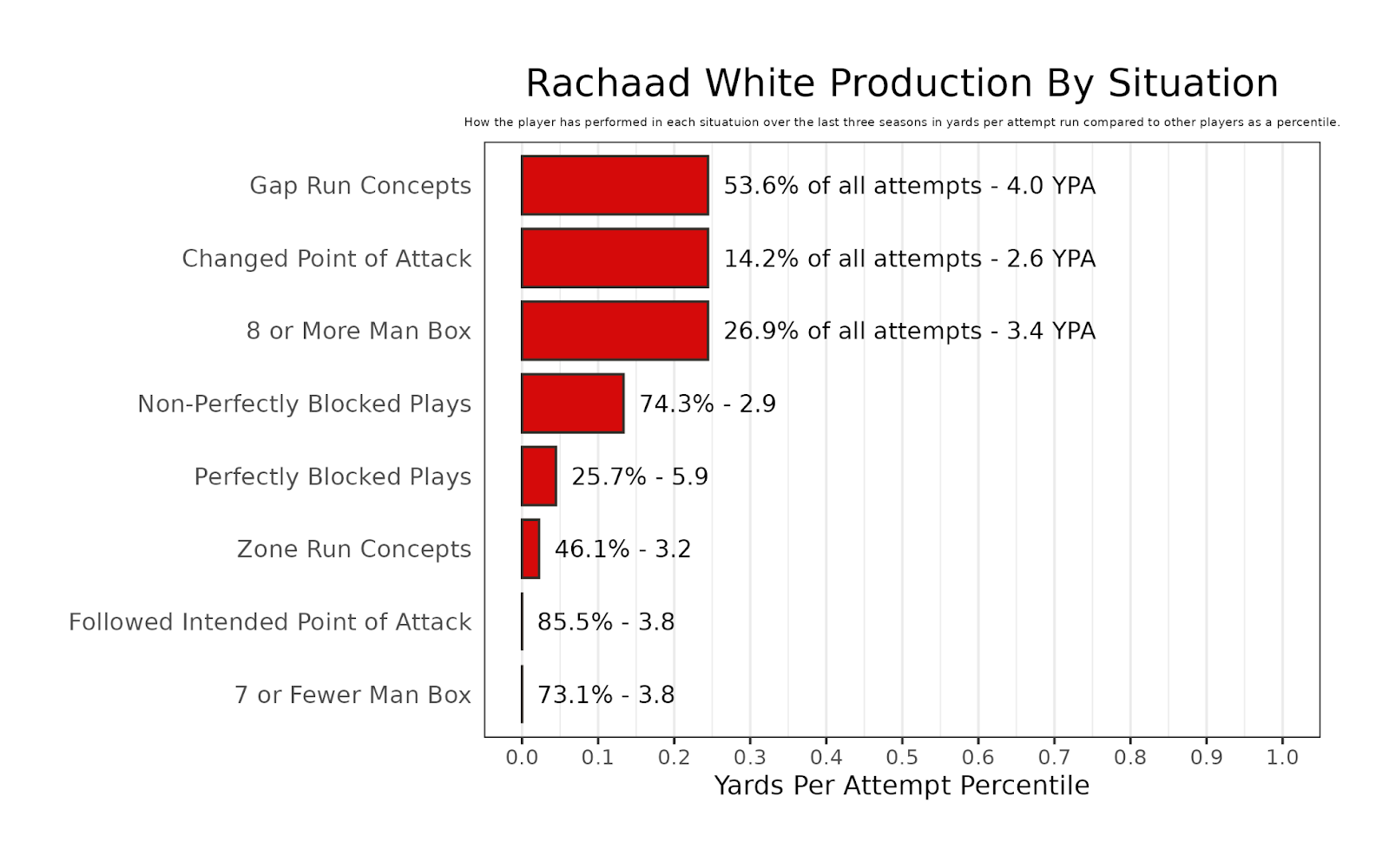
However, White’s rushing efficiency was below average for the position. He moved the chains less frequently and broke off fewer big plays than other running backs.
While it’s easy to point to the offensive line as a reason for White’s inefficiency—and it did play a role, as he experienced perfectly blocked plays less often than most running backs—the fact remains that even on perfectly blocked plays, his yards per carry average was lower than those of many other running backs in the league.
White became the feature last year, with his snap rates in different situations looking somewhat similar to Christian McCaffrey‘s. The Buccaneers tried Chase Edmonds, Sean Tucker and Ke’Shawn Vaughn as the primary backup to White at various times throughout the season; none of them stood out or were able to take time away from White.
The Buccaneers drafted Oregon standout Bucky Irving in the fourth round of the 2024 draft, and he is likely to serve as the primary backup this season. While Irving will probably play around 25% of the Bucs’ offensive snaps to start the season, there is at least a chance (given Irving’s efficiency in college and White’s lack of efficiency in the NFL) that Irving will take over as the primary early-down back at some point this season.
Recent comments by head coach Todd Bowles suggest the team is happy with Irving and that he adds an element they didn’t have last season:
“He [Irving] can stick his foot in the ground and run the ball. More importantly, he can make the first guy miss more often than not, and, you know, that’s a rare trait to have in this ballgame, especially when so many guys can tackle well and get to the ball real fast. To make the first guy miss and potentially have big-play ability, that’s something that we didn’t have a lot of last year.”
White is the taller, more significant back of the two, so even if Irving cuts into White’s playing time on early downs, White could remain in control of the goal-line snaps and short-yardage situations. And while Irving showed some promise as a receiver, White has been more efficient in that area, so it’s less likely White will lose the receiving job.
Liam Coen joins the Buccaneers as the new offensive coordinator. When Coen was the Rams’ offensive coordinator, his team ran more plays than expected. However, they didn’t throw much to their running backs or run many plays overall. This change will likely benefit the fantasy value of the Buccaneers’ wide receivers more than it will help White.
Volume is the most important factor for a running back. White had plenty of it last season, though he was not efficient. While efficient running backs are more likely to maintain their volume, White exemplifies a player who had volume but risks losing it this season if he doesn’t make more of his opportunities.
If White had performed better on a per-play basis last year, he would be a first- or second-round pick. Instead, he remains a risky choice. While he has top-five potential, there’s also the risk he might not be the starter for the Buccaneers very long. Every other running back with an ADP in the first four rounds isn’t at risk of a significant decrease in playing time.