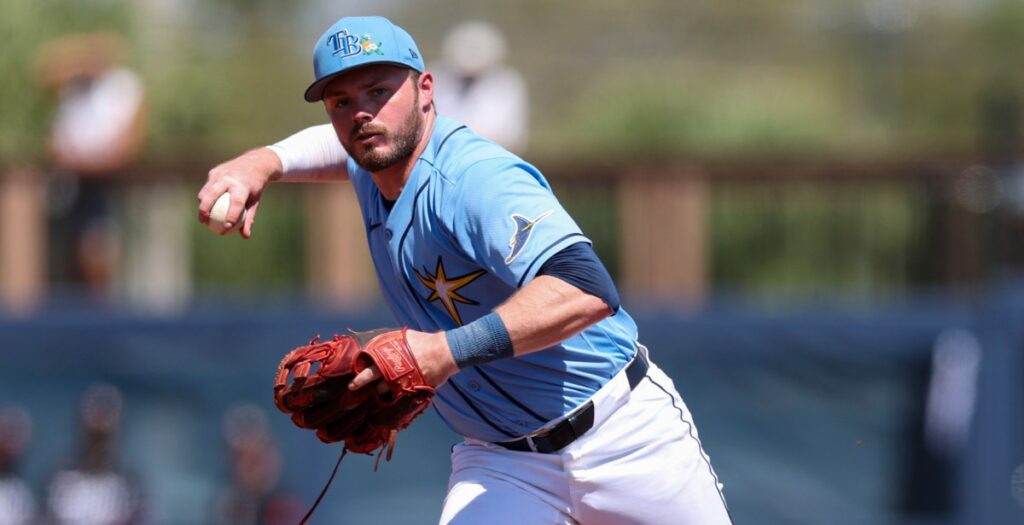
Welcome back to the annual DRaysBay Community Prospect List, a treasured tradition at the site where our community diligently votes for the top prospects in the Rays system.
This off-season saw a dramatic overhaul of the Rays system, and accordingly the DRaysBay list has also shifted dramatically year over year. Only one prospect graduated last year’s list in OF Chandler Simpson (ranked 5th in 2025), while others were traded in Yoniel Curet (7), Mason Montgomery (18), and Colton Ledbetter (22).
Rank |
Player |
Position |
Votes |
Total |
Percentage |
Last Season |
|---|---|---|---|---|---|---|
| 1 | Carson Williams | SS | 14 | 25 | 56% | 1 |
| 2 | Brody Hopkins | RHP | 19 | 25 | 76% | 8 |
| 3 | Jacob Melton | OF | 14 | 28 | 50% | N/A |
| 4 | Theo Gillen | OF | 14 | 26 | 54% | 13 |
| 5 | Ty Johnson | RHP | 12 | 25 | 48% | 15 |
| 6 | Daniel Pierce | SS | 13 | 23 | 57% | N/A |
| 7 | Jadher Areinamo | INF | 15 | 28 | 54% | N/A |
| 8 | TJ Nichols | RHP | 13 | 28 | 46% | N/R |
| 9 | Michael Forret | RHP | 8 | 33 | 24% | N/A |
| 10 | Santiago Suarez | RHP | 11 | 30 | 37% | 16 |
| 11 | Anderson Brito | RHP | 7 | 28 | 25% | N/A |
| 12 | Xavier Isaac | 1B | 9 | 28 | 32% | 3 |
| 13 | Caden Bodine | C | 10 | 25 | 40% | N/A |
| 14 | Brendan Summerhill | OF | 11 | 27 | 41% | N/A |
| 15 | Slater de Brun | OF | 10 | 25 | 40% | N/A |
| 16 | Nathan Flewelling | C | 8 | 26 | 31% | N/R |
| 17 | Trevor Harrison | RHP | 9 | 26 | 35% | 10 |
| 18 | Jose Urbina | RHP | 13 | 26 | 50% | 25 |
| 19 | Tre’ Morgan | 1B/LF | 15 | 25 | 60% | 4 |
| 20 | Jackson Baumeister | RHP | 12 | 27 | 44% | 12 |
| 21 | Aidan Smith | OF | 17 | 29 | 59% | 6 |
| 22 | Homer Bush Jr. | OF | 10 | 25 | 40% | 21 |
| 23 | Dom Keegan | C | 10 | 28 | 36% | 9 |
| 24 | Gary Gill Hill | RHP | 8 | 25 | 32% | 11 |
| 25 | Brailer Guerrero | OF | 8 | 24 | 33% | 14 |
| 26 | Brayden Taylor | 2B/3B | 6 | 25 | 24% | 2 |
| 27 | Adrian Santana | SS | 6 | 26 | 23% | N/R |
| 28 | Austin Overn | OF | 7 | 21 | 33% | N/A |
| 29 | Taitn Gray | 1B/OF/C | 8 | 23 | 35% | N/A |
| 30 | Victor Valdez | SS | 6 | 22 | 27% | N/A |
1. Carson Williams, SS
23 | R/R | 6’2” | 180
AAA | .213/.318/.447 (98 wRC+) 451 PA, 23 HR, 22 SB, 12.4% BB, 34.1% K
MLB | .172/.219/.354 (54 wRC+) 106 PA, 5 HR, 2 SB, 5.7% BB, 41.5% K
Williams made his MLB debut on August 22nd and proved the be the real deal on defense: an elite athlete with excellent movement and a great arm. It was his performance at the plate that has caused his prospect status to lose some shine, at both the MLB and Triple-A levels, particularly due to some trouble with the curve. In the majors he saw 162 breaking balls across 37 plate appearances and got on base only four times (three hits, one walk) with 20 strikeouts, and the results were similar for off-speed pitches as well. It was a strong enough underperformance at the plate that Williams might not make the big league roster out of Spring Training, despite the trade of Brandon Lowe. As a top flight defender at the hardest position, he doesn’t need to be tearing the cover off the ball, but the bat will need to improve for Williams to be a positive contributor moving forward.
2. Brody Hopkins, RHP
24 | 6’4” | 200
AA | 2.72 ERA, 3.33 FIP, 116.0 IP (25 GS) 28.7% K, 12.2% BB
Hopkins was late to pitching, having done so essentially one season in college before being drafted in 2023, and accordingly has been refining his control throughout his pitching career. This was no different in 2025, as Hopkins saw his performance dramatically improve throughout the Double-A season. He’s a pure power pitcher, a rarity these days, but doesn’t allow much hard contact thanks to a plus-plus curveball, a promising in-development sweeper, a plus cutter, oh and a fastball that touches 100. He’s the type of starter that makes batters say “good luck” to the man in the on-deck circle during their walk back to the dugout. Given the quality of stuff and trajectory of performance, he might be one of the top prospects in baseball by mid-season.
3. Jacob Melton, OF
25 | L/L | 6’3” | 208
AAA (HOU) | .286/.389/.556 (141 wRC+) 150 PA, 6 HR, 12 SB, 14.7% BB, 20.0% K
MLB (HOU) |.157/.234/.186 (22 wRC+) 78 PA, 0 HR, 7 SB, 7.7%BB, 37.2% K
Brought over from Houston in the Brandon Lowe deal, Melton was the Astros top prospect and provides strong value defensively, pairing excellent first-step instincts and above-average range with an arm that, while light, is sufficient for the position. At the plate, his 2025 season provided a clear breakout through a dramatic spike in both hardhit rate and exit velocity. Ongoing mechanical refinements have unlocked more of his natural strength without eroding his contact skills. While this approach leaves some exposure to soft stuff and pitches on the outer third—placing added importance on continued growth in swing decisions—the overall profile fits comfortably as an above-average everyday center fielder with power upside.
4. Theo Gillen, OF
20 | L/R | 6’2” | 195
A | .267/.433/.387 (151 wRC+) 324 PA, 5 HR, 36 SB, 19.8% BB, 23.1% K
Gillen fell to 18th overall in the 2024 draft due to shoulder and wrist injuries, despite being considered by some to be the best teenage bat in the draft. Now healthy, so far he has delivered on that promise, despite a calf injury early in the season and a hand injury while sliding that ended his year early by three weeks. The Rays moved him from short to center after drafting but that has so far not yielded any concerns; the power projection is still unknown. As things stand, Gillen has the floor of a major league contributor and the ceiling of an All-Star, but he has to stay on the field, and has a long way to go.
5. Ty Johnson, RHP
24 | 6’6” | 205
AA | 2.61 ERA, 2.33 FIP, 110.1 IP (26 G, 20 GS), 34.7% K, 8.8% BB
A dip-and-drive pitcher with a quick arm action and a limited arsenal with a flat plane have given Johnson a reliever projection most of his minor league career, but his success speaks for itself. Johnson has a fastball that continues to be difficult for batters to see. It sits around 94 as a starter and can ramp up to 98, but talking about the fastball buries the lede. Johnson’s slider passed the test of Double-A in part because he was able to throw it fast and slow to keep hitters off balance. Accordingly, he hasn’t really needed a third pitch just yet, but there’s a change up in development for problematic lefties.
6. Daniel Pierce, SS
19 | R/R | 6’0” | 185
The 14th overall pick in the 2025 draft, Pierce is a preternatural defender at short stop, with a top flight glove that could rival any player in the organization. Early reports say he’s already started building muscle as a professional, which is helpful for his projection on offense. His hit tool carries, with a swing similar to Bobby Witt Jr. — out of the draft he received comps of a “faster Dansby Swanson.” A coach’s son, he has the good face, and should get the starting role in the Holy City and have plenty of time to develop into or above his projection of an above average regular.
7. Jadher Areinamo, INF
22 | R/R | 5’8” | 160
A+ (MIL) | .255/.316/.397 (126 wRC+) 415 PA, 11 HR, 15 SB, 8.2% BB, 11.6% K
AA (TB) | .255/.316/.697 (111 wRC+) 159 PA, 4 HR, 6 SB, 7.5% BB, 11.9% K
VEN | .364/.420/.692 162 PA, 13 HR, 5 SB, 8.6% BB, 12.3% K
Acquired in return for Danny Jansen at the 2025 trade deadline, Arienamo was promoted straight to Double-A by the Rays, and his success at that level carried over into the Venezuealan winter league, where his 1.112 OPS and 13 HR were each the second highest marks in the league and earned him the ROY award. He’s considered to have a high baseball IQ, strong motor, excellent bat control, and defensive flexibility, any one of which could earn him an entertaining major league debut.
8. TJ Nichols, RHP
24 | 6’5” | 190
A+ | 3.63 ERA, 4.52 FIP, 96.2 IP (19 G, 18 GS), 30.4% K, 5.4% BB
AA | 0.97 ERA, 2.27 FIP, 37.0 IP (6 GS), 28.0% K, 6.8% BB
A sixth rounder from 2023, Nichols entered the Rays organization with low mileage and control issues, a match made in development heaven. Fast forward to 2025, and his 68% strike percentage ranked 10th best among all minor league pitchers with 100 innings, according to Baseball America. His breaking ball is a big fish in a little pond thanks to its two-plane movement. By my eye, he has a mid-90’s dead zone-ish fastball with easy, over the top heat, and a classic but inconsistent change up. Despite all his gains in control it’s his command that might hold him back, but he fills the zone and might be able to eat innings, which is enough for a back end starter floor. If you’re buying stock, he’s Kimberly-Clark.
9. Michael Forret, RHP
22 | 6’3” | 190
A+ (BAL) | 1.51 ERA, 2.45 FIP, 59.2 IP (16 G, 15 GS), 33.5% K, 7.5% BB
AA (BAL) | 1.88 ERA, 2.03 FIP, 14.1 IP (3 GS), 15 K, 3 BB
A product of the State College of Florida Manatee – Sarasota (formerly Manatee Junior College), Forret was a well above slot ($450k) 14th round draft choice in 2023 and arrives via the Shane Baz trade. Despite missing some time to a back injury in 2025, his array of fastballs and breaking balls already look major league ready. He seems adept at trying new things, as he picked up a whiff-worthy kick change in 2024, and is already tinkering with a Rays-like sweeper, both through his offseason program at Tread Athletics. He has a low release point (below 6 feet) but a rising fastball, and has — to quote Eric Longenhagen — “sensational feel.” Forret pitches with efficiency and variety, and could climb the ladder quickly in 2026.
10. Santiago Suarez, RHP
21 | 6’2” | ?
A+ | 2.88 ERA, 2.07 FIP, 40.2 IP (10 GS), 26.9% K, 3.6% BB
AAA | 5 ER (9 H, 2 BB, 3 HR) 11.0 IP (2 GS), 9 K
Suarez climbed the ladder to Triple-A to finish a short season, as some triceps/shoulder issues hampered his 2025, but when called upon this Venezuelan strike-thrower has earned the trust of his managers to go out there and pitch. He has two plus fastballs, with easy heat but average ride on the 4-seam, and a hard cutter with tight bite. His only complimentary pitch thus far is a 12-6 curve, which makes it a fairly vertical arsenal. He gets good extension, although I’d be remiss to not mention the double pump in his plant leg that on first glance looks like noise, but has led to evident repeatability. What Suarez boasts in control he might lack in command. Right now it’s a supinator’s profile with an average arm slot. To progress he either needs to add some east-west depth to his arsenal (à la Chris Bassitt), or find ways to unlock the spin rates a touch more (Shane Baz). I’d expect him to slot into Montgomery’s rotation as one of the younger starters for his level.
11. Anderson Brito, RHP
21 | 5’10” | 155
A+ (HOU) | 3.28 ERA, 2.91 FIP, 49.1 IP (12 GS), 31.1% K, 13.4% BB
AFL | 11.1 IP, 6 H, 7 BB, 22 K
Acquired in the Brandon Lowe trade, Brito has three plus pitches with a fastball that touches 100 with cut-ride, and two breakers in a mid-80s curveball with surprising depth and a mid-80s slider he commands best. He also mixes in a developing low-90s cutter and a scattershot but intriguing mid-80s changeup with strong velocity and movement separation, with some added deception from his smaller frame helping limit hard contact. The concern is control, as he’s posted below-average strike rates in A-ball across 2024–25 and lacks consistent feel outside the slider, leaving him to project as a slightly wild, high-leverage reliever for now. Still, with multiple plus pitches, improved durability, and meaningful command gains, he has mid-rotation starter upside, giving him possibly the widest range of outcomes on this list. Baseball Prospectus describes him as having “Shohei Ohtani’s stuff with Johnny Cueto’s body.”
12. Xavier Isaac, 1B
22 | L/L | 6’3” | 240
AA | .201/.366/.446 (144 wRC+) 175 PA, 9 HR, 1 SB, 19.4% BB, 29.7% K
Isaac had his season cut short large-in-part due to the discovery of a brain tumor, disrupting an otherwise great start to the season that duplicated his cup of coffee in Double-A as a 20-year old, despite some minor arm injuries along the way. He has the best power projection in the system, and if he can hold his own for a full season in 2026 — particularly against southpaws, which is somewhat of a concern — the former first round pick (29th overall, 2021) could see his status restored near the top of the Rays prospect rankings.
13. Caden Bodine, C
22 | S/R| 5’10” | 200
A (BAL) | .326/.408/.349 (133 wRC+) 49 PA, 0 HR, 0 SB, 5 BB, 8 K
Drafted 30th overall in 2025, Bodine was acquired in the Shane Baz trade. He profiles as a relatively safe prospect thanks to 60 grade bat-to-ball skills, and comfortably-plus blocking and receiving behind the plate. There is some concern that his smaller frame limits him to fringe power, but those concerns are off-set by solid plate discipline from both sides of the plate; his sweeter swing is left handed. All catching prospects will see their value proposition shift with the challenge system, but his defensive actions, leadership, and receiving give him real value, projecting him as a solid major league contributor.
14. Brendan Summerhill, OF
22 | L/R | 6’3” | 200
A | .333/.429/.444 (160 wRC+) 42 PA, 0 HR, 5 SB, 6 BB, 5 K
Following an All-Star performance at the Cape Cod summer league, Summerhill exhibited some of the best bat-to-ball skills in NCAA as a junior at Arizona. His draft stock took a minor hit due to injury (broken hand from from punching a cooler) and was drafted 42nd overall, but Summerhill rebounded well with a dominant stop at Charleston to finish the year. Summerhill has plus barrel control, allowing for a high-contact approach for his long swing. He has plus speed as well, which provides a chance to stick in center. Evaluators would like to see more power to complete a five-tool profile. Even if the power doesn’t materialize, it’s an above average contributor’s projection.
15. Slater de Brun, OF
18 | L/L | 5’10” | 187
Drafted 37th overall in 2025, through a draft pick traded by the Rays, de Brun was essentially re-acquired in the Shane Baz trade. Like many Rays outfield prospects he’s not expected to develop much power, but compensates with an ability to hit to all fields, and has the benefit of years to develop. His hit tool rates plus thanks to a quick, compact swing, and his double-plus speed elevates both his baserunning and range in center; he has a solid arm and can stick long term. The key to his development will be improving pitch selection to maximize his power potential. Despite not yet playing in a pro game, he’s a good bet to skip the complex league and debut in Charleston this season.
16. Nathan Flewelling, C
19 | L/R | 6’2” | 200
A | .229/.393/.336 (126 wRC+) 439 PA, 6 HR, 9 SB, 20.3% BB, 27.6% K
A+ | 22 PA, 4 H, 5 BB, 6 K
The 94th overall pick from 2024, Flewelling made his debut at 18 years young and caught a full season (75 C, 26 DH), plus a five game cup of coffee (3 C, 2 DH). Taking the longview, he could grow into 50-60 grade power with 50 grade defense, which makes him one to follow. His plus zone awareness at the plate offsets his lagging contact, and most importantly for the position his ability to call games and frame pitches are already plus. A strong season with the bat at High-A could vault him into Top-100 consideration.
17. Trevor Harrison, RHP
20 | 6’4” | 225
A | 2.61 ERA, 3.26 FIP, 82.2 IP (17 GS), 22.4% K, 10.7% BB
A+ | 3.33 ERA, 4.26 FIP, 24.1 IP (5 GS), 23.8% K, 12.4% BB
Harrison entered the season as Baseball America’s top pitcher in the system thanks to a cleaned up delivery and high heat. He ran into some bumps in the road by running up his pitch count against batters, but he still made it over 100 innings in 22 starts. A power pitcher through and through, his hard slider flirts with cutter classification and could evolve into two distinct pitches down the road. It will be interesting to see how his change up plays as he’s challenged at higher levels, but for now he has premium stuff and the upside of a rotation anchor. (video)
18. Jose Urbina, RHP
20 | 6’3” | 180
A | 2.05 ERA, 3.58 FIP, 92.1 IP (19 GS), 26.4% K, 8.2% BB
A+ | 2 ER (2 HR), 4.0 IP (1 GS), 5 K, 0 BB
Good pitchers grow and adjust, and Urbina has done that consistently at an age young for his level. Physically he has grown in strength, sitting at 96 with the fastball after flashing high octane in 2024, and technically he has grown, refining his dialed up slider and his two-plane curveball into complementary pitches — which lack plus command but are thrown with feel. He shouldered a starter’s workload at 19, and was awarded one additional start at High-A, where he allowed two solo shots and struck out five. Overall, the age, body, and body of work have him on the trajectory of top prospect lists in the near future.
19. Tre’ Morgan, 1B/LF
23 | L/L | 6’0” | 215
AAA | .274/.398/.412 (119 wRC+) 402 PA, 8 HR, 8 SB, 15.9% BB, 19.2% K
Morgan continued to hit without power in 2025, a great discouragement for some evaluators, but his present 50-grade hit tool and feel for the zone allow a major league projection. He continued his improved, quieter two-strike approach in 2025 that built on his success retooling his swing in the AFL last year. The Rays gave Morgan 14 starts in Left Field last season, and Baseball America called the defense “playable,” but his value is tied to his plus-plus defense at First.
20. Jackson Baumeister, RHP
23 | 6’4” | 224
AA | 4.62 ERA, 4.15 FIP (15 GS) 62.1 IP, 19.5% K, 9.6% BB
AFL | 6 ER (1 HR), 9.0 IP (4 G, 3 GS), 10 K, 9 BB
A shoulder injury derailed what should have been Baumeister’s coming out party, as his previously plus breaking ball was expected to carve up Double-A. After a tough start to the year and two months on the sidelines, Baumeister returned in August and salvaged the season with a brilliant finish. The tough luck continued, however, in the Arizona Fall League, where a line drive struck him in the head, but he escaped without significant injury. Currently, Baumeister has taken on a fastball/slutter profile, with a slow curve in his back pocket, and has shown teachability and pitchability over the years. The former Seminole currently thrives on his frequently used major league fastball that may be better challenged by a promotion to Triple-A.
21. Aidan Smith, OF
21 | R/R | 6’2” | 190
A+ | .237/.331/.388 (114 wRC+) 459 PA, 14 HR, 41 SB, 11.5% BB, 31.2% K
Acquired in the Arozarena trade, Smith became the prince who was promised, a five tool athlete with a strong bat, good face, and a preternatural glove in center field. That promise unraveled a bit in 2025, with his strikeout rate rocketing nine percent and his power stroke faltering after facing harder velocities in High-A, causing both his hit and power grades to drop into the 40’s. It was a full transformation into a “center field” profile, but with his ceiling that’s not a compliment. He plays with a fire, but the dip in contact rate left some evaluators feeling burned.
22. Homer Bush Jr., OF
24 | R/R | 6’3” | 215
AA | .301/.375/.360 (122 wRC+) 546 PA, 0 HR, 57 SB, 8.8% BB, 17.9% K
Acquired in the 2024 Jason Adam trade, the starting center fielder at Double-A passed the test of advanced pitching, but just barely. He lacks in-game power due to a lack of use of his lower half in his swing, and he whiffed more often than you can for long term success with a low-power approach. His calling cards are Rays-grade defense and plus-speed, having notably swiped 57 bags in back-to-back seasons.
23. Dom Keegan, C
25 | R/R | 6’0” | 210
AAA | .241/.306/.429 (89 wRC+) 297 PA, 10 HR, 0 SB, 8.1% BB, 30.6% K
Keegan is at an inflection point in his minor league career, having joined the 40-man roster as the third catcher, and overall the jury is still out. Trusted more at first base than backstop at Vanderbilt, the Rays have kept him behind the dish but reports still have his defense below average, and 2025 was a wash after an elbow injury in the Spring sank his season, in particular his bat speed. While the lack of progress on the edges of his game has some evaluators calling into question his once-sure major league projection, he’ll get a long look in Spring Training, where his ability to punish mistakes in the zone may flourish.
24. Gary Gill Hill, RHP
21 | 6’2” | 160
A+ | 3.82 ERA, 4.37 FIP, 136.2 IP (25 GS), 18.8% K, 5.3% BB
A groundballer, Gill Hill was a feather in the cap for the Rays scouting department when snagged in the sixth round in 2022. He raised his armslot in 2024 to great success, but got off to a rocky start in 2025, which muddies the water on his statline. On the whole, GGH has the body and the look to be a major league starter, particularly thanks to a plus fastball in the upper 90’s and plus control, but needs to find a longterm solution for opposite handed hitting as he climbs the ladder. Accordingly, he projects as a reliever until his arsenal finds a plus third pitch.
25. Brailer Guerrero, OF
20 | L/R | 6’1” | 215
A | .249/.338/.399 (119 wRC+) 222 PA, 6 HR, 9 SB, 11.3% BB, 29.3% K
AFL | 2 H, 0 HR, 2 SB, 3 BB, 16 K, 29 PA
Good news: the $3.7 million 2023 signee made the leap out of the complex league in his final teenage season. Bad News: He was injured yet again, with hamstring and knee injuries limiting him to 51 games for Charleston. The Rays tried to make up for lost time with an aggressive assignment to the AFL that resulted in only two hits in 29 plate appearances. He makes loud contact from a quick, quiet swing which he pre-loads by reaching back for even more power. He appears to make early decisions to swing, leading to a bit extra whiffs against anything off-speed, but that could easily clear up with some consistent playing time.
26. Brayden Taylor, 2B/3B
24 | L/R | 6’0” | 180
AA | .173/.289/.286 (77 wRC+) 437 PA, 8 HR, 17 SB, 14% BB, 27.7% K
AFL | .264/.400/.472 (.384 wOBA) 65 PA, 1 HR, 5 SB, 12 BB, 19 K
Taylor entered 2025 as a top-100 prospect after demolishing High-A (154 wRC+), and left 2025 as an afterthought on prospect lists, although he was selected as an Arizona Fall League “Fall Star” in between, where he worked to keep his chase rate low and his hard hit rate high. The juice must have been worth the squeeze, as the Rays have elected to invite Taylor to major league Spring Training this year.
27. Adrian Santana, SS
20 | S/R | 5’11” | 155
A+ | .263/.324/.326 (94 wRC+) 409 PA, 2 HR, 47 SB, 8.6% BB, 12.0% K
Once a top-ten or so prospect in 2024, Santana fell off our site’s 2025 list after failing to clear as an honorable mention. Why? The switch-hitting slick fielding short stop was the Rays 31st overall pick in 2023 but has delivered sub-100 wRC+ each stop of his career, although that got closer than ever last season, his third as a professional and his third as a teenager in the Rays system. Could expectations be too high on his bat? He has plus athleticism, is learning to wheelhouse, and has “acrobatic” defense at the hardest position in the game, with 98 swiped bags over the last two seasons. What happens if he survives the test of Double-A breaking balls?
28. Austin Overn, OF
23 | L/R | 6’0” | 175
A+ (BAL) | .242/.367/.386 (127 wRC+) 341 PA, 8 HR, 43 SB, 15.5% BB, 28.2% K
AA (BAL) | .266/.326/.427 (112 wRC+) 136 PA, 5 HR, 21 SB, 6.6% BB, 25.0% K
Acquired in the Shane Baz trade, Overn was once a top draft prospect after committing to baseball over football at USC, but surprisingly struggled as a draft-eligible sophomore. That didn’t stop Baltimore from taking him in the third round (97th overall) in 2024. Now a professional, Overn overhauled his swing in the first half of 2025, and earned an early promotion to Double-A for his efforts, where he didn’t look overmatched. His biggest threat is his speed, which raises his floor and gives him an easy projection to a major league bench thanks to plus defensive instincts (BA gave 70’s to his run and field tools). His offensive profile is buoyed by his ability to work the count, but evaluators would like to see him punish fastballs more often for him to be considered a regular.
29. Taitn Gray, 1B/OF/C
18 | S/R | 6’4” | 220
The Rays 86th overall pick in 2025, Gray fell to the third round due to some concern about whether he will stick at catcher, but that buries the lead. Still just 17 at the time of the draft, Gray showed up to the Rays organization and proved his rumored power was real, running exit velocities up to 115 mph from both sides of the plate, although the left handed swing is sweeter. He has plus athleticism, which elevated his bat speed, foot speed, and fluidity — despite his size. It will be interesting to see where the Rays deploy him on defense, but it’s a great bat to dream on.
30. Victor Valdez, SS
17 | R/R | 6’1” | 186
A pretty swing with a low whiff rate earned Valdez a big payday this winter — $3.5 million — with as good of a power projection as you can reasonably ask for from a a teenage bat, having been given a 25+ home run projection by Baseball America, who also praise his plus foot speed, bat speed, and control of the zone. Reports say he has ever improving lateral movements on defense, with smooth actions and a strong arm. If it all clicks, it’s a middle-of-the-order bat on the left side of the infield. At signing, the Rays gave him a comp to Francisco Lindor. It will be interesting to see if his first professional season can solidify the five tool profile.
Cooper Flemming, SS
19 | L/R | 6’3” | 190
One of the best high school bats in the 2025 draft, Flemming surprisingly fell into the Rays laps in the second round. He has a too-quiet swing that lacks the load necessary to hit for power, but he’s historically compensated for that with a high contact rate that would have rated him as first round material if his defense projected to stick. The Rays were able to convince him to forgo an education at Vanderbilt by going above slot ($2.3m, Comp-A money).
Dean Moss, OF
19 | L/R | 6’0” | 180
Signed well above slot out of the 2025 draft at No. 67 overall, Moss’s family moved from California to the Tampa Bay Area to enroll Moss at IMG, and it earned him a new-home-town selection. A jack of all trades, Moss’s hit tool shades his best thanks to plus bat speed. His swing is clean, with projection for his power to reach major league average. He will have competition internally to stick at center, but may get the first nod in the rookie league.
Émilien Pitre, 2B
23 | L/R | 5’11” | 185
A+ | .268/.356/.393 (122 wRC+) 524 PA, 9 HR, 14 SB, 11.6% BB, 20.4% K
The Rays 58th overall pick in 2024, Pitre has risen on draft boards through a strong performance in the Cape Cod league in 2023, but the power was a real question mark on his profile. Now given a chance to develop as a professional, he wouldn’t be the first to add muscle. His run and hit tools are plus, with a well coiled swing and solid contact in and out of zone. He’s too old to return to High-A and it be viewed as positive. His power stroke will be the key to his success in 2026.
Alex Cook, RHP
25 | 6’2” | 220
AA | 2.30 ERA, 2.29 FIP, 15.2 IP (13 G), 30.5% K, 5.1% BB
The Rays added Cook to the 40-man roster this off-season to protect him from the Rule 5 draft, despite only throwing 20 innings (if you include four appearances in the complex league) after a slow start to the season. Cook had attempted to convert to starting in 2024 but succumbed to a shoulder injury. He bounced back in the bullpen in 2025 throwing 99 mph — and he has shown up to camp continuing to pitch with confidence. He has plus control and command, with stuff that leans into his low release point, including a cut-ride fastball and two-plane slider, and an MLB average cutter to prevent platoon split problems. He should slot into high leverage for Durham and ride the shuttle in 2026.
Fabricio Blanco, SS
17 | S/R | 5’11” | 161
A bat-first middle infielder, the Venezuelan is an elite prospect within the context of the international signing process, with some believing he’s the best Rays signee this off-season, despite gathering only a $1 million bonus. He can barrel up from both sides of the plate, but may settle into a right handed swing in the long term, with quick hands. He has the ability and instincts to stick at short, with a high-IQ approach and gritty demeanor.
Victor Mesa Jr., OF
24 | L/L | 5’11” | 195
AAA (MIA) | .301/.368/.510 (136 wRC+) 171 PA, 7 HR, 4 SB, 9.9% BB, 16.4% K
MLB (MIA) | 6 H (1 HR), 5 BB, 5 K (81 wRC+) 38 PA
This Cuban power bat already made his major league debut with Miami last year after bouncing back from a spring hamstring injury, and was dealt to the Rays in February. He profiles as a fourth outfielder but has an option remaining, so the organization may send him down for regular playing time and one last chance for something more in development. If not, he’s a center field capable on defense, which goes a long way for a platoon bat. In the running for the nicest guy in baseball.
Maykel Coret, OF
18 | R/R | 6’4” | 187
DSL | .273/.294/.370 (115 wRC+) 188 PA, 2 HR, 15 SB, 12.8% BB, 22.3% K
Tampa Bay’s top signee from the 2025 international class, Coret reported tall and young with a lot of projection. His future depends mostly on his hit tool, with prospect evaluators divided on a player that has a long way to go, but the exit velocity (111 mph) and foot speed are plus for his age. Promisingly, after he had a hot start to his professional career, Coret saw his strikeouts elevate in July, but he got them back under control in the final month. A move to the complex league in 2026 would be aggressive.
Alexander Alberto, RHP
24 | 6’8” | 203
A | 1.98 ERA, 2.55 FIP, 13.2 IP (11 G, 0 GS), 35.2% K, 7.4 BB
A+ | 2.83 ERA, 2.99 FIP, 35.0 IP (31 G, 0 GS), 29.0% K, 11.0% BB
Taken in the Rule 5 draft this off-season, this lanky Dominican fireballer was returned to the Rays organization by the White Sox on March 19 after not making their MLB roster. At FanGraphs, Longenhagen notably compared Alberto to “an Andean condor” that needed five years professionally to finally start throwing strikes, while Fegan compared his throwing motion to a “baby giraffe running for the first time,” given his penchant to tumble off the mound. Alberto’s next step will be locating his 100 mph heat at the top of the zone to challenge more advanced hitters, and continue refining his cutter and slider. In camp with the White Sox, Alberto allowed 10 runs (8 earned) over seven appearances (6.2 IP) with seven strikeouts against 12 hits and four walks.
Jonathan Russell, RHP
21 | 6’1” | 180
CPX | 3 H (2 ER), 0 BB, 2 K, 3.0 IP
A | 2.17 ERA, 2.15 FIP, 37.1 IP (25 G, 0 GS), 30.5% K, 7.3% BB
The Rays signed Russell (no relation to yours truly) out of Cuba in May 2023 at 18, slotting him directly into the DSL team where he made the All-Star roster. The Rays brought him stateside in 2024 and it didn’t go great! He started in the FCL again in 2025 though and in two weeks he was at Charleston, getting 15 appearances as their closer and pitching to a 2.17 ERA, striking out 46 batters in 151 faced (30%) with only 11 walks. Where he should have been thinking about Bowling Green next, the Rays decided to give him some chances in the Arizona Fall League, where he closed out two games in six appearances. It’s majority fastball with some slider, mechanics are solid, if anything I’d like to see him try to get his release point closer to the plate. With his age 21 season coming up, he could be something if/when he adds a third pitch.